


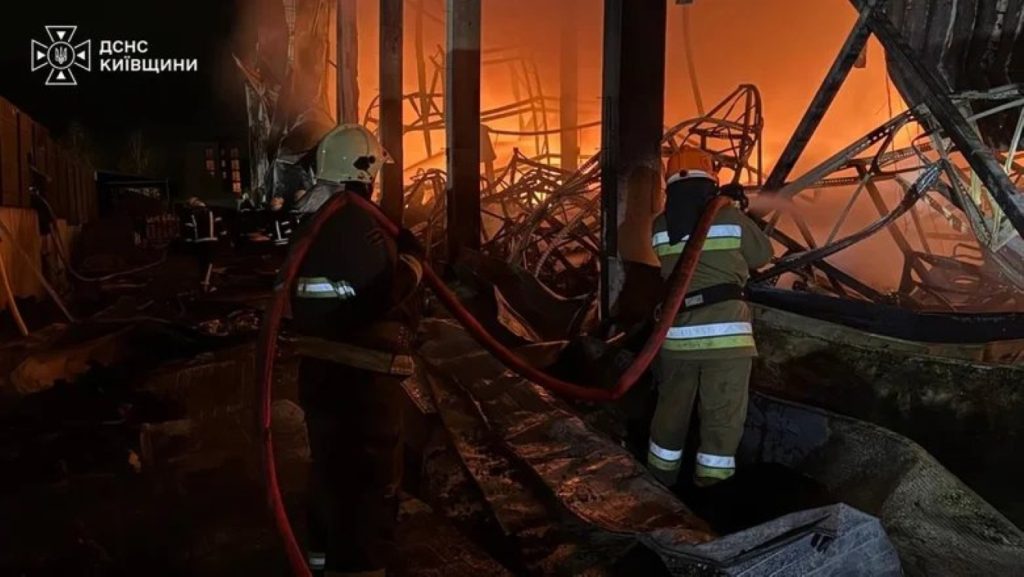
New Delhi: Russian attacks that disrupted electricity and water supplies across Kyiv have deepened Ukraine’s infrastructure crisis, while the death toll from a separate bombing of an aid centre in the south has risen to 40. Water services in the capital were restored on Wednesday, but Ukrainian authorities reported further drone strikes overnight into Thursday as the country prepared for another round of peace negotiations.
The president of Ukraine, Volodymyr Zelenskyy, said more than 30 people might still be beneath the rubble in Komyshuvakha, a frontline settlement in the Zaporizhzhia region struck on Monday. His latest casualty update, issued on Wednesday, said some bodies remained unidentified and rescuers were working under the persistent threat of further attacks.
The latest overnight attacks injured at least four people in the Kyiv and Dnipropetrovsk regions, according to local authorities cited by the Kyiv Independent. Strikes on Dnipro and Samar injured three people, while an attack in Kyiv region’s Bucha district injured a man and started a fire at a logistics facility, with no deaths reported there in the preliminary assessment.
Those attacks followed a barrage in which Russia launched 310 drones overnight into Wednesday, including 81 jet-powered aircraft, according to Ukraine’s air force. It said 272 drones were shot down or neutralized through electronic countermeasures, figures reported by AP.
Power failures spread to water and transport
Kyiv’s water emergency developed after the November 3 bombardment damaged electricity infrastructure supplying the capital’s pumping facilities. The disruption demonstrated how attacks on the power network can disable other essential services even when water infrastructure itself remains capable of operating.
According to Kyiv Independent, that residents across much of the city went without running water for more than 24 hours, with specialists describing it as the capital’s most severe water outage since the full-scale invasion began. Authorities had not established the precise number of affected consumers, and the disruption varied between neighbourhoods and buildings.
Kyiv’s water utility, Kyivvodokanal, restored supplies in stages, initially reconnecting the left bank and Obolonskyi district while pressure remained low elsewhere. By the afternoon of November 4, it reported that all water and sewage pumping stations were operating normally and network pressure had stabilized.
Reconnecting electricity did not immediately bring water back to every tap: equipment had to restart, pipes had to refill and pressure had to recover across the network. Although emergency electricity restrictions were lifted in Kyiv, scheduled power cuts continued, with the national grid operator, Ukrenergo, warning that conditions remained difficult in the capital and surrounding region.
Residents were directed towards public water points, while emergency centres provided hot drinks and facilities for charging phones and other devices. The electricity shortage also forced the temporary suspension of tram and trolleybus services from the evening of Tuesday, extending the disruption beyond homes and businesses.
The private energy company, DTEK, said the Tuesday strikes had forced three thermal power plants to stop generating electricity after extensive equipment damage. Ukrenergo reported more than 20 attacks on energy facilities during the preceding 24 hours, adding to the repair burden as colder weather increased the importance of reliable electricity and heating.
Aid centre becomes a mass-casualty site
In Komyshuvakha, the targeted school premises had ceased holding classes because of their proximity to the front and were being used for humanitarian assistance. Zelenskyy said residents gathered there every Monday to collect aid, and that an initial bombing was followed by another attack on the shelter where people had sought protection.
The charity World Central Kitchen, which supplies food and water to the community, confirmed that the facility served as a humanitarian and administrative centre. Two rescue workers and four police officers were among those killed, according to emergency services quoted in Reuters’ reporting from the settlement.
Police body-camera footage, verified by Reuters, showed civilians heading down into an underground shelter after a radio warning about incoming glide bombs. The recording ended after a powerful explosion, providing evidence of the sequence in which people sought cover following the earlier strikes.
Russia’s defence ministry said it had attacked Ukrainian military units around Komyshuvakha and two other settlements, claiming that up to 25 servicemen had been killed. That account differed from Ukrainian officials’ description of the aid-centre bombing, and the Russian casualty claim was not independently established in the reporting reviewed.
Zelenskyy called for additional air-defence support and criticized what he described as an inadequate international response to the attack. Regional authorities declared mourning from November 3 to November 5 as search teams continued working through the destruction.
Diplomacy continues ahead of Abu Dhabi talks
The attacks came as Ukraine’s partners met in Brussels on November 4 to coordinate their approach to prospective peace negotiations and post-war recovery. Representatives from Ukraine, the United States, Germany, France, Britain, Nato and the World Bank participated in discussions hosted by the European Commission on reconstruction and economic development.
The three-way talks involving Russia, Ukraine and the United States are scheduled for November 10 and November 11 in Abu Dhabi, with the Kremlin confirming the dates. The planned negotiations follow renewed American efforts to bring the parties together, although major disagreements over territory and security arrangements remain unresolved.
The wider campaign against Ukraine’s electricity infrastructure has already prompted international criminal proceedings over earlier attacks. On March 5, 2024, the international criminal court issued arrest warrants for Lieutenant General Sergei Kobylash and Admiral Viktor Sokolov over alleged crimes connected to strikes during 2022–23; those allegations concern an earlier period and do not constitute a judicial finding on this week’s bombardments.