


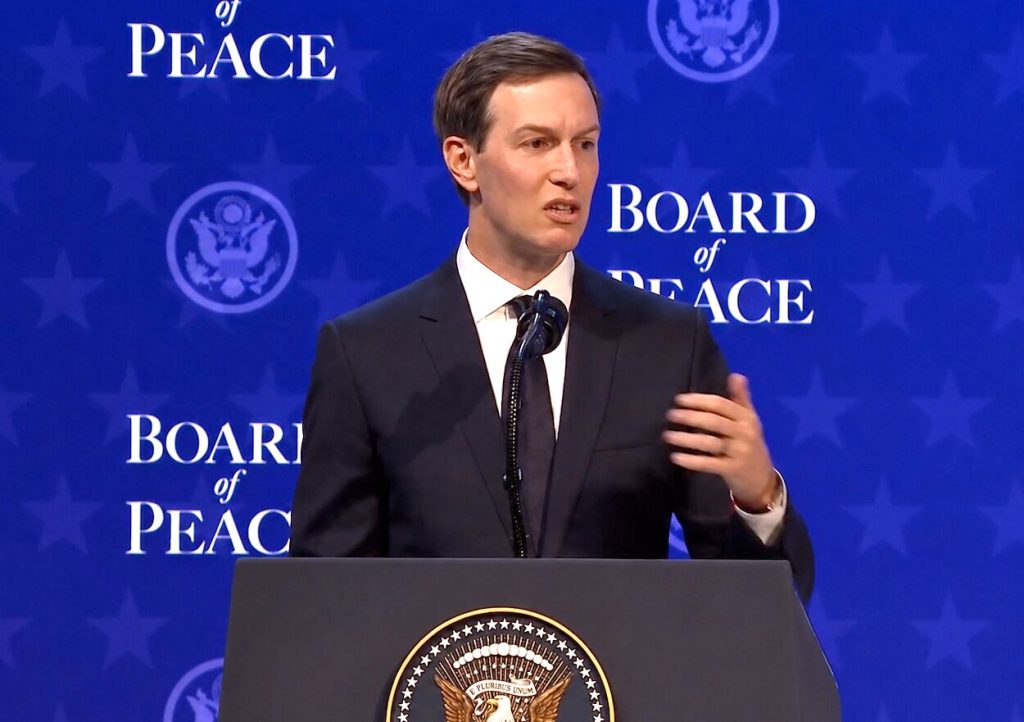
New Delhi: President Trump’s son-in-law and Middle East envoy, Jared Kushner, held a rare, direct meeting with Hamas leadership in Egypt on Sunday, in a fresh push to rescue a fragile, US-backed peace plan for Gaza after Israel’s rejection of it last week. The meeting was held in an effort to advance the deal, which had been met with opposition from Israel.
The talks took place in the coastal town of El Alamein, where Kushner met Hamas’s new political chief, Khalil al-Hayya, who took charge of the group in July. Associated Press reported that Kushner’s Sunday meeting was specifically with al-Hayya. Another official familiar with the matter said the meeting’s objective was to translate the roadmap’s obligations into concrete, verifiable steps.
Meeting ‘productive’
According to Axios, which cited a source with direct knowledge of the discussions, Hamas leaders reaffirmed their commitment to disarm and demilitarize Gaza during the meeting. Kushner used the rare, direct encounter to press Hamas for tangible steps on disarmament, warning that Israel does not trust the group to follow through on its commitments. The source described the meeting, which ran for around 90 minutes, as productive in ensuring Hamas takes practical steps towards fulfilling its obligations.
The gathering was not limited to Kushner and al-Hayya. The Board of Peace’s high representative, Nickolay Mladenov, and former British prime minister Tony Blair, also a board member, joined Kushner, along with senior advisers Aryeh Lightstone and Liran Tancman. On the Hamas side, al-Hayya was accompanied by Egypt’s intelligence chief, Hassan Rashad, a Qatari diplomat, Ali al-Thawadi, and a senior Turkish official. It was, notably, Kushner’s first sit-down with Hamas’s leadership since the Gaza agreement was struck last October.
Disarmament remains sticking point
A source familiar with the discussions told CBS News that any way forward requires no ambiguity: Hamas must relinquish governing authority along with all weapons and military infrastructure, and Gaza must never again become a source of terror directed at Israel. Under the 15-point plan drawn up by the Board of Peace, Israeli forces are to withdraw from Gaza as disarmament proceeds, though Hamas and Israel disagree over which step should come first.
For its part, a Hamas official said the group remains committed to the plan and is now waiting for mediators to begin a 14-day negotiation period to work out a timetable for implementation. Al Jazeera separately reported that Hamas’s leadership used the meeting to brief Kushner on what it described as Israeli ceasefire violations in Gaza, while Kushner told the delegation that Washington rejects any plans to displace Gaza’s residents.
Away from the substance of disarmament, there was also a note of reciprocal thanks. Kushner thanked Hamas leaders for their cooperation in recovering the remains of deceased Israeli hostages, while Hamas leaders in turn thanked the Trump administration and the Board of Peace for their efforts to ease Gaza’s humanitarian situation.
Egypt talks and a rebuke for Israel
Kushner also held a separate meeting with Egypt’s president, Abdel Fatah El-Sisi. A statement carried by Egypt’s state broadcaster said the two men stressed the need for all parties to implement their obligations under the ceasefire agreement in the Gaza Strip.
Ahead of Kushner’s onward travel, several regional governments made their displeasure with Israel public. Saudi Arabia and the United Arab Emirates were among the powers that issued a statement condemning Israel’s rejection of the roadmap, declaring that Israel now bears responsibility for obstructing efforts to bring peace to Gaza. Jordan, Pakistan, Indonesia and the ceasefire’s mediating nations were among the other signatories.
The foreign ministers’ joint statement went further still. It called on the Board of Peace and the United States to take immediate and concrete measures to prevent any party from obstructing the plan’s implementation. The intervention underlines how the diplomatic weight behind the roadmap now extends well beyond Washington and Cairo.
Netanyahu talks next in Jerusalem
Kushner is due in Jerusalem on Monday for what promises to be a tougher conversation, with Israel’s prime minister, Benjamin Netanyahu, who rejected the 15-point plan only last week despite Trump having publicly hailed it as a breakthrough. Kushner is expected to discuss with Netanyahu the “corresponding steps” Israel itself must take under the plan. Mladenov is expected to accompany him for those talks.
The stakes attached to this diplomacy are considerable. Some two million people remain in Gaza, an enclave whose reconstruction has stalled and which is now largely controlled by Israeli forces, more than ten months after the ceasefire brought major military operations to a halt. The war itself dates back to Hamas’s cross-border attack on southern Israel on October 7, 2023, and even after the ceasefire took effect in October 2025, Israel has continued striking Gaza, killing more than 1,250 people, according to the Hamas-run Palestinian health ministry.
For India, which has consistently backed a two-state resolution while deepening strategic ties with Israel, the durability of any Gaza settlement carries direct bearing on energy security, expatriate welfare in the Gulf and the wider stability of a region through which a substantial share of its trade and energy imports pass. New Delhi has not commented publicly on Sunday’s meeting.