


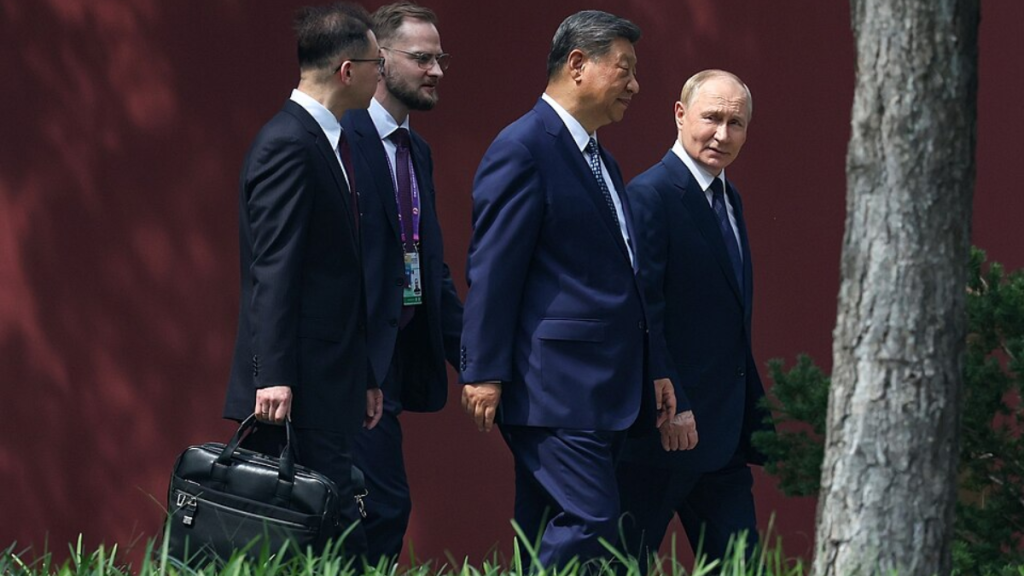
Against the backdrop of red carpets, military bands, and the grand columns of the Great Hall of the People, Vladimir Putin arrived in Beijing on May 20, just five days after Donald Trump had departed the same city following his own two-day summit with Xi Jinping.
Trump’s state visit ran from May 13 to 15, and Putin’s arrival was announced only a day after Trump’s departure.
The back-to-back summits converging in Beijing have put Chinese President Xi Jinping in the spotlight.
Xi Jinping and Vladimir Putin oversaw the signing of more than 20 cooperation agreements spanning trade, technology, science, and education, according to the Chinese People’s Political Consultative Conference. The official agenda of Putin’s visit also included commemorating a quarter-century-old agreement called the 2001 Treaty of Good-Neighbourliness and Friendly Cooperation.
President Putin said, “Over the 25 years since the signing of the landmark Treaty on Good-Neighbourliness, Friendship and Cooperation, Russia-China engagement has expanded significantly. Our specialised agencies maintain close and constructive contacts and are actively working to further advance joint projects and initiatives.”
A key highlight of the Beijing summit was the signing of a joint declaration focused on building a “multipolar world.” “We’ll expand our bilateral cooperation and actively engage in international forums where our teams are working closely together to build a strong foundation for a multipolar world,” Putin said during the talks.
Without directly referring to the United States, Xi warned of “unilateral and hegemonic counter currents running rampant.” The Chinese President also reportedly said that as permanent members of the UN Security Council and major world powers, China and Russia should adopt a “long-term strategic view” and cooperate to build “a more just and equitable global governance system.”
Referring to the ongoing conflict in West Asia, Xi Jinping said it is “imperative” to stop the fighting, but that the situation is now at a “critical juncture,” transitioning from war to peace. According to Chinese state news agency Xinhua, Xi put forward a four-point proposal for maintaining and promoting peace and stability in the region.
“My four-point proposal for maintaining and promoting peace and stability in the Middle East aims to further build international consensus and contribute to easing tensions, deescalating conflict, and promoting peace,” Xi said.
According to the Kremlin, the two sides signed a joint statement on “further strengthening” their comprehensive partnership and strategic cooperation, building on a strategic partnership first established in 1996. President Putin termed the Russia-China relationship “a model of interstate relations in the modern world,” adding that it is “founded on the principles of equality and mutual respect for each other’s interests, mutual support, friendship and genuine good neighbourliness.”
President Xi said, “China reaffirms its commitment to emerging as a mighty power and reviving the Chinese nation by promoting China-style modernisation,” adding that the country is “committed to becoming increasingly open to the outside world at a high level while sharing our development opportunities with Russia and other countries around the world to build a prosperous future for humankind.”
The two leaders, however, failed to reach a deal on the Power of Siberia 2 gas pipeline. Kremlin spokesman Dmitry Peskov, quoted by the Moscow Times, said there is an understanding of the main parameters for the pipeline, along with agreement on the route and construction process, but noted that a few nuances remain to be finalised.
The Power of Siberia 2 is a 2,600-kilometre pipeline that would carry 50 billion cubic metres of Russian gas annually through Mongolia to China, a project that has been stalled for years over disagreements on pricing and financing.