


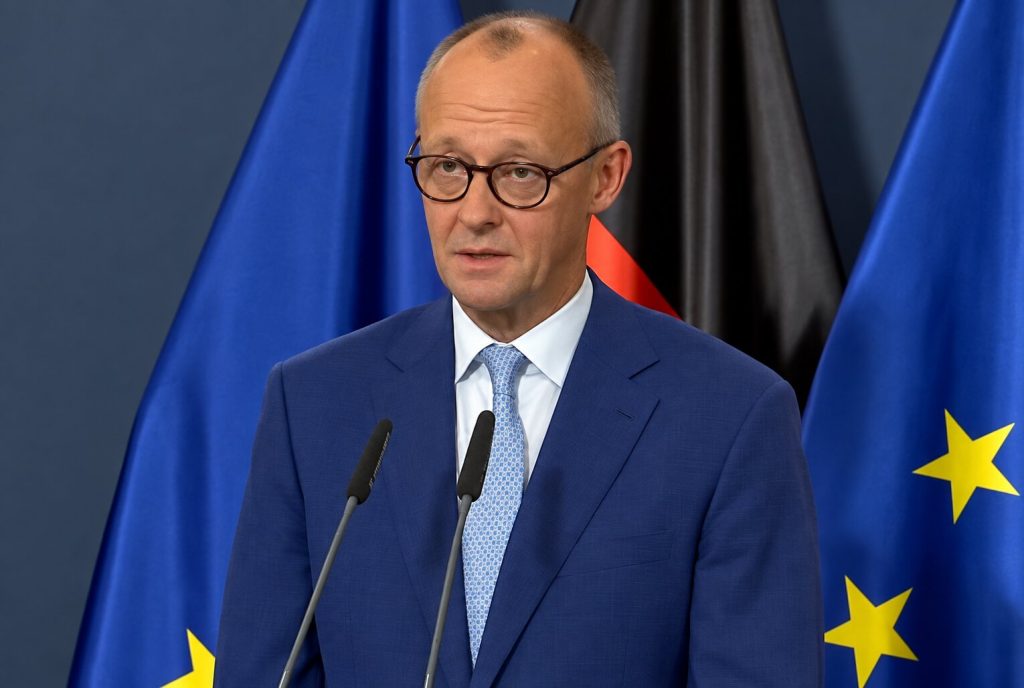
New Delhi: The German chancellor, Friedrich Merz, called his party’s performance a “disaster” after the Christian Democratic Union (CDU) suffered its worst state election result in postwar Germany on September 20. It failed to win a seat in Mecklenburg-Western Pomerania as the far-right Alternative for Germany (AfD) finished first, while voters in Berlin also pushed the CDU out of first place.
The official preliminary result in Mecklenburg-Western Pomerania gave the AfD 38.2 per cent of the vote, more than twice its share at the previous election in 2021. The Social Democrats (SPD), who govern the northeastern state under its premier, Manuela Schwesig, came second with 35.5 per cent.
The CDU won 4.9 per cent, just below the five per cent threshold for representation in the state parliament, and lost all its seats there. It was the first time the party had failed to enter a German state parliament, turning what might otherwise have been a regional setback into a severe test of Merz’s national leadership.
The AfD’s victory also ended the SPD’s 28-year run as the state’s largest party, despite Schwesig’s stronger showing in the closing weeks of the campaign. She had sought to distinguish her state government from Merz’s federal coalition, of which the SPD is a member, while warning against a government led by the AfD.
Winning the most votes does not, however, guarantee the AfD control of Mecklenburg-Western Pomerania. The Left Party received 6.5 per cent and the Greens 5.7 per cent, giving the SPD a possible route to a majority with both parties if coalition talks succeed.
The SPD already governs the state with the Left Party, but the election has left the two parties needing a third partner to retain power. Germany’s established parties have generally refused to form coalitions with the AfD, a practice they call a “firewall”, even as its rising vote share makes alternative governing majorities harder to assemble.
The result carries a foreign policy dimension in a Baltic Sea state where the Nord Stream gas pipelines from Russia come ashore. Schwesig said opposition to German financial and military support for Ukraine, along with calls to restore Russian gas supplies through Nord Stream, had helped the AfD attract voters; the party campaigned on reviving that energy link.
For Merz, the northeastern defeat followed an AfD victory in Saxony-Anhalt on September 6, making this the far-right party’s second first-place finish in a state election within two weeks. The sequence has sharpened questions about whether his government can deliver the economic changes it promised while retaining support from its SPD coalition partner.
Merz signalled that he would remain chancellor and continue pursuing reforms to pensions, taxation and healthcare despite the election results. The SPD’s federal leader and vice-chancellor, Lars Klingbeil, indicated that his party wanted a change of course, pointing in particular to voters’ concerns about pensions.
Germany’s weak economy and high living costs formed the backdrop to both campaigns, with rising fuel prices adding to voters’ concerns. The result leaves Merz with a difficult calculation: his government needs agreement on reforms intended to revive growth, while the election losses give its coalition partners reason to resist measures they fear will cost them further support.
Berlin delivered a different verdict on the governing parties. The Left Party, led by Elif Eralp, won 25.7 per cent in the official preliminary count, more than doubling its 12.2 per cent share in 2023 and finishing first in a Berlin election for the first time.
The CDU fell from 28.2 per cent in 2023 to 18.8 per cent, placing second, while its governing partner in Berlin, the SPD, dropped to 12.1 per cent. The AfD rose to 16.3 per cent and took third place, ahead of the Greens on 14.3 per cent.
The CDU and SPD no longer have the numbers to continue their Berlin coalition, leaving negotiations to determine who governs the capital. Eralp has said she wants talks with the SPD and Greens, but agreement among the three parties remains to be negotiated.
Housing was central to the Left Party’s campaign in a city where rents and the shortage of affordable homes have become persistent political concerns. Eralp has proposed tighter rent controls and bringing large privately owned housing portfolios into public ownership, although the cost and implementation of that proposal would present major obstacles for any coalition.
The two elections therefore pose distinct problems for Germany’s governing parties: the AfD has become the largest force in another eastern state, while the Left Party has overtaken them in the capital. For Merz, the immediate challenge is to keep his federal coalition working and persuade voters that its programme can address the economic pressures reflected in both results.