


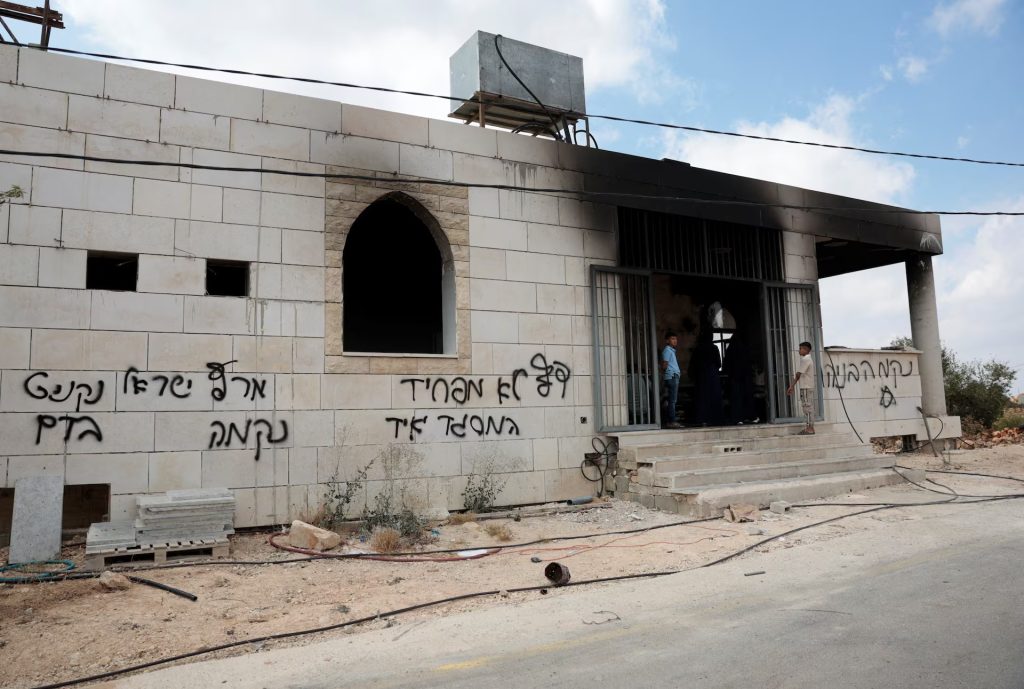
New Delhi: Israeli troops forced two Palestinian families from their homes in the occupied West Bank village of Qusra on Thursday, five days after settlers began a siege that cut the properties off from water, electricity and outside assistance. The removals came a day after a senior Israeli commander visited the families and promised to end the settlers’ campaign against them.
The confrontation, which began in July, got extremely serious on August 9 when settlers blocked the approach to three houses on the village’s outskirts and pitched a tent in their front yards, preventing about 15 residents from entering or leaving. The United Nations said those trapped included two children, while residents reported that an ambulance was prevented from reaching a sick toddler.
Settlers also allegedly threw stones, damaged property and shouted abuse at the families as their food and drinking-water supplies dwindled. Qusra lies southeast of Nablus in Area C of the West Bank, where Israel retains full security and administrative control under the arrangements created by the Oslo accords.
Major General Avi Bluth, the commander of Israeli forces in the West Bank, visited Qusra on August 12 and told residents that the settlers would be removed. Troops later dismantled the tent but left several settlers and their equipment at the site, and an attempt to disperse the group with riot-control measures failed.
Soldiers returned at about 10am on August 13 and told residents that they had to leave because a military operation in the area could continue for three days. The families initially refused but were subsequently moved into one house, according to Qusai Ridi, one of the Palestinians caught in the siege.
Ridi was allowed to return to his property later in the day, but his neighbour, Yousef Hassan, remained with him while soldiers continued to occupy Hassan’s home. Soldiers also took positions in several other Palestinian houses, although six of the properties commandeered earlier in the day were later returned to their occupants.
The precise number of homes still occupied by troops remained unclear late on August 13. The village mayor, Abdul Azim Wadi, and residents told Reuters that troops remained inside three houses, while the Guardian reported that settlers were still moving around the village.
The Israel Defense Forces said the deployment was intended to protect residents and maintain security, adding that troops had been instructed to allow the Palestinian families to remain in their homes. Its statement appeared to conflict with residents’ accounts that they had been ordered out and consolidated in a single property during the operation.
Video recorded earlier in the week showed men in Israeli military uniform joining settlers in prayers at the tent erected outside the houses. The military said disciplinary action would be taken against personnel found to have assisted the settlers, while additional troops were sent to reinforce the area.
Residents who returned to houses vacated by soldiers reported damage to their belongings, including destroyed decorations and torn pages of a Qur’an. Ridi also said a security camera had been damaged and equipment was missing from his property.
The US ambassador to Israel, Mike Huckabee, called the siege a “horrific act of terror” and described those responsible as Israeli terrorists, an unusually strong intervention from a diplomat who has generally supported Israel’s settlement movement. Huckabee said Israeli troops and police had acted after a US request, but the affected families said condemnation alone had not provided them with security or restored normal access to their homes.
The former Israeli prime minister, Ehud Olmert, described the events as a “concerted and meticulous attempt at ethnic cleansing” and accused the Israeli government and security agencies of failing to act. Israeli commentators also questioned why the police had negotiated with the settlers rather than arresting those suspected of intimidation, trespass and property damage.
Qusra has repeatedly been targeted in settler attacks, and the violence has already proved fatal. A settler allegedly shot dead 28-year-old Amir Moatasem Odeh near the besieged houses in March and another attacker stabbed his father, but no arrests had been made in either case by the time of the latest confrontation.
Why settler violence is escalating in West Bank
The Qusra siege reflects a wider method of exerting control over Palestinian land without immediately constructing a large settlement. Small groups establish tents, farms or makeshift outposts beside Palestinian homes, fields, springs and grazing grounds, after which repeated intimidation can make ordinary life and livelihoods increasingly difficult.
The attacks commonly involve assault, stone-throwing, arson, livestock theft, vandalism, the destruction of water pipes and the obstruction of roads. Once families leave, even temporarily, settlers can expand their presence and argue that the surrounding land is unused, abandoned or required for security.
This pattern is particularly effective in Area C, which comprises about 60 per cent of the West Bank and remains under full Israeli control. Palestinians in the area face severe restrictions on construction, while Israeli settlements, access roads and infrastructure continue to expand through a separate planning system.
The government led by the prime minister, Benjamin Netanyahu, has accelerated settlement approval and moved to regularize outposts that were initially established without formal authorization. Far-right members of the ruling coalition openly advocate permanent Israeli sovereignty over the West Bank and reject the creation of a Palestinian state.
Settler violence is not the only source of insecurity in the territory, where Palestinian attacks have also killed Israeli civilians and security personnel. Israel cites such attacks and broader security concerns to justify military deployments, road closures and protective measures around settlements, but international humanitarian law still requires an occupying power to protect the civilian population under its control.
One reason the violence persists is the weakness of law enforcement against Israeli offenders. The Israeli human-rights organization Yesh Din found that 93.8 per cent of the investigation files it monitored between 2005 and 2024 ended without an indictment, while only three per cent produced a full or partial conviction.
The low prosecution rate has reinforced Palestinian distrust of the Israeli police, and many victims no longer submit complaints because they expect no effective investigation or fear repercussions. Israeli authorities say settler extremists represent a minority and have occasionally ordered arrests or dismantled outposts, but rights groups argue that enforcement remains inconsistent and rarely reverses the seizure of land.
The humanitarian consequences have intensified sharply since January 2023. According to the UN Office for the Coordination of Humanitarian Affairs, more than 6,200 Palestinians, including over 3,000 children, were displaced following settler attacks and associated access restrictions between January 2023 and July 6, 2026.
At least 121 Palestinian communities experienced full or partial displacement during that period, with 46 emptied completely. The UN recorded more than 1,200 settler attacks causing casualties or property damage across over 240 Palestinian communities during the first half of 2026 – an average of about six incidents a day.
From strategic footholds to entrenched settlements
Israel captured the West Bank from Jordan during the June 1967 war and established its first post-war settlement, Kfar Etzion, in September that year. Early settlements were concentrated around Jerusalem and in the Jordan Valley, with Israel’s Labour-led governments presenting them primarily as strategic positions intended to provide territorial depth and defensible borders.
The movement changed significantly after the emergence of Gush Emunim in the 1970s and the election of the Likud government in 1977. Religious-nationalist activists increasingly established communities in the West Bank’s interior, arguing that Jews had a historical and biblical right to what they call Judea and Samaria.
Successive governments supported the settlement system through land allocations, roads, military protection, public services and financial incentives, although their political objectives and preferred territorial boundaries differed. Some Israelis moved for ideological reasons, while others were attracted by subsidized housing and lower living costs.
The Oslo accords of 1993 and 1995 divided the West Bank into Areas A, B and C as an interim arrangement but deferred borders, settlements, Jerusalem and security to final-status negotiations. Those negotiations never produced a comprehensive agreement, leaving a supposedly temporary division in place for more than three decades.
A second category of settlement – the outpost – began proliferating in the 1990s, frequently on hilltops or agricultural land. These sites initially lacked the approvals required under Israeli law, yet official inquiries found that some received roads, utilities, security or other assistance from state institutions.
Settler militancy also developed over several decades, ranging from underground Jewish extremist cells in the 1980s to the killing of 29 Palestinian worshippers by the settler Baruch Goldstein at Hebron’s Ibrahimi Mosque in 1994. From the late 2000s, “price-tag” attacks targeted Palestinians, religious sites and property in retaliation for Palestinian violence or Israeli attempts to remove unauthorized outposts.
The settlement map has since become extensive and fragmented. Peace Now counted 146 government-recognized settlements and about 511,100 settlers in the West Bank, excluding East Jerusalem, while Reuters reported approximately 390 smaller outposts as of August 2026.
What international law and world say
Nearly every country regards the West Bank, including East Jerusalem, as occupied territory and considers Israeli settlements illegal. Article 49 of the Fourth Geneva Convention prohibits an occupying power from transferring parts of its civilian population into territory it occupies, which is the central legal provision applied to the settlement enterprise.
UN Security Council Resolution 2334, adopted in 2016, states that the settlements have “no legal validity” and constitute a flagrant violation of international law. It also demands an immediate end to settlement activity and calls upon countries to distinguish between Israel and the territories occupied since 1967.
In its July 19, 2024 advisory opinion, the International Court of Justice concluded concluded that Israeli settlements in the West Bank and East Jerusalem had been established and maintained in violation of international law. The court said Israel should cease new settlement activity and end its unlawful presence in the occupied Palestinian territory as rapidly as possible.
Israel rejects this interpretation and describes the West Bank as disputed rather than sovereign Palestinian territory. Its official legal position argues that the Geneva Convention’s population-transfer provision was intended to prohibit forced deportations, that Jews move to the settlements voluntarily and that competing territorial claims must be resolved through negotiations.
That argument has not been accepted by the UN Security Council, the International Court of Justice, the International Committee of the Red Cross or the overwhelming majority of governments. Even outposts considered unauthorized under Israeli law are part of a broader system that the international community regards as illegal in its entirety.
International criticism has increasingly moved beyond statements. The European Union imposed additional sanctions on four organizations and three individuals in May 2026, saying they had facilitated serious abuses and the forced displacement of Palestinians.
Britain, Canada, France and Norway announced coordinated measures in June against people and financial networks accused of enabling settler violence, complementing action taken by Australia and New Zealand. Israel rejected the sanctions as politically motivated and said they challenged the right of Jews to live in the territory rather than addressing violence impartially.
The US position is less consistent: the second Trump administration rescinded sanctions imposed on violent settlers by its predecessor, yet Huckabee’s intervention in Qusra demonstrated that even a strongly pro-Israel administration could not ignore an overt siege involving an American-linked family. Washington, however, continues to oppose international measures that it considers one-sided or likely to replace direct Israeli-Palestinian negotiations.
The central international concern is that settlements, outposts and the roads and security zones built around them are breaking the West Bank into disconnected Palestinian enclaves. As that territorial fragmentation advances, diplomats warn that the land required for a viable and contiguous Palestinian state is steadily disappearing, making the internationally supported two-state solution increasingly difficult to implement.