


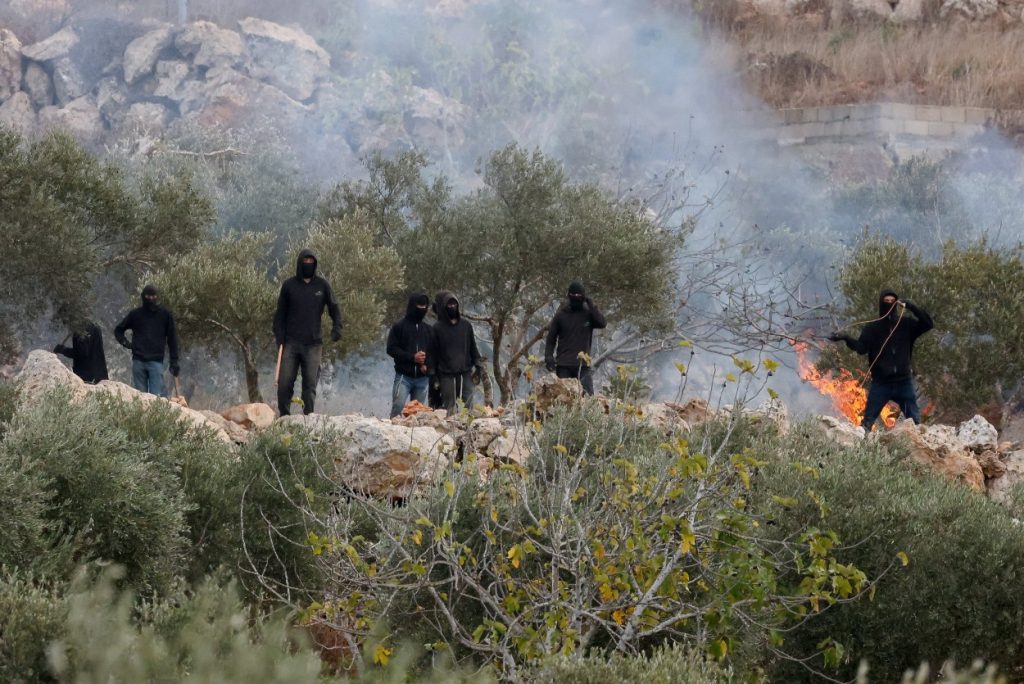
New Delhi: Israeli settlers attacked European diplomats and a visiting French mayor near the Palestinian town of Taybeh in the occupied West Bank on Saturday, according to Belgian officials and witnesses. The violence during the olive harvest prompted condemnation and calls for sanctions, while the Israeli prime minister, Benjamin Netanyahu, questioned whether the available evidence established what had happened.
The delegation included representatives from France, Belgium and Poland, alongside Catholic representatives, visiting the predominantly Christian town. The Belgian foreign minister, Maxime Prévot, said his country’s consul general was among those targeted and that a Belgian diplomatic vehicle had been damaged.
Witnesses and diplomats told AFP that the confrontation began when settlers arrived to stop Palestinians gathering olives. The mayor of the northern French town of Aulnoye-Aymeries, Bernard Baudoux, was assaulted while wearing a sash in the French tricolour, making his official status visible.
Baudoux said attackers kicked him and struck him with iron bars, knocking him to the ground before a priest helped him escape. He did not suffer serious injuries and was able to continue his visit, which included plans for a cooperation agreement between his municipality and Taybeh.
Video examined by AFP showed the mayor on the ground beside a car, while other footage showed damage to a diplomatic vehicle. Israeli police announced an investigation, saying officers were gathering testimony and working to identify the suspects.
Israel’s initial official responses differed in emphasis from Netanyahu’s subsequent statement. The Israeli foreign minister, Gideon Sa’ar, condemned the violence, as did the Israeli military, although both stressed that the diplomatic visit had not been coordinated with the military beforehand.
Netanyahu’s office later urged caution, arguing that images of masked people approaching a vehicle, a broken window and a man lying on the ground did not establish the full sequence of events or individual responsibility. “The more serious the accusation, the greater the demand for compelling evidence,” it said, while describing violence against diplomats as unacceptable.
The statement also alleged that the reports came amid a campaign to damage Israel’s reputation during the olive harvest, according to the Times of Israel’s account. It said the circumstances remained under investigation, rather than announcing findings that disproved the diplomats’ accounts.
Prévot said Belgium would press for European Union sanctions against those responsible and those supporting the violence. He also called on Israel to protect Palestinians, diplomats and journalists, arguing that the attack reflected the insecurity Palestinians experience regularly.
The Palestinian vice-president, Hussein al-Sheikh, similarly described the incident as part of the violence Palestinians face daily. Reuters reported that prosecutions over settler attacks remain uncommon, underscoring the gap between promises of investigations and demands for accountability.
The Taybeh attack followed violence a day earlier near Abu Falah, where masked settlers burned olive trees and threw stones at Palestinians during the harvest. The assault injured the American photojournalist, Heidi Levine, who was working for The Washington Post, adding to concerns about the safety of people documenting attacks on farming communities.
The harvest is an important source of income for Palestinian households, but access to olive groves has become a recurring point of confrontation. Farmers face overlapping risks – being prevented from reaching their land, losing harvested crops and suffering damage to trees that support future production.
Ahead of this year’s season, the UN Office for the Coordination of Humanitarian Affairs identified restricted access, settler attacks, crop theft and destruction of agricultural infrastructure among the principal threats to farming households. Its October 2 assessment also highlighted rising agricultural costs, leaving families exposed to economic pressure alongside physical insecurity.
The UN had recorded 185 harvest-related settler attacks across 70 communities between October 1 and November 30, 2025. That compared with between 40 and 99 incidents during the equivalent period in each year from 2021 to 2023, according to its September 2026 humanitarian report.
The wider dispute concerns settlements in territory Israel occupied in 1967 and its responsibilities towards the Palestinian population. In its July 19, 2024 advisory opinion, the International Court of Justice reaffirmed that settlements in the West Bank and East Jerusalem violate international law; Israel rejected the opinion as wrong and one-sided. The court also made clear that its finding that Israel’s continued presence was unlawful did not remove Israel’s obligations towards people under its control.
That responsibility remains central to the diplomatic demands following Taybeh – protecting those at risk and establishing accountability for the attack.