


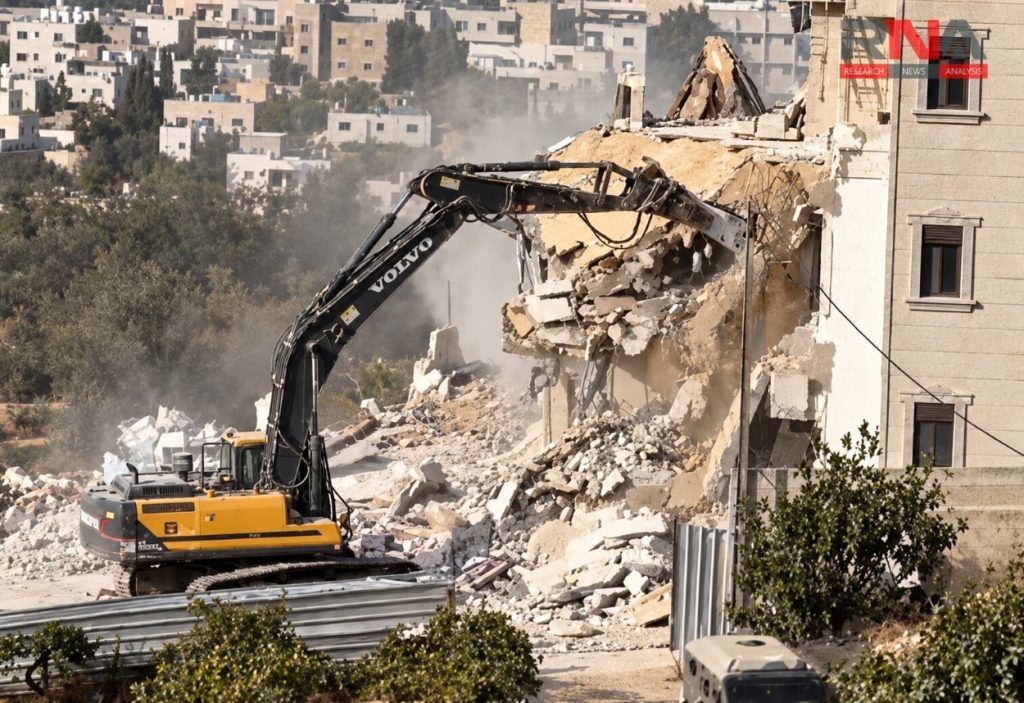
New Delhi: Israeli forces withdrew from neighbourhoods of Hebron in the occupied West Bank on Monday, allowing displaced Palestinian families to begin returning after a military operation that lasted about 10 days. The governor, Khaled Dudin, announced the withdrawal as local authorities assessed damage to homes, businesses and infrastructure following an offensive launched after two Israeli soldiers were killed.
Dudin said Palestinian security personnel had taken control of the evacuated areas and were coordinating arrangements for residents to return safely. The Palestinian news agency Wafa reported withdrawals from Al-Jalda and Ein Deir Baha, among other neighbourhoods, where Israeli troops had occupied residential properties during the operation.
The Israeli military had not immediately commented on the withdrawal, according to the Times of Israel’s report on Monday morning. Palestinian accounts described the operation as a 10-day siege or an 11-day offensive, reflecting the period from its launch on October 23 to the withdrawal on Monday.
Palestinian civil defence officials urged returning residents to avoid suspicious objects and stay out of damaged buildings until specialists had inspected them. They also asked people to keep roads clear for emergency responders and explosive ordnance disposal teams, and to take particular care of children, older people and those with disabilities.
Attack followed by closures and demolitions
As RNA Media had reported earlier, the operation began after two Palestinian gunmen attacked an Israeli checkpoint near Hebron on October 23, killing two soldiers and injuring three others, according to the Israeli military. Both attackers were killed, and Israeli forces subsequently imposed roadblocks, searched buildings and moved into neighbourhoods associated with the assailants.
In its account of the operation, the military said its objectives included finding weapons, dismantling militant infrastructure and preventing further attacks. It reported recovering an M16 rifle and other equipment, detaining suspects and demolishing structures near the attack site that it described as unauthorized and a security threat.
Israeli forces also demolished the homes of the two gunmen on October 30, Reuters reported, after their families had already been forced to leave. Palestinian officials said the broader operation extended well beyond those properties, damaging homes, commercial premises and roads while restrictions hampered movement and access to medical care.
According to the Hebron governorate, more than 3,300 Palestinians were displaced or otherwise affected, particularly in Al-Jalda and Ein Deir Baha. Troops took over some homes and used them as military posts, while closures affected the city and surrounding villages.
Schools and businesses count the cost
The municipality said 15 homes and other structures had been demolished and 327 businesses forced to close. It estimated daily economic losses at more than 12 million shekels, alongside infrastructure damage exceeding six million shekels and losses of roughly 500,000 shekels in the health and environmental sectors.
The mayor, Yousef al-Jabari, said approximately 80,000 students had been unable to attend school during the closure. These figures were assessments provided by local authorities, rather than a completed independent audit of the operation’s impact.
The UN’s humanitarian coordination office, OCHA, separately documented disruption across the wider Hebron governorate in its humanitarian situation report, recording that more than 251,000 students in 691 schools shifted to remote learning on October 25–26. That figure covers a larger geographical area and a specific period and should not be treated as interchangeable with the municipality’s estimate for the city.
OCHA said most displaced families had been staying with relatives and noted that its reported displacement estimate of approximately 3,000 people remained under verification. Its account also documented the destruction of commercial properties that provided livelihoods for affected families, as well as water storage facilities and other belongings.
Questions over the operation’s duration
Israeli reporting also pointed to disagreements within the country’s leadership over how long troops should remain in the affected neighbourhoods. Israel’s military chief, Lieutenant General Eyal Zamir, had recommended ending the operation shortly after it began, arguing that there was no operational reason to continue or legal basis to prevent residents from returning.
According to that report, the prime minister, Benjamin Netanyahu, rejected the recommendation. There are reports of disagreement between senior commanders and the political leadership, with officers questioning the value of prolonging the deployment and security officials defending its wider objectives.
The UN high commissioner for human rights, Volker Türk, had called for the operation to end, warning about disproportionate force, displacement and threats to empty entire neighbourhoods. He also called for displaced Palestinians to be allowed home and for compensation and reparations over unlawful evictions and demolitions.
Withdrawal does not resolve Hebron’s divided control
The announcement concerns troops deployed during the latest operation and should not be read as the end of Israel’s longstanding military presence in Hebron. Under the 1997 Hebron agreement, approximately 80 per cent of the city, known as H1, was transferred to Palestinian Authority control, while Israel retained control over the remaining 20 per cent, known as H2.
H2 includes Israeli settlement compounds and Palestinian residential neighbourhoods where the UN has documented longstanding movement restrictions. Monday’s withdrawal therefore opens the way for families displaced by this operation to return, while leaving the city’s underlying territorial and security arrangements unresolved.