


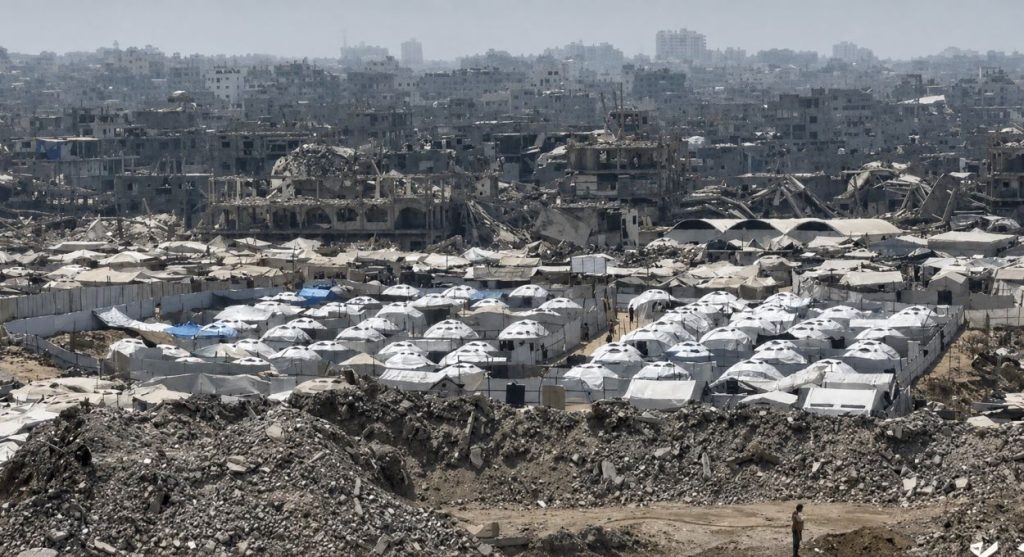
New Delhi: Israel is prepared to facilitate the removal of Palestinians from the Gaza Strip by sea, air and other routes once it secures US backing, the Israeli defence minister, Israel Katz, said on Wednesday. The statement revived a proposal presented by the Israeli government as voluntary migration but denounced by Palestinian representatives and human-rights groups as a blueprint for forced displacement.
Speaking at a conference hosted by the Israeli news website Ynet and the newspaper Yedioth Ahronoth, Katz said there was “no real solution for Gaza” without such migration and that the government had completed the necessary preparations. He also claimed that 80 per cent of Gaza’s Palestinians wanted to leave, although reports of his remarks cited no evidence supporting the figure.
Katz acknowledged that the principal obstacle was the absence of countries willing to receive Palestinians and said prospective destinations wanted political and financial assurances from Washington. He asserted that the US president, Donald Trump, had not abandoned his earlier proposal but had merely “frozen” it, adding that discussions were continuing and American approval could eventually alter the position of regional governments.
The minister singled out Egypt, which shares a border with Gaza and has consistently opposed the permanent relocation of Palestinians to the Sinai Peninsula. Cairo has argued that displacement would undermine Palestinian statehood, threaten Egyptian security and effectively transfer the consequences of the conflict to neighbouring Arab countries, while the White House did not immediately respond to questions about Katz’s latest comments.
The position outlined by Katz appears to conflict with Trump’s subsequent 20-point Gaza framework, which formed the basis of the October 2025 ceasefire and envisaged reconstruction without compulsory population transfer. The plan explicitly provided that Palestinians would not be forced to leave, while those choosing to travel abroad would be allowed to return – a commitment central to the distinction between voluntary migration and permanent expulsion.
The latest remarks were not an isolated policy intervention. In February 2025, Katz announced an Israeli defence ministry directorate to help Palestinians wishing to settle in third countries, with an initial plan prepared by Cogat covering travel arrangements by land, sea and air.
Trump had earlier proposed that the US take control of Gaza, relocate its Palestinian population and redevelop the devastated territory, an idea that provoked widespread opposition across West Asia. That proposal was later overtaken by the American peace framework, which coupled Hamas’s disarmament with transitional administration, reconstruction and an eventual Israeli military withdrawal.
Katz’s comments coincided with a visit by the Israeli prime minister, Benjamin Netanyahu, to a military position near the so-called yellow line inside Gaza. Netanyahu said Israeli forces would remain in the territory they controlled until Hamas was disarmed and Gaza demilitarized, underlining the unresolved differences over the implementation of the ceasefire.
Whether Palestinians could freely consent to relocation is the central legal question surrounding the Israeli proposal. Article 49 of the Fourth Geneva Convention prohibits individual or mass forcible transfers and deportations from occupied territory, except for temporary evacuations required for civilian safety or imperative military reasons.
Rights groups argue that consent cannot be regarded as genuine when civilians face destroyed homes, restricted aid, military pressure and little prospect of rebuilding their lives. Human Rights Watch has previously accused Israel of deliberately displacing Palestinians in circumstances that could constitute war crimes and crimes against humanity, while Israeli officials maintain that any overseas movement would be voluntary and that their military operations are directed against Hamas.
There was no immediate public response from New Delhi to Katz’s latest statement. India’s established position supports a negotiated two-state solution leading to a sovereign and viable Palestinian state alongside Israel, and it has previously joined international declarations opposing attempts to forcibly displace or expel Palestinians from their land.
Without US approval and countries willing to accept large numbers of Palestinians, the Israeli proposal remains diplomatically and logistically blocked. Katz’s confirmation that mechanisms for implementing it have nevertheless been prepared is likely to intensify concern over Gaza’s demographic future and further complicate negotiations on reconstruction, governance and a lasting political settlement.