


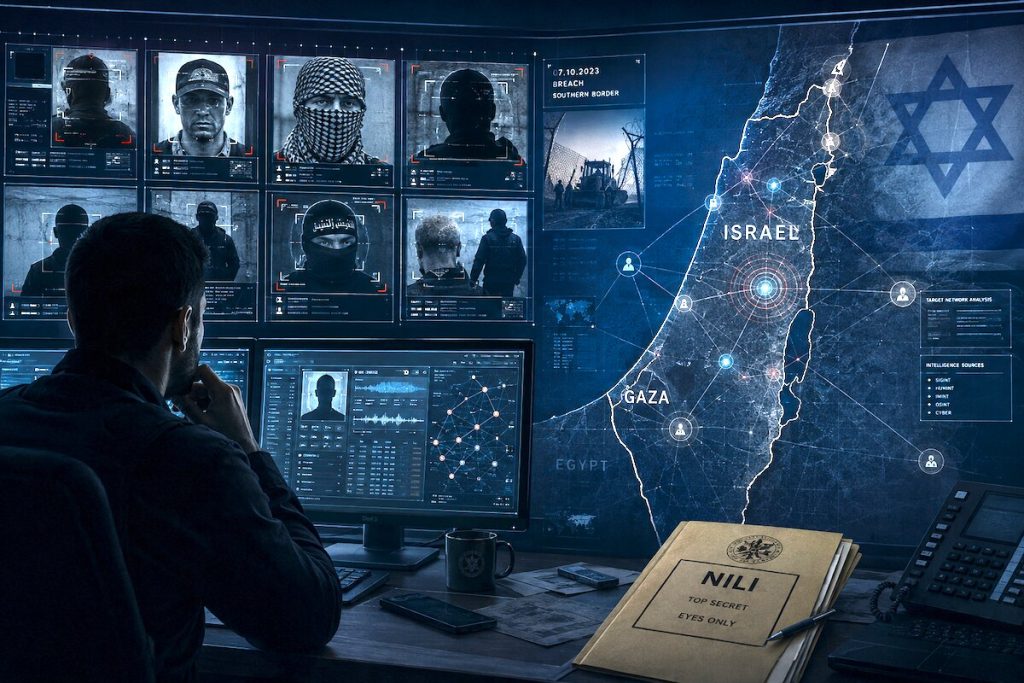
New Delhi: Israel’s military and internal security service have for the first time publicly confirmed a covert, years-long campaign to track down and eliminate every individual involved in the Hamas-led raid of October 7, 2023. Officers from a joint unit codenamed Nili told Israeli broadcaster Channel 12 that facial recognition, artificial intelligence, interrogations of detainees and human intelligence have all been used to compile and act on a target list running into the thousands.
According to the Channel 12 broadcast at the weekend, some 2,800 of the roughly 5,000 people identified as having taken part in the attack or its aftermath have already been killed. That figure includes the approximately 1,200 people killed by Israeli forces on the day itself, with the rest tracked down and struck over the nearly three years since. Around 300 more suspects have reportedly been captured and are awaiting trial before military tribunals that are yet to be constituted, and a genocide conviction carries the death penalty.
Three years of quiet, painstaking work
Nili officers said the unit was set up almost immediately after October 7, when Hamas-led gunmen killed about 1,200 people and abducted 251 others from communities in southern Israel. Adi Rotem, a former senior Shin Bet official who now serves with the unit, described the volume of material it had to process as overwhelming, compiled from thousands of hours of video and photographic evidence, much of it filmed by the attackers themselves on body-mounted cameras.
The unit built bespoke facial-recognition tools to run this footage against known individuals. Conventional tradecraft supplemented the technology – field agents, informants and interrogations of Palestinian detainees held in Israel – with artificial intelligence systems used to piece the fuller picture together.
Every person who guarded, met or abused Israeli hostages during their captivity in Gaza has also been added to the target list, a Nili sergeant identified only by the codename Aleph said. So too, according to the same broadcast, have those who took part in staged hostage-release ceremonies during the war.
No target too small or too senior
Officers said the list makes no distinction between rank or notoriety. Lammed, a lieutenant in the IDF’s Southern Command working with Nili, recalled the elimination weeks earlier of a platoon commander who had led the assault on the Nachal Oz military base. She described how the unit had tracked his daily movements for months, down to, in her words, “when he goes to pray, and what he eats for breakfast.”
Lammed said the list draws no distinction between prominence and obscurity: an ordinary member of the Nukhba raiding force is treated with the same priority as the driver of the earthmover that breached the Gaza border fence at the start of the invasion, an image that became one of the defining visuals of the day. Those who captured well-known hostages such as Yaffa Adar, Yagil Yaakov, Yarden Bibas and Avinatan Or are reported to be among those already eliminated.
Modelled on hunt for Munich militants
Israeli officials have repeatedly drawn a parallel between the Nili campaign and the pursuit of those responsible for the massacre of 11 Israeli athletes at the 1972 Munich Olympics. Codenamed “Operation Wrath of God”, it stretched over two decades with only partial success. The Wall Street Journal reported in May 2026 that the unit is formally a joint effort between the Shin Bet and Mossad, and that its name derives from a biblical Hebrew acronym, Netzach Yisrael Lo Yeshaker – “The Eternal One of Israel does not lie” – first used by a Jewish underground intelligence network during the First World War.
A former senior Shin Bet official, Shalom Ben Hanan, told Israeli media that the operation was meant to send “the clear message to all future enemies” about the cost of joining an attack of that scale. Israel’s military maintains that international law permits strikes against civilians who take a direct part in hostilities, a position it has invoked to justify targeting individuals years after the event itself.
One target identified by name is Izz ad-Din al-Haddad, described by the IDF’s chief of staff, Lieutenant General Eyal Zamir, as one of the chief planners of the October 7 massacre and the head of Hamas’s military wing; he was killed in an air strike reported earlier this year. Separate reporting by JNS put the confirmed death toll among the roughly 5,000 identified participants at above 2,500 as of last month, a figure that appears to have climbed further since, going by Channel 12’s tally.
Where New Delhi stands
India has maintained diplomatic relations with both Israel and the Palestinian Authority for decades and continues to call for a two-state solution as the basis for lasting peace in the region. Unlike several western governments, India has not designated Hamas a terrorist organization, and its officials and media typically describe the group’s fighters as militants or gunmen rather than terrorists, even while condemning the violence of October 7, 2023, unreservedly.
This vocabulary reflects New Delhi’s studied diplomatic position rather than any minimization of the attack, which resulted in the deaths of 1,200 Israelis and 251 taken hostage, most of them civilians. Among the 1,200, many Israeli’s were killed when the IDF attacked the vehicles carrying the hostages after invoking the “Hannibal doctrine”, according to Israeli media.
Hunt continues despite ceasefire
The Gaza ceasefire that took hold in October 2025 has not brought Nili’s work to a close. An Israeli defence official told the Times of Israel last month that the unit’s efforts would continue for as long as necessary – even years from now – until every name on the list has been addressed, and that operations were being carried out within Israel’s declared legal and operational framework.
The IDF and Shin Bet had, until now, declined multiple requests for comment on the unit’s existence. Saturday’s broadcast marks the first time either body has allowed its own officers to discuss the campaign in public, lending official confirmation to reporting that had circulated for months beforehand.