


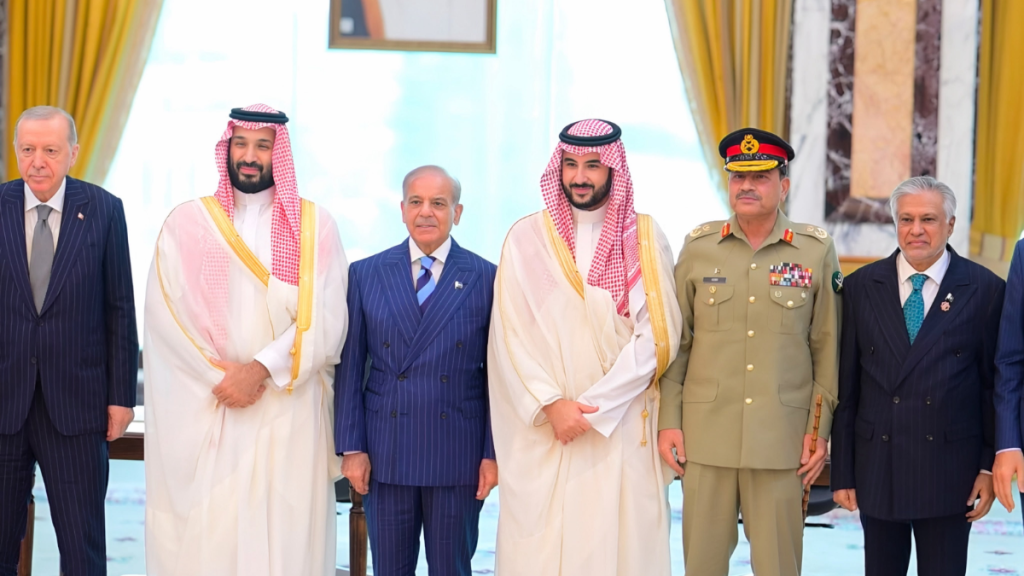
New Delhi: Bangladesh is open to the possibility of joining an economic or defence framework involving Saudi Arabia, Pakistan and Türkiye, foreign affairs adviser Humayun Kabir said in an interview on Thursday. His comment comes weeks after the three countries signed the Mecca Joint Defence Agreement on August 7.
Kabir’s statement comes as Bangladesh strengthens its defence and maritime ties with Saudi Arabia, while also broadening trade and people-to-people links with Pakistan. This follows a period of tension in India-Bangladesh relations, largely stemming from the country’s deposed prime minister Sheikh Hasina’s continued presence in India after being ousted from power in Bangladesh in 2024.
They also come at a time when the country’s prime minister, Tarique Rahman, is evaluating his scheduled visit to India on August 23-24. Rahman has not yet officially confirmed or denied whether he would be coming to New Delhi, even as Rashtrapati Bhavan withdrew a statement indicating preparations, including a full-dress rehearsal, for a ceremonial welcome of the prime minister of Bangladesh.
Fresh tensions arose between the two countries after Hasina held a virtual press conference in New Delhi on August 5 detailing her plan to return to Bangladesh. Taking exception to this, Bangladesh set Hasina’s extradition as a condition for the prime minister’s India visit.
Amid tensions, Kabir, in an interview to Bangladesh Sangbad Sangstha (BSS), said that even though the “Indian media have been speculating about the Prime Minister’s possible visit ahead of the BRICS Summit scheduled to be held in New Delhi on September 12-13, Bangladesh has adopted a policy of not rushing into such a visit without clearly defined national interests.”
In the interview, Kabir, referring to the government’s “Bangladesh First” policy, said the government was pursuing a “balanced foreign policy in the international arena, with national interests at its core.”
To this effect, he said that Bangladesh maintains a “positive approach towards the possibility of joining an economic or defence framework involving Saudi Arabia, Pakistan and Türkiye, taking into account its own interests and the changing dynamics of the global economy and trade”.
Rahman will likely visit Riyadh at the invitation of Saudi Arabia’s crown prince and prime minister, Mohammed bin Salman, according to Kabir.
BSS quoted him as saying that Bangladesh is strengthening its working bilateral relationship with Pakistan at the same time as part of normal diplomatic engagement, with a focus on trade and bilateral people-to-people connectivity.
What is the Mecca defence pact?
Saudi Arabia, Pakistan and Türkiye signed the Mecca Joint Defence Agreement on August 7, establishing a mutual-defence arrangement under which an armed attack against any one of the three countries would be treated as an attack against all three. Turkish foreign minister, Hakan Fidan, subsequently described the arrangement as technically similar to Nato’s Article 5, while stressing that the agreement was intended to strengthen deterrence and regional security.
The pact does not currently include Bangladesh. What Kabir’s remarks do is put the possibility of a wider framework involving the three founding members on Dhaka’s agenda.
For Bangladesh, that possibility comes against the backdrop of an already expanding defence relationship with Saudi Arabia.
Bangladesh and Saudi Arabia are already expanding defence ties
Bangladesh’s relationship with Saudi Arabia has been deepening steadily for a while now. Bangladesh and Saudi Arabia held their first joint committee meeting on defence cooperation in Dhaka in May 2025, providing a formal channel for the two sides to discuss military cooperation.
The relationship has also widened beyond military cooperation. Earlier this month, on August 4, Saudi deputy foreign minister, Waleed bin Abdulkarim El-Khereiji, visited Dhaka and met Bangladesh’s foreign minister, Khalilur Rahman. The discussions covered security, investment, multilateral affairs and developments in the Middle East. Bangladesh also proposed elevating its relationship with Saudi Arabia to a “comprehensive partnership” covering political, economic, security and people-to-people cooperation.
Bangladesh has also backed a separate Saudi-led maritime defence coalition announced on July 30, with 14 countries supporting the initiative to strengthen maritime security and safeguard freedom of navigation and trade routes in the Red Sea region, including around the Bab el-Mandeb and Gulf of Aden. At the time, Kabir said Bangladesh joined the coalition to address the Houthi challenge and described the country’s relationship with Saudi Arabia as becoming “increasingly strategic”.
In other words, Dhaka isn’t starting this conversation from zero. It had already built a fair amount of security infrastructure with Riyadh before this latest comment about the Mecca pact even came up.
Dhaka widens its engagement with Pakistan and China
Bangladesh is also rebuilding engagement with Pakistan after years of limited political contact. Kabir has described the renewed focus on trade and people-to-people connectivity as normal diplomatic engagement.
Pakistan’s position within the Mecca pact gives that relationship an additional relevance. If Bangladesh were eventually to participate in a wider framework involving Saudi Arabia, Pakistan and Türkiye, it would create another institutional channel for Dhaka and Islamabad to work together.
But there is no indication in Kabir’s remarks that Bangladesh has made such a decision. For now, Dhaka has only signalled that it is open to considering the possibility.
Bangladesh’s outreach is not limited to Saudi Arabia and Pakistan. Kabir has called China an important partner Dhaka wants to strengthen ties with, and the two countries have been in talks covering infrastructure, trade, investment and the long-pending Teesta river project.
None of this is happening in isolation. Bangladesh appears to be building out relationships with several major powers at once, rather than picking one lane.
Where India fits into all this
Kabir said a proposed visit by Bangladesh’s prime minister, Tarique Rahman, to India ahead of the BRICS Summit remains unlikely unless an “appropriate environment” is created between the two countries. He also said there was “no justification for rushing into a top-level visit” without consideration of Bangladesh’s national interests.
A major source of friction remains Hasina, who left Bangladesh for India following the July 2024 uprising that ended her government. Dhaka has sought her extradition, while Kabir has criticized India for allowing her to undertake political and media activities from Indian territory.
He said India needs to properly understand the political reality created by an uprising that, according to him, cost more than 1,500 lives. For now, therefore, the most significant development is not that Bangladesh has joined the Mecca pact. It has not. The significance lies in Dhaka publicly leaving the door open to a framework involving Saudi Arabia, Pakistan and Türkiye at a time when its defence relationship with Riyadh is expanding, its engagement with Islamabad is growing and its relationship with New Delhi remains unsettled.