


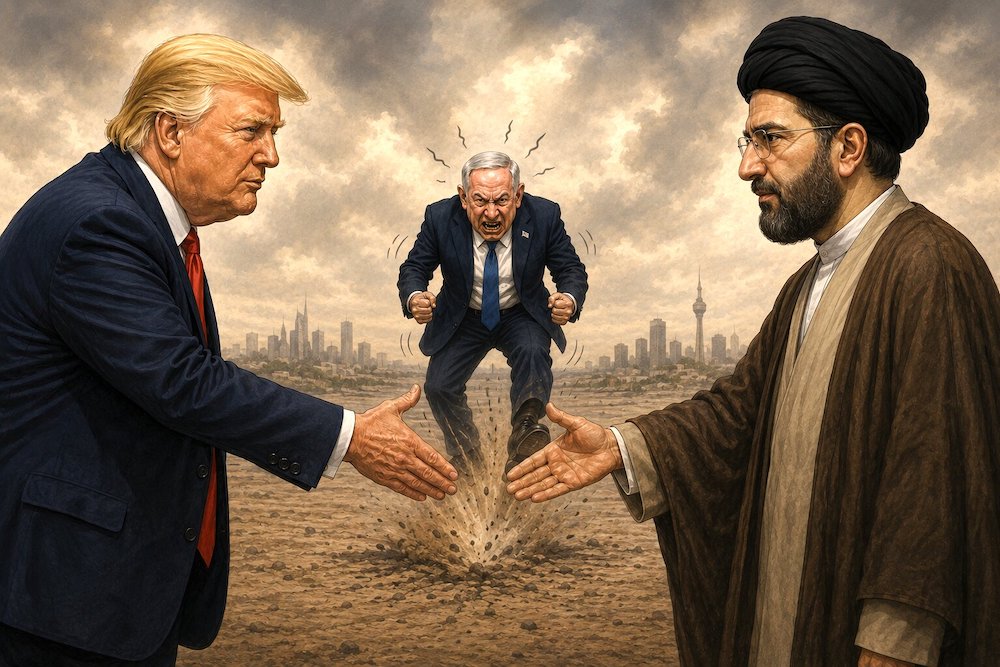
New Delhi: After Pakistan’s prime minister, Shahbaz Sharif, announced that Iran and the United States have reached a peace deal, both Tehran and Washington said the two sides have agreed to on an interim memorandum of understanding (MoU) to end their war. The formal signing of the MoU is scheduled for Friday, June 19 in Geneva, Switzerland.
However, the agreement is a structured pause rather than a comprehensive settlement, leaving the hardest questions for a second phase of talks.
What the deal contains
The MoU, described as a 14-point framework, requires an immediate and permanent ceasefire across all fronts. This includes Lebanon, the reopening of the Strait of Hormuz to toll-free international shipping, and the lifting of the US naval blockade on Iranian ports.
Performance-based sanctions relief, tied to Iranian compliance on nuclear commitments, is also included, along with a pledge by Tehran never to develop a nuclear weapon and to resolve the status of its highly enriched uranium stockpiles. Frozen Iranian assets are to be released during the negotiation period, while a 60-day window has been set for follow-on technical talks covering a broader settlement on sanctions, reconstruction, and regional security.
The war itself erupted in February this year, drawing in months of military exchanges that severely strained Iran’s economy, disrupted global shipping through the Strait of Hormuz, and raised fears of a wider regional conflagration. Pakistan and Qatar served as the principal mediators throughout, with Pakistan’s army chief, Field Marshal Syed Asim Munir, personally leading diplomatic missions to Tehran at critical junctures.
What officials have said
The US president, Donald Trump, declared the deal “now complete” on Monday and authorized the toll-free reopening of the Strait of Hormuz. Pakistan’s prime minister, Shehbaz Sharif, confirmed both the agreement and the June 19 signing date, having played a central role in mediating the final text. Iran’s supreme national security council (SNSC) said the MoU text had been finalized, while the country’s deputy foreign minister, Kazem Gharibabadi, confirmed that war would end immediately and that negotiations toward a final agreement would continue within two months.
Yet the messaging from Tehran has not been uniform. Even as the SNSC confirmed finalization, other Iranian officials and state-linked media continued to describe the arrangement as provisional and subject to compliance – a deliberate ambiguity that allows the leadership to claim a diplomatic win while retaining room to dispute binding obligations later.
Israel’s rejection
Israel’s reaction has been pointedly hostile. The far-right national security minister, Itamar Ben-Gvir, declared that Israel “must not settle for anything less than the dismantling of Hezbollah,” while the defence minister, Israel Katz, said Israeli forces would remain in Lebanon, Syria, and Gaza “for an unlimited period of time,” signalling that Jerusalem does not regard itself as bound by an arrangement it played no part in negotiating.
Israel’s core fear is that the deal freezes the conflict without stripping Iran of its strategic leverage. In practical terms, Washington secures de-escalation and restored shipping lanes, while Iran retains enough military and nuclear infrastructure to rebuild pressure at a later stage. That arrangement – a US-Iran detente purchased at Israel’s expense – remains the sharpest fault line in the agreement’s political architecture.
Iran’s divided public
Inside Iran, the dominant mood appears to be relief tempered by deep scepticism. Months of war, economic damage, and mounting insecurity have left much of the population quietly welcoming a halt to hostilities, and Tehran’s markets reacted positively to news of the MoU. Hardline factions, however, moved swiftly to attack the agreement through state media, and protests were reportedly organized against the foreign minister and the negotiating team.
Even conservative outlets, according to Al Jazeera, had begun signalling that some form of interim compromise was inevitable, which is a rare concession from institutions that had previously resisted any deal framed as a capitulation to Washington.
The unresolved core
The June 19 signing will clarify whether the event represents the formalization of a binding document or a ceremonial endorsement of a framework whose details remain contested. The most consequential issues – the precise scope of sanctions relief, the timeline for asset releases, verification mechanisms for Iran’s nuclear commitments, and the status of Lebanon and other regional theatres – are explicitly deferred to the 60-day negotiation phase.
Israel has made clear it will not alter its military posture in Lebanon regardless of what Washington and Tehran sign in Geneva. That means even a clean signing on June 19 will deposit the region into a fragile and contested pause, not a settled peace.
The real test of this agreement lies not in the ceremony but in whether the follow-on talks can produce the verification architecture, sanctions framework, and regional security guarantees that this MoU deliberately leaves unresolved.