


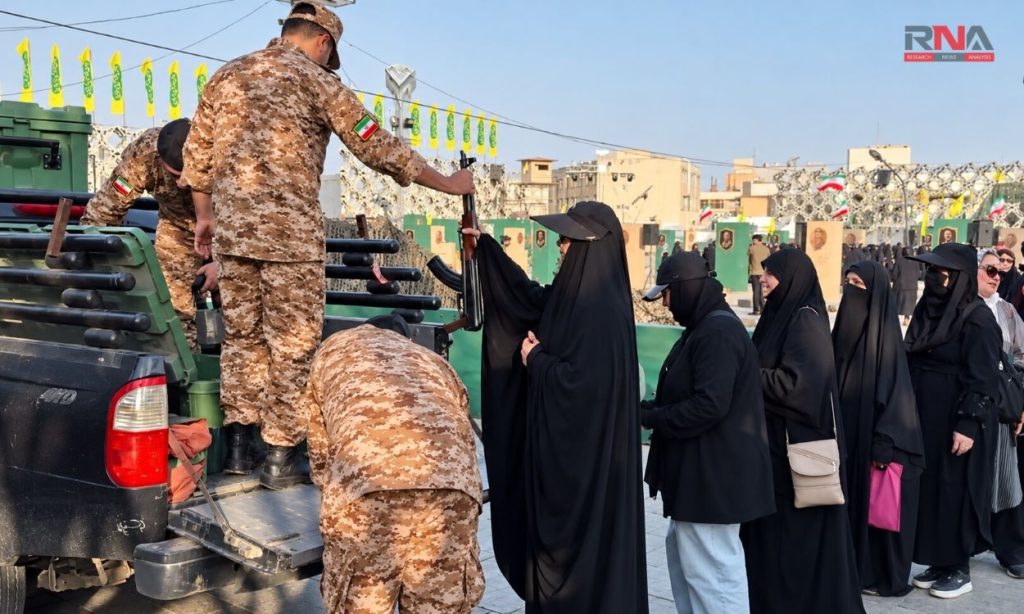
New Delhi: Iran has opened a military training centre in Tehran as part of a wider effort to prepare civilian volunteers for national defence, including a possible ground attack by US or Israeli forces. The facility began operating on Saturday with a senior Basij official saying 1,000 battalions had been organized for training under the country’s expanding mobilization programme.
The centre at Haft-e Tir Square will provide weapons instruction to registered volunteers, extending an initiative that combines military preparedness with emergency response. Anadolu footage of the opening, distributed through Reuters Connect, showed soldiers demonstrating drills and commanders inspecting rocket launchers and air-defence equipment.
The deputy for training at the Basij organization, Ali Kowsari, said preparations had been made to train the battalions and emphasized the importance of civil defence across society. According to Middle East Eye’s report, demonstrations also included obstacle courses and weapons instruction using virtual-reality headsets.
The battalion figure describes the scale of the announced training effort, rather than independently verified combat strength. The available reports do not establish how many volunteers have completed instruction, the personnel strength of each unit or how many battalions are ready for operational deployment.
The expansion comes against the background of a conflict that began with US-Israeli attacks on February 28, 2026. A truce on April 8, 2026, halted the initial 40-day war, although subsequent hostilities have sustained Iranian preparations for renewed fighting.
The training drive forms part of the state-backed Janfada campaign, whose name conveys a willingness to sacrifice one’s life for Iran. Iranian authorities have presented the initiative as a means of drawing civilians into defence, relief work and other national activities, with the Basij and the Islamic Revolutionary Guard Corps (IRGC) playing central organizational roles.
The Haft-e Tir facility follows an earlier centre at Imam Hossein Square, which opened on September 23, 2026. At that inauguration, the head of the Basij, Hossein Taeb, said volunteers were being assessed and organized into units, with those seeking combat roles to be assigned to specialized defence battalions according to their capabilities.
The announced curriculum progresses through basic, intermediate and advanced levels, covering wartime readiness, neighbourhood security, reconnaissance, search and rescue, marksmanship and weapons handling. Selected participants are also expected to receive instruction involving defensive and anti-aircraft equipment, while officials have said similar centres will gradually open elsewhere in Iran.
Iran’s regular armed forces are also becoming involved in the programme, according to an October 4 report by Khaama Press citing West Asia News Agency. It reported that three military training facilities in Tehran had been allocated for volunteers, with instructors drawn from the ground, naval, air and air-defence branches.
The deputy for training and education, Brigadier General Mohammad Reza Arian-Nejad, said participants would begin with basic military instruction before advancing to more demanding courses. That involvement broadens a programme previously centred on Basij-supervised facilities and links civilian recruitment more directly with the regular military’s training capacity.
Public weapons instruction in Tehran predates the latest openings: AFP reported in May that authorities had established booths where civilians learned the basics of assault-rifle handling. The newer centres and battalion structure indicate an effort to turn those introductory sessions into a more organized system of training and assignment.
The mobilization also has a domestic security dimension because of the institutions overseeing it. In its report on September’s large Tehran rally, the Associated Press described the volunteers as an additional security layer alongside the Revolutionary Guard and the Basij, which has played a major role in suppressing anti-government protests.
For now, the clearest development is the expansion of training facilities and the assignment of military instructors to civilian volunteers. Whether the announced 1,000-battalion structure becomes an effective auxiliary force will depend on recruitment, sustained instruction, equipment and command arrangements that the public announcements have yet to fully establish.