


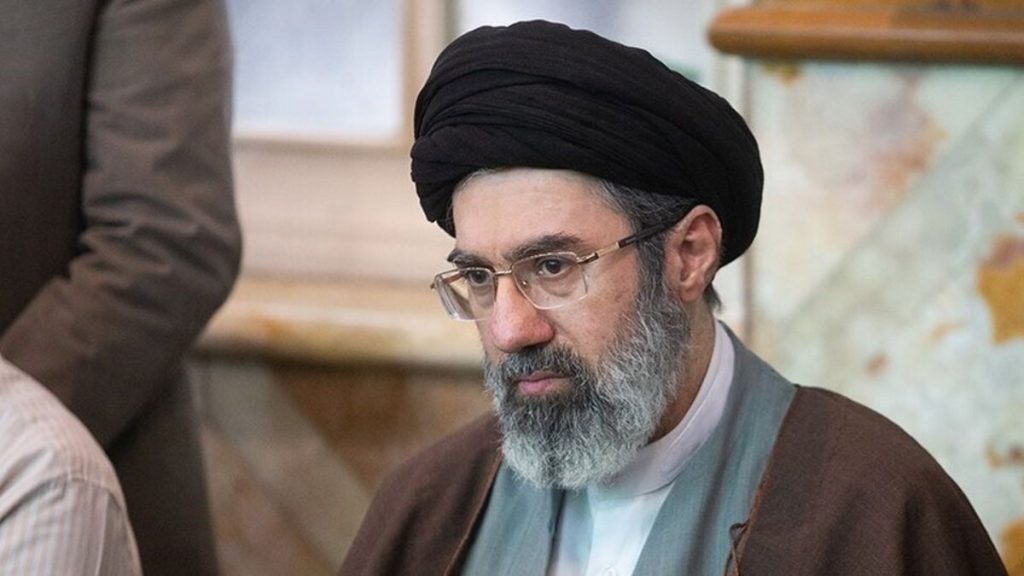
Iran’s Supreme Leader, Mojtaba Khamenei, has signalled a hardening stance against US demands on shutting down its nuclear programme, directing that the nation’s weapons-grade uranium should not be shifted out.
Mojtaba Khamenei’s direction, reported on Thursday (May 21, 2026), is expected to rile up US President Donald Trump and complicate the peace talks to end the war that began on February 28.
“The Supreme Leader’s directive, and the consensus within the establishment, is that the stockpile of enriched uranium should not leave the country,” Western media reports quoted unnamed Iranian officials as saying.
The officials said Iran believed sending the weapons-grade material abroad would leave the country more vulnerable to future attacks by the US and Israel. Khamenei has the last word on the most important state matters.
The same day, Trump vowed that the US would not allow Iran to have its stockpiles of highly enriched uranium. “We will get it. We don’t need it, we don’t want it. We’ll probably destroy it after we get it, but we’re not going to let them have it,” Trump told reporters at the White House.
Israeli officials, quoted by the Western media houses, said Trump had assured their nation that Iran’s stockpile of highly enriched uranium, needed to make an atomic weapon, will be sent out of Iran and that any peace deal must include a clause on this.
Israeli Prime Minister Benjamin Netanyahu had previously said he would not consider the war over until enriched uranium is removed from Iran, Tehran ends its support for proxy militias, and its ballistic missile capabilities are eliminated.
“President Trump has been clear about the United States’ red lines and will only make a deal that puts the American people first,” White House spokeswoman Olivia Wales said.
Meanwhile, Iran and the US were engaged in indirect talks aimed at agreeing on a framework for their peace talks, Iranian media reported. The two sides were currently exchanging messages through Pakistan’s Interior Minister Mohsin Naqvi, who is currently in Tehran.
The messages exchanged included a solution for the Strait of Hormuz and maritime traffic through the blockaded waterway, the reports said. In this regard, Iran was considering introducing a toll for cargo vessels passing through the Strait of Hormuz and had discussed the matter with its neighbour, Oman, a US ally.
Iran has ignored a US warning against the collection of tolls for merchant ships at the Strait of Hormuz, even as US Secretary of State Marco Rubio warned once against that Washington would not tolerate such attempts by Tehran to control the flow of goods, particularly crude oil, through the waterway.
Rubio heavily criticised Iran’s efforts to regulate vessel movement through the key maritime corridor, asserting that Tehran cannot “normalise” a system where ships require Iranian approval or payments to pass through the route.
“If what they mean by opening the Straits is ‘Yes, the straits are open as long as you coordinate with Iran. Get our permission, or we’ll blow you up and pay us.’ That’s not opening the Strait. That is an international waterway,” the US official was quoted as saying.
“They cannot normalise, nor can we tolerate them trying to normalise, a system in which the Iranians decide who gets to use an international waterway and how much you have to pay them to use it,” he said.
Meanwhile, another media report claimed Iran suspected the unilateral ceasefire extension announced by Trump a few weeks ago was a tactical move by the US to create a false sense of security before launching fresh attacks.
According to the report, there is deep suspicion among top Iranian officials that the US was using the temporary reduction in conflict to prepare for renewed military action.
Iran’s top negotiator, Mohammad Baqer Qalibaf, reinforced those fears on Wednesday (May 20), saying both “obvious and hidden moves by the enemy” suggested that the US was preparing for new attacks on Iran.
Iranian President Masoud Pezeshkian reaffirmed his nation’s commitment to military readiness, noting that his government supported the strengthening of the armed forces.
Pezeshkian was speaking at a high-level security meeting with Iranian Army Commander-in-Chief Major General Amir Hatami, when the two leaders focused on national defence policy, operational readiness, and the strategic reinforcement of the state’s military infrastructure.
Underscoring the foundational pillars of Iran’s defence doctrine, the Iranian President emphasised that internal cohesion and military capability are entirely codependent when safeguarding the nation from external challenges.
He further assured the military leadership that state resources would remain aligned with strategic defence requirements, reiterating that “the government supports the strengthening of the armed forces with all its capacity.”