


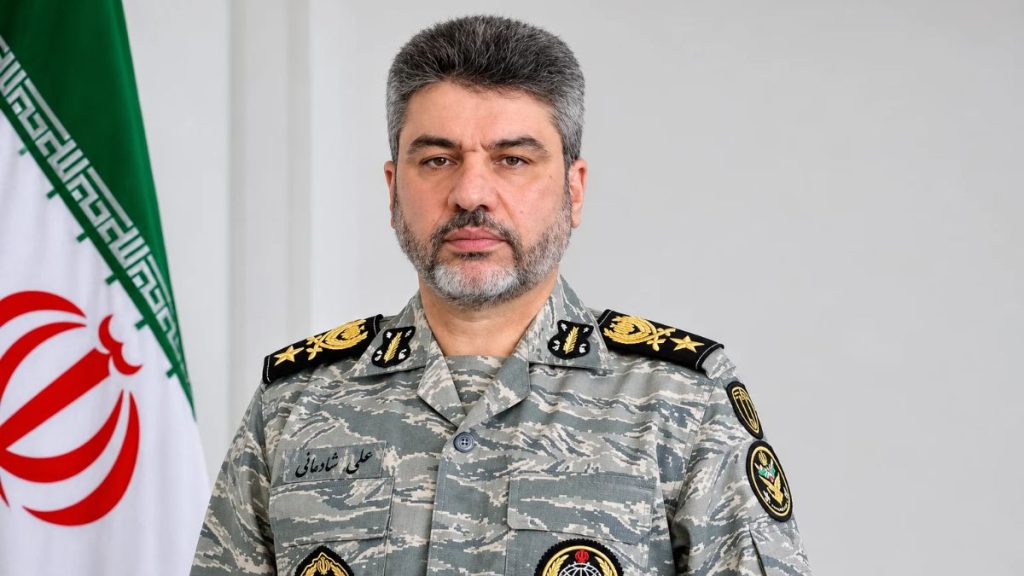
New Delhi: Iran’s Army spokesman, Brigadier General Mohammad Akraminia, claimed on Saturday that the country’s navy maintains surveillance and operational control over waters extending from the eastern Strait of Hormuz to the northern Indian Ocean. The assertion comes amid Washington’s continuing naval blockade of Iranian ports and an escalating confrontation over maritime access in the region.
In a post on X marking Iran’s Navy Day, Akraminia recalled the 1980–1988 Iran-Iraq War, claiming that Iran’s Navy had defeated its Iraqi counterpart within 67 days, rendering it incapable of further action for the remainder of the conflict.
“In the current war, it firmly controls and patrols the area from the eastern Strait of Hormuz to the northern Indian Ocean,” Akraminia said, according to the English translation of his Persian-language post. His assertion of maritime control has not been independently verified.
Iran challenges effectiveness of US blockade
Iranian navy commander, Rear Admiral Shahram Irani, dismissed Washington’s blockade as an indication that the United States had failed to achieve its military objectives, claiming that Tehran’s efforts to break it were already underway. Speaking to the Islamic Republic of Iran Broadcasting (IRIB) on Friday, he argued that naval blockades were traditionally imposed before the commencement of hostilities.
“When a blockade is imposed during a war, it means the war has been lost,” Irani said, in remarks reported by ANI, citing Iranian media. He maintained that Iranian ports remained operational and that naval escorts were being provided to Iranian vessels despite American restrictions.
Irani also alleged that Iranian forces had struck the US aircraft carrier USS Abraham Lincoln on the second day of the ongoing conflict. The claim has not been independently verified.
US disables commercial vessel
The United States, which reinstated its blockade of Iranian ports in July, announced on Friday that it had disabled the Palau-flagged commercial vessel M/V Pacific Archer in the Gulf of Oman on Thursday. US Central Command (Centecom) said the vessel had attempted to breach the blockade after leaving Bandar Abbas, despite repeated warnings.
Centcom said precision munitions were used to disable the vessel’s propulsion system without injuring its civilian crew. The command added that since the blockade resumed, US forces had redirected 158 commercial vessels and disabled six for refusing to comply with restrictions.
Growing risks to global energy shipments
The Islamic Revolutionary Guard Corps (IRGC) navy, which is distinct from Iran’s regular navy, claimed that an oil tanker had struck a naval mine and exploded north of Ghanam Island while attempting an unauthorized passage through the Strait of Hormuz. The incident, reported by Tasnim News Agency, has not been independently confirmed.
Iran has also announced upgrades to its maritime surveillance infrastructure and the deployment of new monitoring systems, Reuters reported on Wednesday. The competing maritime operations have heightened concerns over freedom of navigation and the safety of commercial vessels.
The Strait of Hormuz connects the Persian Gulf with the Gulf of Oman, providing access to the Arabian Sea and shipping routes towards South Asia. International Energy Agency (IEA) data shows that approximately 20 million barrels of oil and petroleum products passed through the waterway daily in 2025, accounting for around 25 per cent of global seaborne oil trade.