


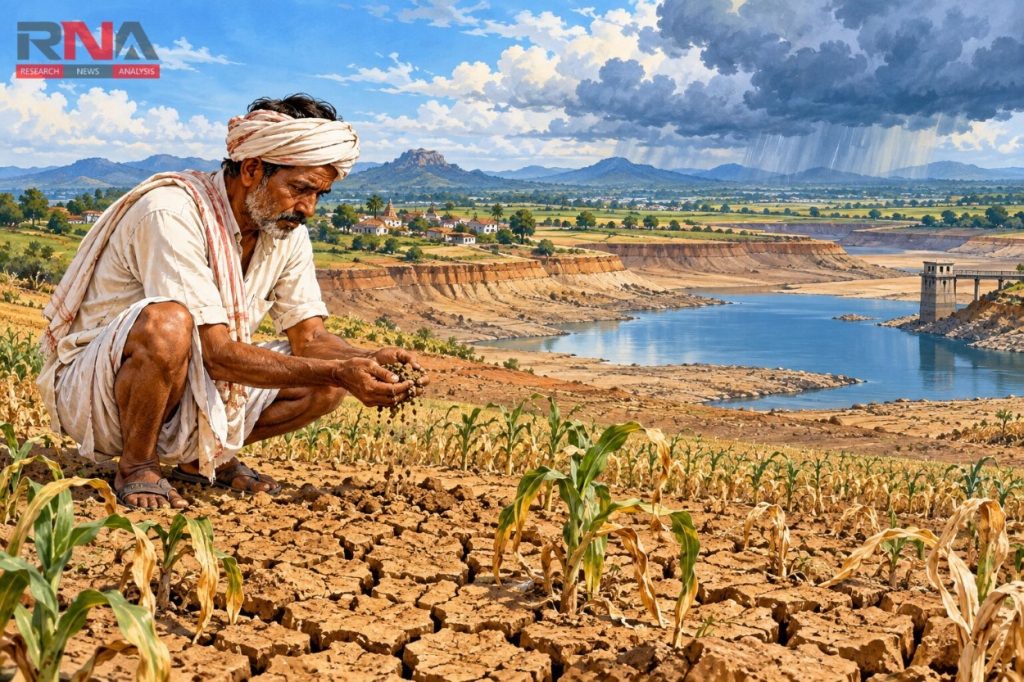
New Delhi: India’s southwest monsoon is retreating after delivering its weakest seasonal rainfall in 11 years, leaving a deficit of nearly 13% and raising concerns over agricultural yields and water availability. The national shortfall conceals a sharper regional crisis, with east and northeast India recording their lowest monsoon rainfall since 1901 and large parts of the southern peninsula facing prolonged shortages.
The country received 759.4 millimetres of rain between June 1 and September 30, against a long-period average of 868.6 millimetres, according to the India Meteorological Department’s seasonal assessment. That represents a shortfall of 12.6%, rounded to 13%, making this the fourth-lowest seasonal total since 2001 and the 13th-lowest since records began in 1901.
East and northeast India received 1,017.1 millimetres, approximately 26% below normal, while the southern peninsula recorded 542 millimetres, a deficit of 24%. Central India fared considerably better with a shortfall of about 3%, while northwest India finished roughly 6% below its seasonal average.
The uneven distribution is also evident across India’s 36 meteorological subdivisions: 17, accounting for 42% of the country’s area, received deficient rainfall, while 18 recorded normal rainfall. Odisha was the only subdivision to register excess rainfall, illustrating how a nationally weak monsoon can still produce substantial rain in particular regions.
The shortfall developed early and persisted through most of the season, with June receiving only about 65% of its normal rainfall. July offered a partial recovery at approximately 101% of normal, but August and September again fell short, receiving around 84% and 92%, respectively.
The long-period average used for the national comparison is based on rainfall during 1971–2020, providing a benchmark against which each season is assessed. However, a seasonal total alone cannot establish the extent of crop damage, which also depends on when rain falls, the length of dry spells and access to irrigation.
A major influence this year has been El Nino, the warming of the central and eastern equatorial Pacific that can alter atmospheric circulation and suppress rainfall over India. IMD’s Thursday assessment said strong El Nino conditions were prevailing and were expected to strengthen further in the coming months.
Rain-bearing low-pressure systems nevertheless helped sustain rainfall over parts of central India, preventing an even deeper shortfall in those areas. The director general of IMD, Mrutyunjay Mohapatra, said the season had 77 days under the influence of such systems, compared with a normal of 57 days, according to the Indian Express.
The consequences are already apparent in Maharashtra, where the government announced drought conditions in 265 of its 358 talukas and ordered field assessments of crop losses. Its relief measures include agricultural loan restructuring, a suspension of loan recovery, land-revenue waivers, electricity concessions and water tankers wherever drinking-water shortages arise.
Crop failures have also brought forward seasonal migration from parts of Marathwada and northern Maharashtra, with small farmers and landless labourers leaving before the usual sugarcane-cutting season. Reports from affected communities found families departing in August and September, some travelling as far as Tamil Nadu after losing farm income and local employment.
National sowing figures suggest the rainfall deficit has not translated into an equally large contraction in cultivated area, but uncertainty remains over eventual yields. Business Standard reported that kharif crops covered approximately 110.7 million hectares by September 25, only 1.2% below the previous year, while prolonged dry spells in Maharashtra and Karnataka had heightened production concerns.
Water storage presents another concern as attention shifts towards winter cultivation and demand during the dry months. Reservoirs monitored in southern India stood at about 50% of their live storage capacity on September 24, compared with 79% nationally, according to the same report.
The close of the June–September accounting period does not mean the monsoon has withdrawn from the entire country. Withdrawal began in west Rajasthan on September 19, while IMD’s withdrawal criteria require sustained dry weather, reduced atmospheric moisture and changes in circulation before its retreat is declared over successive regions.
IMD expects conditions to favour further withdrawal from much of central and northwest India during October 1–7, followed by much of eastern and northeastern India and parts of the northern peninsula during October 8–14. Rainfall nationally is forecast to remain below normal during both weeks, although localized heavy rain remains possible in parts of southern India.