


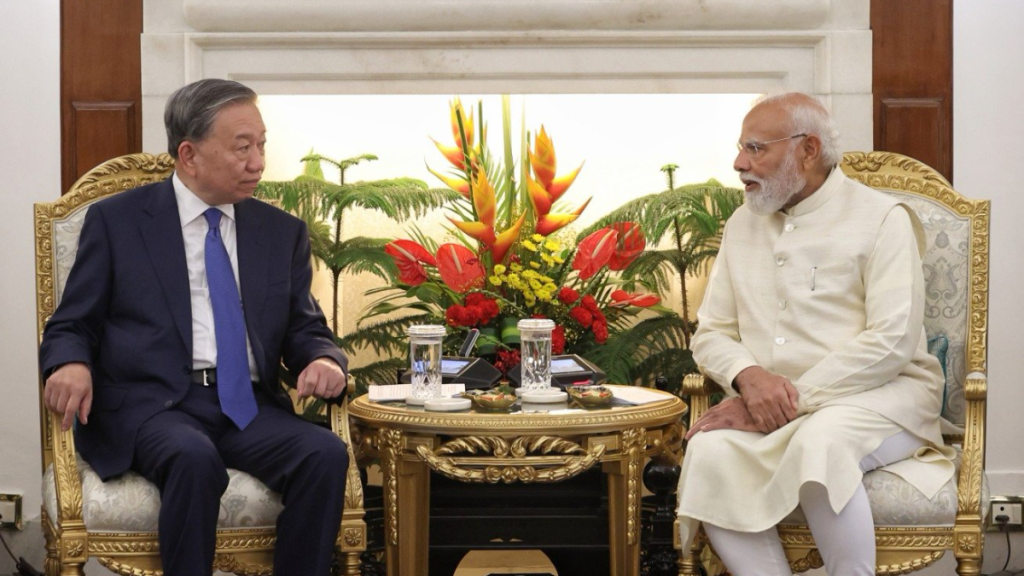
India and Vietnam, on Wednesday (May 6, 2026), agreed to elevate their bilateral ties to an ‘Enhanced Comprehensive Strategic Partnership’ and set a new trade target of $25 billion by 2030, and separately discussed two defence deals for the sale of BrahMos missiles and Sukhoi jets repair services.
These decisions were arrived at during a summit meeting between India’s Prime Minister Narendra Modi and the visiting Vietnamese President to Lam in New Delhi, marking a significant expansion of economic and sector-specific cooperation between the two nations.
Modi announced at a joint media interaction that India and Vietnam formalised a roadmap for an enhanced comprehensive strategic partnership and to grow their bilateral trade, even as he witnessed the exchange of several agreements between the two nations along with To Lam.
“We have taken several important decisions today to take our bilateral trade to $25 billion by 2030. The MoU between our drug authorities will now increase access to Indian medicines in Vietnam,” the Indian Prime Minister said. Bilateral trade had doubled over the past decade, touching $16 billion.
“The export of Indian agricultural, fisheries, and animal products to Vietnam is also going to become easier,” he said, highlighting the specific measures taken to enhance market access and trade volume.
“Very soon, Vietnam will taste India’s grapes and pomegranates, and we will taste Vietnam’s pomelos. Not only this, but we also agreed to update the India-ASEAN Trade Agreement by the end of the year,” Modi said.
“This will give new impetus to trade and investment between India and all ASEAN countries,” he added, noting that the agricultural exchange would soon yield tangible results for consumers in both countries.
“New initiatives in critical minerals, rare earths, and energy cooperation will ensure the economic security and supply chain resilience of both our countries,” the Indian Prime Minister said.
“Connectivity and capacity building are important pillars of our partnership. We are very happy that air connectivity between the two countries is continuously increasing,” he said. “To push financial connectivity, today we have taken the initiative to increase cooperation between our Central Banks,” he added.
Modi also announced that the two nations were “elevating our relationship to the level of an Enhanced Comprehensive Strategic Partnership.”
“We will now steer our partnership toward even loftier goals. From culture, connectivity, and capacity-building to security, sustainability, and supply chain resilience—our cooperation is set to reach new heights across every sector,” he added.
India and Vietnam had entered into a Strategic Partnership in 2007, which was the first that New Delhi had with any ASEAN nation. This relationship was enhanced to a Comprehensive Strategic Partnership in 2016.
The two nations signed 11 agreements, ranging from rare earth to digital payments, urban management to culture and manuscripts. Vietnam also joined the Indo-Pacific Oceans Initiative (IPOI).
In a joint statement, the two nations made an oblique reference to China’s belligerent behaviour in the South China Sea. Underlining the link between prosperity and security, the leaders reaffirmed the importance of maintaining peace, stability, security, and freedom of navigation and overflight in the South China Sea.
They also asked the littorals to pursue the peaceful resolution of disputes in accordance with international law, particularly the 1982 United Nations Convention on the Law of the Sea (UNCLOS), without resorting to threat or use of force.
The joint statement also underscored the importance of “non-militarisation and self-restraint in the conduct of all activities by claimants and all other states, and avoidance of actions that could further complicate the situation or escalate disputes affecting peace and stability.”
It underlined that “UNCLOS is the comprehensive legal framework” governing all activities in the oceans and seas, further calling for “the full and effective implementation of the Declaration on the Conduct of Parties in the South China Sea (DOC) in its entirety.”
The statement also called for an early conclusion of negotiations towards a substantive and effective Code of Conduct in the South China Sea (COC).
Underlining that “defence and security cooperation” is a “key pillar” of the India-Vietnam Comprehensive Strategic Partnership, it said that the leaders agreed to further “strengthen cooperation and enhance engagements in both traditional and emerging areas of defence cooperation.”
This would include defence policy dialogue, joint exercises, staff talks, joint research and co-production of new defence technologies, enhanced port calls by naval vessels and air force aircraft, peacekeeping activities, information sharing, hydrography, defence exhibitions, capacity-building, defence industrial cooperation, maritime security, maritime safety, and search and rescue operations based on mutual interest and priorities of the two countries.
India also discussed the potential sale of BrahMos supersonic cruise missiles to Vietnam, and separately offered Maintenance, Repair, and Overhaul (MRO) support to Vietnam’s Sukhoi Su-30 fighter aircraft and the Kilo-class submarines.
Ministry of External Affairs Secretary (East) P. Kumaran, briefing the media on the Modi-Lam talks, said, “We do talk about several platforms, and the BrahMos platform is also one of them.”
Vietnam has expressed interest in purchasing the BrahMos missile and is seeking faster deliveries. It has conveyed its interest in the shore-based anti-ship variant to bolster coastal defence capabilities in the South China Sea.