


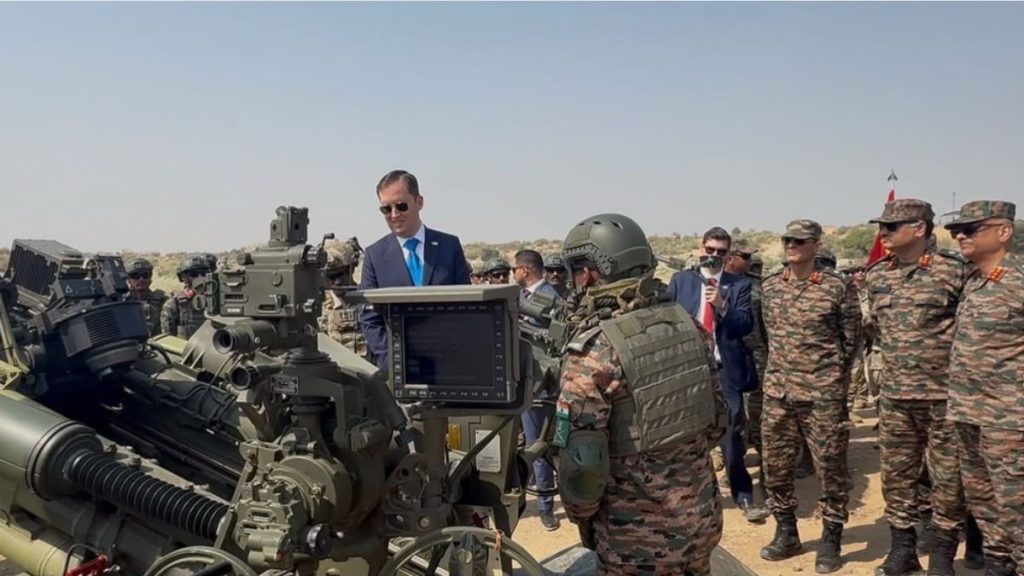
New Delhi: India-US defence-to-defence ties remain “really strong and growing” even as executive-to-executive relations are at “a bit of a low point”, according to an expert assessment presented at a US Army Command and General Staff College panel. The assessment draws a distinction between an increasingly institutionalized military partnership and strains affecting parts of the wider government-to-government relationship.
Philip Hultquist, director of the global and national security policy Institute at the university of New Mexico, made the remarks during a September 23 cultural and area studies office panel at Fort Leavenworth, Kansas. The discussion examined strategic competition and partnerships in the Indo-Pacific and was an academic forum rather than a formal US government policy announcement.
Hultquist said the military instrument was comparatively effective but cautioned that “you can’t replace all of the instruments of national power”. His assessment points to the limits of treating defence cooperation as a substitute for political, diplomatic and economic engagement.
Defence cooperation has acquired considerable institutional depth. India and the US signed a 10-year framework for their major defence partnership in October 2025, covering military engagement, information sharing, defence industrial cooperation, science and technology and coordination mechanisms.
That momentum was visible again during the 22nd Exercise Yudh Abhyas in September, when 600 personnel from each army trained at Auli in Uttarakhand and the mahajan field firing range in Rajasthan. The exercise focused on interoperability, joint planning, operations in mountainous terrain, drones, autonomous systems and emerging technologies. As RNA Media reported earlier (link), the Indian Army chief, General Dhiraj Seth, subsequently discussed Indo-Pacific security and deeper military cooperation with the US Army Pacific commander, Lieutenant General Joel B Vowell.
Over two decades, the relationship has also expanded through US origin platforms in Indian service, including C-17 and C-130J transport aircraft, P-8I maritime patrol aircraft, Apache and Chinook helicopters, MH-60R helicopters and M777 howitzers. The bilateral agenda has increasingly moved towards co-production, technology cooperation and stronger defence industrial links.
Hultquist described India as a focal point of influence in South Asia and referred to a US “hub-and-spoke” approach centred on a long-term partnership with New Delhi. He also called India a potential “strategic counterweight” to China and pointed to Beijing’s Belt and Road Initiative as a source of growing economic influence in smaller South Asian states.
Hultquist said Washington had effectively chosen to “trade access to the smaller states in the region for a chance at an India partnership”, reflecting the weight assigned to New Delhi in the US approach to South Asia.
Those formulations were the panel’s assessment, not a declared US doctrine. India continues to pursue strategic autonomy, working with the US, Japan and Australia in the Quad while remaining a member of Brics and maintaining longstanding relations with Russia.
Lt Col Jason Levay, an instructor at the command and general staff college, said southeast Asian governments were particularly concerned about retaining sovereign choice rather than being pushed into competing blocs. “The United States does not necessarily need southeast Asian states to choose America. It needs to remain a partner they repeatedly choose,” he said.
The assessment comes as the prime minister, Narendra Modi, and the US president, Donald Trump, reaffirmed the India-US comprehensive global strategic partnership in a September 30 call while bilateral trade negotiations remained unresolved. The next indicators will include implementation of the 10-year defence framework, military exercises, defence technology and industrial projects, alongside developments in trade and political engagement.