


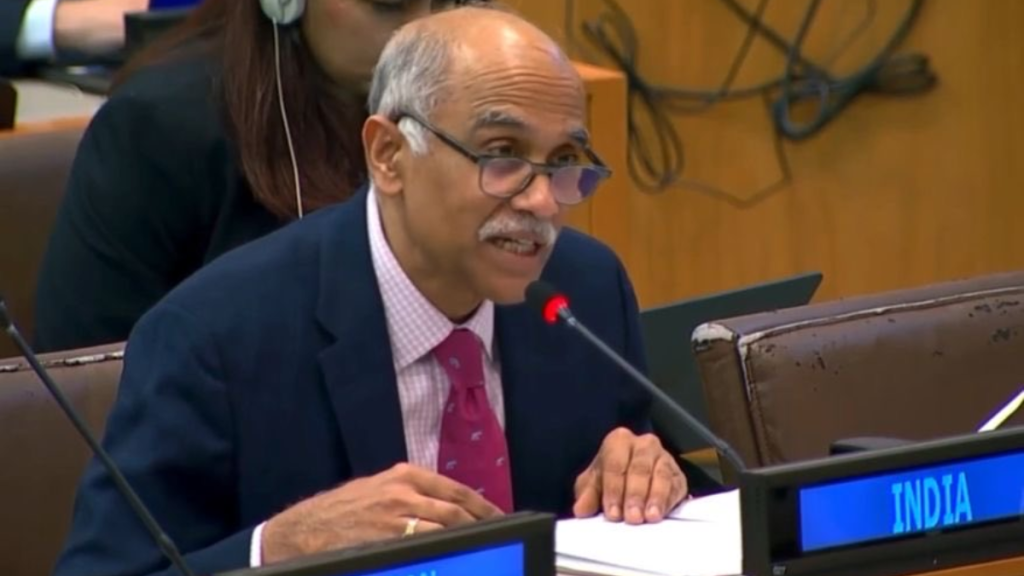
At the United Nations General Assembly on Sunday (May 17), India raised serious concerns over attacks on commercial shipping in the Strait of Hormuz, warning that the ongoing conflict is affecting global trade, maritime security, and energy supply chains.
Speaking at the special meeting of the United Nations Economic and Social Council (UNECOSOC) on safeguarding energy and supply flows, India said a mix of immediate and long-term policy measures, along with international cooperation, is necessary to tackle the crisis.
In a statement shared on X, India’s Permanent Representative to the UN, Ambassador Parvathaneni Harish, said he had “shared India’s approach to the recent energy and fertiliser crisis in light of the West Asia conflict” during the meeting.
“Targeting of commercial shipping, endangering live of Indian civilian crew and impeding freedom of navigation in the Strait of Hormuz are unacceptable. International law in this regard must be fully respected,” he said.
He further stressed that “open and predictable trade must be preserved and fragmentation avoided,” adding that coordinated international efforts are needed “to stabilize energy markets and support countries facing external and fiscal pressure.”
“Strengthening multilateral financial support mechanisms will also be critical in this regard,” he said.
Highlighting the need for long-term resilience, Parvathaneni Harish said, “This crisis underscores the importance of combining immediate responses with long-term transformation. Carefully designed policies, particularly those that address structural bottlenecks and market failures, can enhance resilience and sustain growth over time.”
“India remains fully committed to working with all partners to advance collective and practical solutions,” he added.
According to the assessment of the Reserve Bank of India, the West Asia conflict could impact the Indian economy through elevated crude oil prices, disruption in energy and fertilizer markets, increased uncertainty in financial markets, weaker global growth, and possible long-term supply chain disruptions affecting domestic output, investment and consumption.
Calling for immediate restoration of safe maritime movement, he stressed that international law must be respected to ensure uninterrupted global commerce through the strategically vital waterway.