


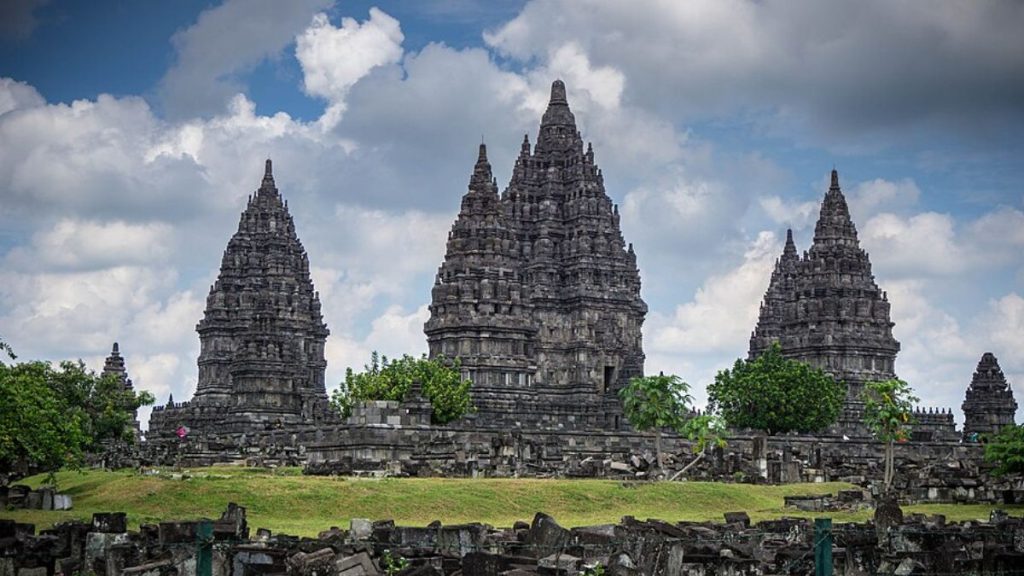
New Delhi: On the eastern bank of the Opak river in Indonesia stands Prambanan, a vast Hindu temple complex associated with the ancient Mataram kingdom and built more than 1,100 years ago. India has now begun helping Indonesia conserve parts of this fragile stone monument, extending a cultural connection that predates the modern relationship between the two countries.
The conservation project was launched on July 8 when the prime minister, Narendra Modi, and the Indonesian president, Prabowo Subianto, marked the start of restoration work at the Unesco World Heritage Site. The Archaeological Survey of India (ASI) is working with Indonesian authorities on the project, which follows an understanding reached during Prabowo’s state visit to India in January 2025.
Indonesia’s culture ministry says the first phase will focus on 54 perwara, (attendant) temples in the northeaster part of the Prambanan complex. The work adds heritage conservation to an India-Indonesia partnership that already covers defence, maritime security, trade, technology, space and people-to-people exchanges.
A temple built for the gods
Indonesian cultural records describe Prambanan as the country’s largest Hindu temple and a royal monument reflecting the architectural idea of the mandala. The temple complex covers about 39.8 hectares and is divided into three courtyards, with the sacred inner area centred on shrines dedicated to Shiva, Brahma and Vishnu.
The central Shiva temple dominates the complex, flanked by the Brahma and Vishnu temples. Opposite them stand smaller shrines associated with the deities’ vehicles, while the wider complex originally included hundreds of attendant temples arranged in concentric rows.
Reliefs along the Shiva and Brahma temples depict the Ramayana, while carvings on the Vishnu temple illustrate the Kresnayana. Unesco describes the Ramayana panels as masterpieces of stone carving and says the wider Prambanan property demonstrates sophisticated building technology and the coexistence of Hindu and Buddhist traditions in ancient Java.
An Indonesian culture ministry publication links the complex to the Siwagrha inscription, which records the inauguration of a temple complex in 856 CE during the reign of King Rakai Pikatan. The monument is regarded as an important expression of the political and cultural power of ancient Mataram.
Centuries of damage and repair
Prambanan’s survival has never been assured. Unesco says the temples suffered from earthquakes, volcanic activity and political changes, with major structures collapsing over the centuries.
Systematic restoration began in 1918 and has continued in phases.
The site again suffered damage during the 2006 Java earthquake, underlining why conservation at Prambanan requires more than rebuilding visible walls. Restorers must preserve original stone, structural stability and the authenticity of a monument that has already undergone more than a century of repair.
India takes conservation expertise abroad
Prambanan is part of a much wider Indian heritage-conservation effort overseas. The External Affairs Ministry says India has completed more than 50 cultural and heritage projectsabroad, while around 25 others are under implementation.
Indian-supported conservation has included the My Son temples in Vietnam, Vat Phou in Laos and Ta Prohm and Preah Vihear in Cambodia, besides Buddhist, Islamic and other heritage projects across Asia and beyond. The approach allows India to use archaeological and technical expertise as a form of cultural diplomacy rooted in local heritage rather than newly created symbols.
That gives the Prambanan project significance beyond the stones being restored. The 2026 India-Indonesia joint statement places cultural cooperation alongside an expanding strategic agenda covering maritime security, defence technology, connectivity, digital systems and space.
An idea two decades in making
The idea of Indian assistance at Prambanan is itself not entirely new. An India-Indonesia joint statement in 2007 recorded Jakarta’s welcome for an Indian offer to assist restoration work at the complex. Nearly two decades later, the proposal has evolved into an active conservation project led from the Indian side by ASI.