


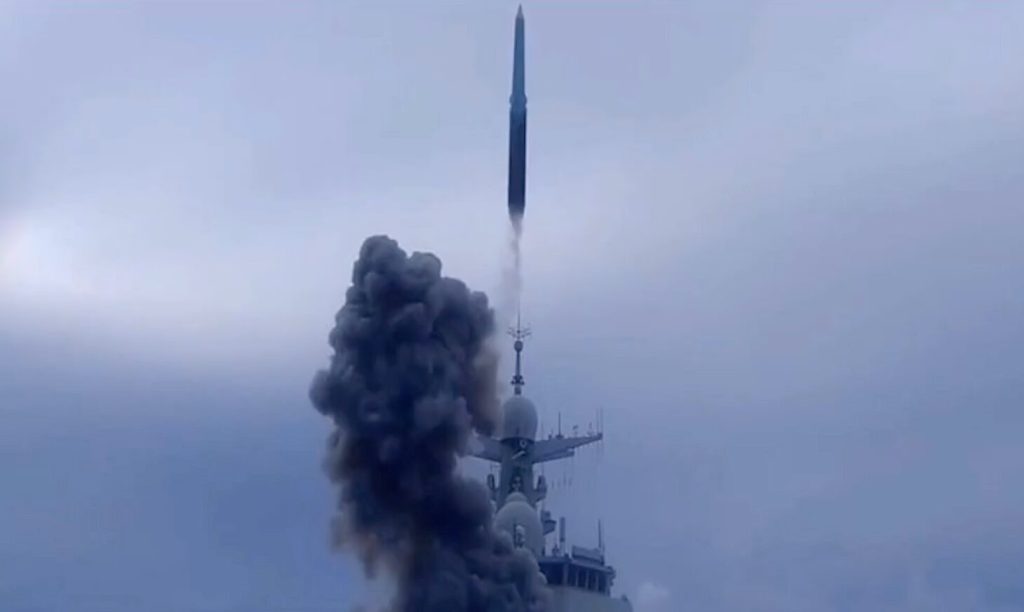
New Delhi: Chinese state media have for the first time broadcast footage of the YJ-20 hypersonic anti-ship missile being launched from a Type 052D destroyer, the People’s Liberation Army – Navy’s (PLA-N) most numerous warship class. The footage, aired on Wednesday by CCTV’s military channel, as Global Times reported, shows the missile leaving a vertical launch cell on the destroyer’s foredeck before its rocket motor ignites and the weapon accelerates away.
The broadcast marks only the second confirmed platform for the YJ-20, after the missile was fired from the larger Type 055 destroyer Wuxi during a test late last year. Fitting it onto the far more numerous Type 052D fleet suggests Beijing intends to spread the capability widely, rather than keep it confined to a handful of flagship vessels.
Cold launch from foredeck
The video shows a cold launch, in which the missile is ejected from its vertical launch cell before its rocket motor fires in mid-air. This method reduces thermal stress on the launcher and allows a larger weapon to be squeezed into a cell designed for several different missile types.
No target engagement was shown in the footage.
The Type 052D’s launch cells ordinarily carry the HHQ-9 surface-to-air missile, the YJ-18 subsonic anti-ship cruise missile, the CJ-10 land-attack cruise missile and the CY-5 anti-submarine weapon. It remains unclear whether every cell aboard the class can accommodate the considerably larger YJ-20.
The Chinese military affairs expert, Zhang Junshe, told Global Times that the YJ-20 is a boost-glide weapon combining a rocket booster with a bicone glide vehicle. He said the bicone shape generates shockwaves in flight that allow the missile’s control surfaces to manoeuvre sharply as it nears its target, making interception difficult.
Fleet-wide weapon, not just for flagship
The Type 052D, known in Nato reporting as the Luyang III class, displaces roughly 7,500 tonnes and carries 64 vertical launch cells split evenly between bow and stern. About 35 of the destroyers are already in service, with more under construction, making it comfortably the most produced destroyer class built anywhere since the end of the Cold War.
The Type 055, by contrast, carries 112 launch cells and has long been regarded as the PLA-N’s premier surface combatant. Yet only around 10 of these larger Renhai-class destroyers are currently operational, against a Type 052D fleet several times that size and already patrolling Chinese waters.
Equipping the smaller, far more common destroyer with a hypersonic strike weapon therefore does more to widen China’s reach than a similar upgrade confined to the Type 055 alone.
Seven years in the making
The YJ-20 was first shown publicly, in mock-up form, during the military parade in Beijing on September 3, 2025, marking 80 years since victory over Japan in World War II. Speculation about the weapon, however, stretches back to 2022, when a similar missile – then referred to by observers as the YJ-21 – was seen fired from a Type 055 during trials.
Chinese disclosures since suggest that the 2022 sighting was in fact an early version of the same programme. The test from the Wuxi in December 2025, described by the PLA-N as a “finalization test”, was the first official acknowledgement that the missile had reached advanced trials aboard a warship.
Estimates suggest the YJ-20 cruises above Mach 6 and may reach Mach 9 to Mach 10 in its terminal phase, with a range of between 1,000 and 1,500 kilometres. Its capacity to manoeuvre unpredictably in the final seconds of flight is meant to defeat modern ship-based air defences, including those fitted to American carrier strike groups.
Why it matters beyond Western Pacific
The Pentagon’s annual report to United States Congress [pdf] on Chinese military power, published in December 2025, stated that China now fields the world’s most advanced hypersonic missile arsenal. Fitting the YJ-20 to a second, far more numerous destroyer class lends weight to that assessment and pushes Beijing’s anti-access and area-denial envelope well beyond the First Island Chain.
For the Indian Navy, the development is a reminder that hypersonic anti-ship weapons are moving from prototype to fleet-wide deployment faster than many earlier assessments had anticipated. Chinese destroyers, including Type 052Ds, already make periodic forays into the Indian Ocean region on anti-piracy and research missions, and a hypersonic-armed fleet would sharpen the threat such deployments could one day pose to Indian and allied shipping.
India’s own hypersonic and long-range anti-ship efforts, including DRDO’s hypersonic glide-vehicle programme and the planned BrahMos-NG, remain some distance from operational service. That gap is likely to feature prominently in future discussions on naval modernization within South Block.