


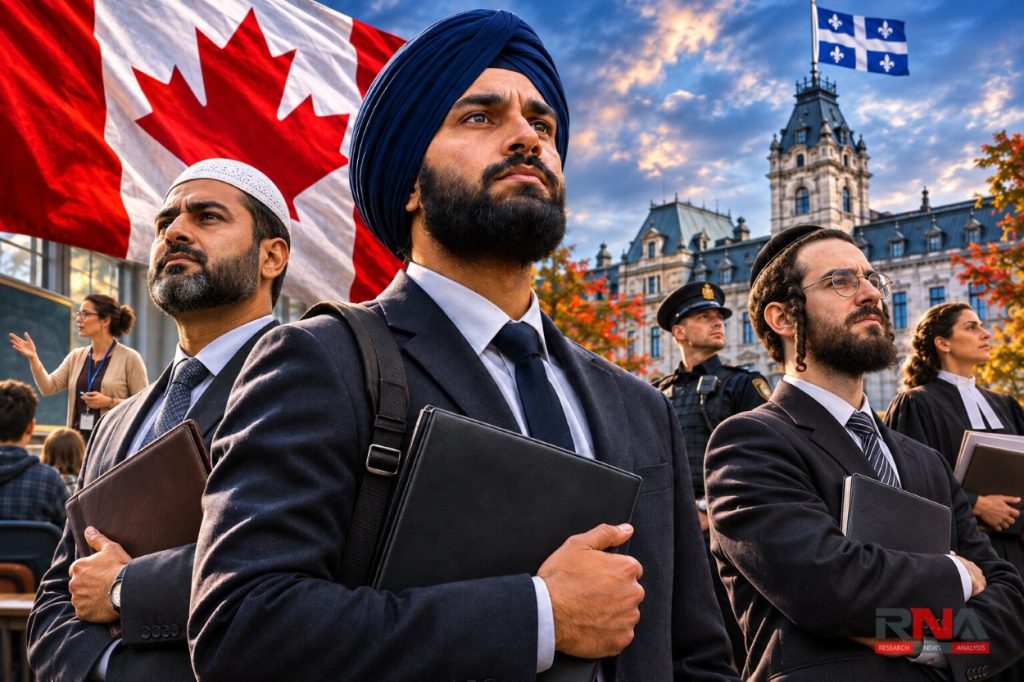
New Delhi: In a landmark judgment with far-reaching implications for religious freedom and minority rights in Canada, the country’s supreme court on Friday largely upheld Quebec’s controversial law prohibiting certain public-sector employees from wearing religious symbols at work. The ruling deals a significant blow to the province’s Sikh, Muslim and Jewish communities, leaving restrictions on access to several public-service professions in place for those who wear articles of their faith.
In a 6–1 verdict, the Canadian supreme court upheld Quebec’s constitutional authority to invoke special provisions shielding its secularism legislation, popularly known as Bill 21, from challenges under several fundamental rights guaranteed by the Canadian Charter of Rights and Freedoms. The judgment brings to a conclusion a prolonged legal battle over the legislation enacted in June 2019, although it leaves room for certain forms of judicial scrutiny.
The legislation, formally titled the Act respecting the laicity of the State, prohibits public schoolteachers, police officers, government prosecutors and several other categories of public officials from wearing religious symbols while performing their duties. These include Sikh turbans, Muslim hijabs, Jewish kippahs and Christian crucifixes.
The chief justice of Canada, Richard Wagner, defended the constitutional validity of Quebec’s legislative approach, pointing to the province’s historical commitment to secular governance. Religious organizations and civil liberties campaigners, however, have argued that the legislation effectively discriminates against citizens whose religious observances require them to wear visible articles of faith.
How Quebec circumvented constitutional protections
At the heart of the dispute is Section 33 of the Canadian Charter of Rights and Freedoms, commonly known as the “notwithstanding clause”. The provision allows federal and provincial legislatures to temporarily override certain constitutional protections, including freedom of religion, freedom of expression and equality rights, for renewable periods of up to five years.
Quebec invoked this provision when introducing Bill 21 and renewed its application in 2024. The provincial government’s pre-emptive use of the clause substantially restricted the grounds on which opponents could seek to have the legislation struck down.
The Supreme Court nevertheless ruled that judges retain the authority to examine whether legislation protected by the notwithstanding clause is incompatible with charter rights, even if such findings cannot invalidate provisions protected by the override. However, it declined to issue such a declaration in the present case.
The court also rejected arguments that Bill 21 violated the constitutional educational rights of Quebec’s English-speaking minority. It unanimously struck down the application of a separate face-covering restriction to elected members of Quebec’s National Assembly, finding that it infringed democratic rights that cannot be overridden through Section 33.
What the ruling means for Quebec’s Sikh community
According to Statistics Canada’s 2021 census, Quebec was home to 23,345 Sikhs, accounting for approximately 0.3 per cent of its population. Although considerably smaller than the Sikh communities in Ontario and British Columbia, the province has an established Sikh diaspora, particularly in the greater Montreal region.
For practising Sikhs, the implications of the judgment extend beyond restrictions on religious expression in the workplace. The turban, or dastaar, represents an integral part of Sikh religious identity and is closely associated with the religious obligation to maintain unshorn hair, making its removal a matter of conscience rather than personal preference.
Consequently, observant Sikhs aspiring to become police officers, public schoolteachers, prosecutors or hold other positions covered by the legislation face a choice between adhering to their religious convictions and pursuing their preferred careers in Quebec. The restrictions could also encourage qualified professionals to relocate to other Canadian provinces where comparable prohibitions do not exist.
The World Sikh Organization of Canada (WSO), which participated in the legal challenge, expressed deep disappointment over Friday’s judgment. Its president, Danish Singh, said the legislation had deprived practising Sikhs of employment opportunities in public service and contributed to their alienation.
One of the most prominent cases involved Amrit Kaur, a Sikh woman who completed her teacher training on the day Bill 21 was adopted. Unable to teach in Quebec’s public schools while wearing her turban, she subsequently relocated to British Columbia, leaving behind her family and the community where she had intended to work.
The legislation contains a grandfathering provision protecting eligible employees who occupied their positions on March 27, 2019, provided they continue in the same function within the same organization. However, this protection offers little relief to new entrants and can restrict the career mobility of existing employees.
The ban does not extend to all workplaces or prohibit Sikhs from wearing turbans in public spaces. Nevertheless, the WSO has reported instances of harassment and pressure on Sikhs to remove their turbans even in workplaces outside the legislation’s jurisdiction.
Quebec’s distinct approach to secularism
Quebec’s approach to secularism has its roots in the Quiet Revolution of the 1960s, when the predominantly French-speaking province underwent sweeping social and institutional changes. These included dismantling much of the Roman Catholic Church’s influence over education, healthcare and public administration.
Supporters of Bill 21 regard the legislation as a continuation of that transformation and argue that officials exercising state authority should maintain visible religious neutrality. Opponents counter that institutional neutrality should be determined by the conduct of public servants rather than their personal appearance or religious affiliation.
The verdict represents a political victory for Quebec’s sovereigntist Parti Québécois government, headed by the provincial premier, Paul St-Pierre Plamondon. It also comes at a sensitive moment for the Canadian prime minister, Mark Carney, whose government faces challenges in maintaining national cohesion amid provincial assertions of autonomy and economic tensions with the United States.
Wider implications for Canada
The judgment’s significance extends well beyond Quebec, as other Canadian provinces have increasingly invoked the notwithstanding clause to insulate contentious legislation from constitutional challenges. Friday’s decision reinforces legislative authority to use this mechanism while preserving a limited role for judicial scrutiny.
For Canada, which formally adopted multiculturalism as a national policy in 1971, the ruling exposes a fundamental tension between provincial autonomy and the protection of religious minorities. For Quebec’s Sikhs, the more immediate consequence is that several avenues of public employment remain effectively closed to those unwilling to compromise their religious observances.