


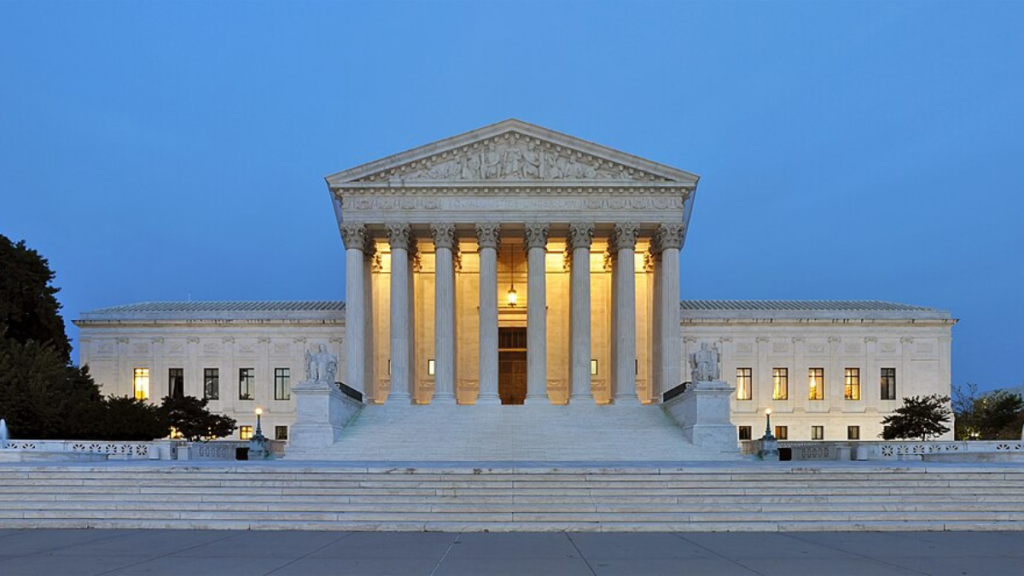
New Delhi: A divided United States supreme court on Tuesday upheld a broad conception of birthright citizenship. The ruling rejected an executive order by the country’s president, Donald Trump, that had declared children born to people in the US illegally or temporarily are not American citizens.
This judgment is being viewed as one of the biggest constitutional rulings of 2026, upholding judicial limits on the president’s executive powers, while also upholding a historically consistent interpretation of the US constitution’s 14th Amendment’s citizenship clause.
Background
The US has largely applied the principle of jus soli – “right of the soil”, which was adopted after the American Civil War in 1868 by the 14th Amendment that makes a citizen of anyone born in the country, with very limited exceptions. Under this amendment, anyone born in the United States is a citizen of the country.
On January 20, 2025, Trump signed an executive order that would stop this practice for children who are born to non-citizen parents. The executive order requires that no agency will permit US citizenship for any child born in the country where neither parent is a citizen or a lawful permanent US resident.
The Trump administration stated that such children were not “subject to the jurisdiction” of the United States, and therefore do not qualify for US citizenship under the 14th Amendment. Many states and civil rights groups promptly filed a lawsuit challenging this executive order, and lower courts issued a nationwide injunction prohibiting enforcement of the executive order on the grounds that the executive order is likely unconstitutional because it is inconsistent with the citizenship clause.
Trump’s SC appearance
Trump attended the supreme court’s arguments on April 1 – a first for a sitting president to do so – and left shortly thereafter, emphasizing the political heat of the case. Outside the court, thousands of people rallied and those protesting for birthright citizenship held banners urging the Court to protect the promise of the 14th Amendment, while those opposed to birthright citizenship were calling for immigration reform.
Supreme court Ruling
The court relied heavily on the landmark United States v Wong Kim Ark (1898) decision, which established that a child born in the United States regardless of their parent’s immigration status is a US citizen under the constitution. The court also found that the administration’s proposed domicile requirement was invalid, because the constitution provides for the policy of jus soli (citizenship by birth) as compared with jus sanguinis (citizenship by descent).
The majority also indicated that the president has no power or authority to change or affect constitutional rights by executive order; and thus, the principle of birthright citizenship as set forth in the 14th Amendment has been consistently applied since its enactment.
Justice Kavanaugh, with Justice Barrett, agreed with the outcome of the case, but not the reasoning for arriving at that conclusion. He argued that the order fell under the realm of federal immigration law and not the constitution and there are already statutes in place which provide for birthright citizenship by statute, and if the US Congress wanted to change this law, then the legislative body itself would have to amend the law, which they have not done to this point.
Reactions
The ruling was followed by a sharppolitical reactions. Trump criticized the judgment and called for legislation by Congress to restrict birthright citizenship, an indication that immigration reform will continue to be part of the President’s political agenda.
Civil rights groups, including the American Civil Liberties Union (ACLU) view the verdict as the reaffirmation of constitutional protections and the rule of law. Leaders of the Democratic Party characterized the ruling as a defence of one of the key constitutional principles of this country, while a number of Republican leaders believed that birthright citizenship encourages illegal immigration and should be reviewed by the legislature.
The reinstatement of birthright citizenship was especially welcomed by immigrant families. The Council on Foreign Relations notes that Trump’s executive order would have impacted “hundreds of thousands” of US-born children each year. The reinstatement of birthright citizenship means that those children would keep their American citizenship from birth.