


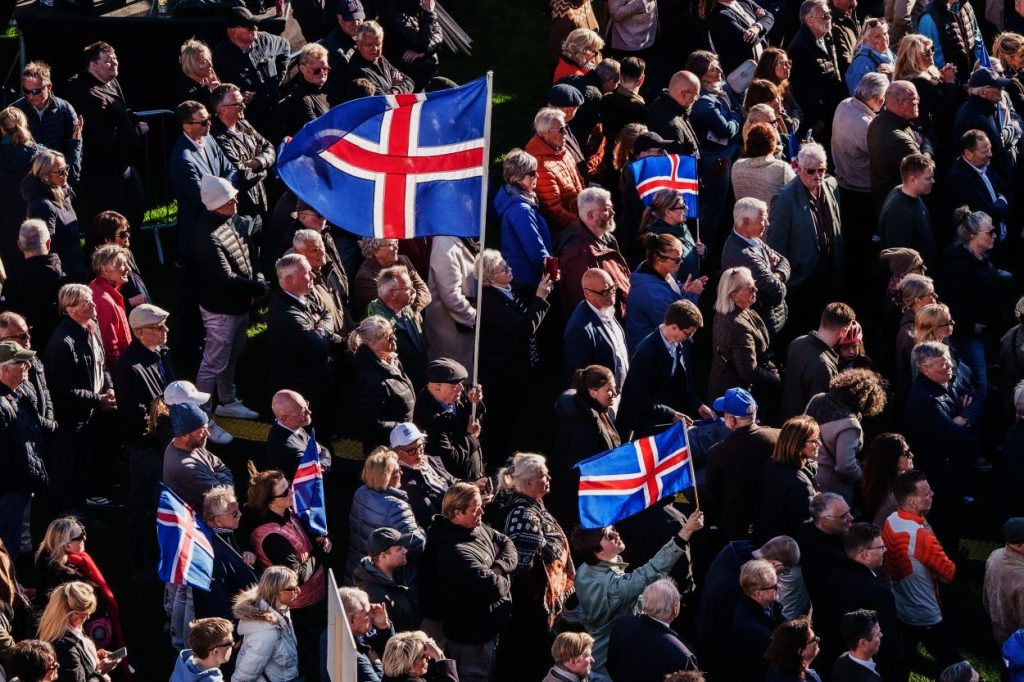
New Delhi: Icelanders have narrowly rejected a proposal to resume membership negotiations with the European Union, bringing the country’s latest attempt to reconsider its place outside the 27-member bloc to an abrupt halt. The “no” campaign secured 52.8 per cent of the vote against 47.2 per cent for “yes”, according to results reported by Iceland’s public broadcaster, RUV.
The referendum on Saturday, was not a direct vote on joining the EU but on whether Iceland should reopen accession negotiations suspended more than a decade ago. Even if voters had approved the proposal, any agreement eventually negotiated with Brussels would have required endorsement through a second referendum.
The contest exposed a pronounced geographical divide, with Reykjavík supporting renewed negotiations while every constituency outside the capital voted against them. Turnout was approximately 82.5 per cent, reflecting the significance attached to a question that has divided Icelandic politics for nearly two decades.
The prime minister, Kristrun Frostadottir, had presented the referendum as an opportunity to resolve the issue after years of political uncertainty and warned that rejection would push EU membership off the agenda. Following the result, Frostadottir acknowledged the concerns expressed by rural communities and said her government would remain attentive to anxieties surrounding agriculture, fisheries and natural resources.
Supporters argued that closer integration with Europe could give Iceland greater economic stability, reduce borrowing costs and eventually open the way for replacing the volatile Icelandic krona with the euro. They pointed to expensive mortgages and a central-bank interest rate of 8 per cent, compared with the European Central Bank’s 2.25 per cent rate, although adopting the euro would have required EU membership and further political decisions.
Opponents countered that membership could weaken Iceland’s ability to regulate its economy, negotiate independent trade agreements and exercise control over its maritime resources. Their campaign concentrated particularly on the EU’s common fisheries policy, which they feared could eventually expose Icelandic fishing grounds and quota decisions to rules negotiated in Brussels.
Fishing retains an economic and historical importance in Iceland that extends well beyond its direct contribution to employment. Marine products generated 38.9 per cent of the country’s goods-export earnings in 2025, making control over fishing waters a politically sensitive question as well as an important commercial concern.
The result does not sever Iceland’s extensive economic and political relationship with Europe, as the country remains part of the European Economic Area and the Schengen free-movement zone. Through the EEA, Iceland participates in the EU single market and incorporates much of its legislation, but agriculture and fisheries remain largely outside that arrangement.
Iceland originally applied for EU membership in 2009 after the collapse of its banking system exposed the vulnerabilities of its small economy and currency. Formal negotiations began in 2010 but were suspended by a Eurosceptic government in 2013 before the most contentious discussions on fishing and agriculture had been completed.
The debate returned with greater urgency after the centre-left coalition led by Frostadottir took office in 2024 and committed itself to consulting voters. Recent trade tensions, Russia’s war against Ukraine and the US president, Donald Trump’s, rhetoric about acquiring Greenland also strengthened arguments that Iceland needed a firmer institutional position in an increasingly contested Arctic.
Security considerations nevertheless produced less electoral traction than domestic questions about household finances, sovereignty and access to natural resources. Iceland is already a founding member of Nato and relies on the alliance and a bilateral defence agreement with the United States despite being the only Nato country without its own military forces.
Its location in the Greenland–Iceland–United Kingdom gap gives the country considerable strategic importance for monitoring naval and air activity between the Arctic and the North Atlantic. Iceland supports allied surveillance and operations from facilities including Keflavík, making it an important contributor to Nato security even without maintaining a standing military.
The outcome is a setback for Brussels, which regarded Iceland as a relatively uncomplicated prospective member with established democratic institutions and substantial alignment with EU law. It also demonstrates that strategic uncertainty in the Arctic has not displaced longstanding Icelandic concerns over fisheries, farming and sovereign control of resources.
For Iceland, the referendum settles the immediate political question but leaves the country in its familiar position – economically integrated with Europe and militarily anchored in Nato, yet unwilling to accept the obligations of full EU membership. The narrow margin also suggests that the underlying debate has been deferred rather than permanently resolved.