


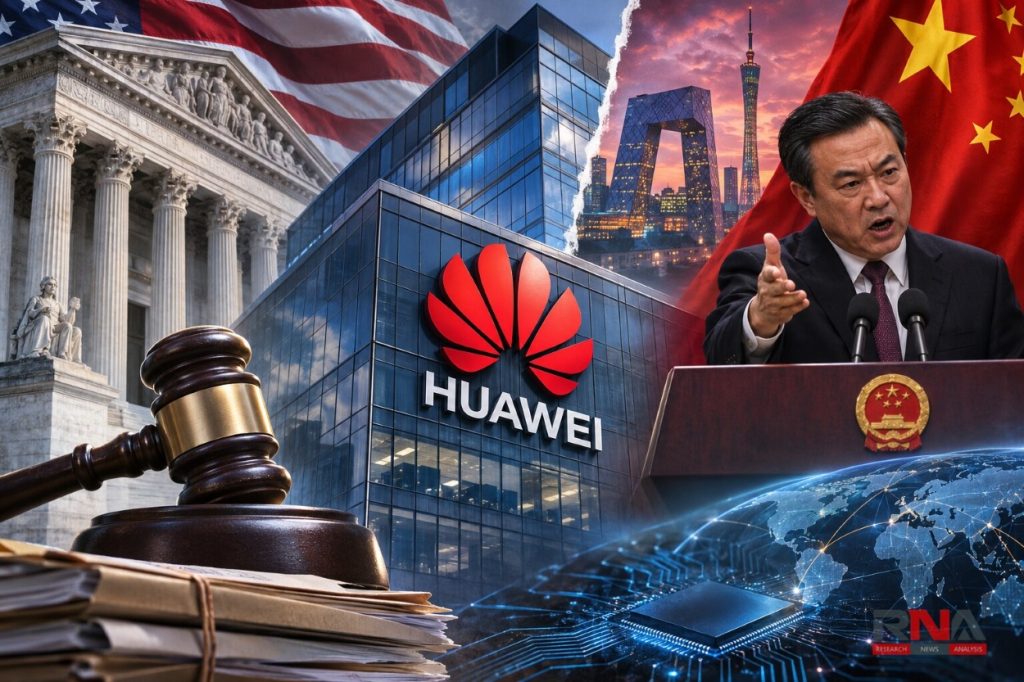
New Delhi: Chinese telecommunications and technology giant Huawei has been convicted by a United States federal jury on multiple criminal charges, including violating American sanctions on Iran, bank fraud and conspiring to steal trade secrets from US companies. The verdict, delivered in New York on Tuesday, prompted a sharp response from Beijing, which accused Washington of attempting to suppress Chinese enterprises.
The conviction marks a watershed in a nearly eight-year legal battle that has become intertwined with the intensifying technological and geopolitical rivalry between the world’s two largest economies. However, Huawei secured a significant legal victory within the broader setback, with the jury clearing the company of racketeering conspiracy and conspiracy to obstruct justice, while its lawyers indicated that they would challenge the convictions.
US jury finds Huawei guilty on 10 criminal counts
The federal jury in Brooklyn found Huawei guilty on 10 of the 12 criminal counts brought against it following a trial that lasted nearly three months. The prosecution presented more than 60 witnesses, while the defence called 15 witnesses in a case that examined the Chinese company’s international business practices stretching back over two decades.
According to the US justice department, the verdict also covered three Huawei subsidiaries – Huawei Device, Futurewei Technologies and Huawei Device USA. The offences included violations of the International Emergency Economic Powers Act, conspiracy to launder money, bank and wire fraud, conspiracy to defraud the United States and conspiracy to misappropriate commercially sensitive technology.
The US district judge, Ann Donnelly, is scheduled to pronounce the sentence on September 14, 2027. Huawei and its subsidiaries could face substantial financial penalties, including criminal fines, forfeiture of assets and compensation to affected parties, although the potential financial liability remains unclear.
How Huawei concealed its dealings in Iran
Central to the prosecution was Huawei’s relationship with Skycom Tech, a Hong Kong-based company through which the Chinese telecommunications giant conducted business in Iran. Prosecutors established that Skycom was effectively controlled by Huawei despite the latter’s representations to international financial institutions that it was merely an independent business partner.
US authorities maintained that Huawei’s misrepresentations enabled it to retain access to dollar-denominated financial services while concealing activities that exposed international banks to sanctions-related liabilities. The case illustrates the considerable extraterritorial reach of American financial regulations, particularly when transactions involving sanctioned countries pass through the US banking system.
The justice department also said Huawei had supplied technology that helped Iranian authorities monitor internet activity, restrict access to online content and conduct surveillance of protesters. These findings introduced a national security and human rights dimension to what initially appeared to be a predominantly financial fraud investigation.
Theft of American technology
Another major component of the prosecution concerned the unauthorized acquisition of intellectual property belonging to technology companies, including Cisco Systems and T-Mobile. Prosecutors argued that Huawei had sought to accelerate its technological development and reduce the costs associated with independent research by unlawfully obtaining proprietary information from competitors.
One prominent example involved T-Mobile’s touchscreen-testing technology, known as Tappy, while another concerned proprietary software used in Cisco’s networking equipment. Evidence involving semiconductor technology and antenna designs also formed part of the prosecution’s case.
The US attorney general, Todd Blanche, welcomed the verdict, maintaining that foreign corporations operating in the United States were subject to the same legal obligations as domestic businesses. American officials characterized the convictions as an important step towards protecting intellectual property, financial institutions and national security.
The case that triggered a three-country diplomatic crisis
The origins of the prosecution can be traced to investigative reports published by Reuters in 2012 and 2013 concerning Huawei’s commercial operations in Iran. The disclosures eventually contributed to a criminal investigation that escalated into an international diplomatic confrontation in December 2018.
Meng Wanzhou, Huawei’s chief financial officer and daughter of its founder, Ren Zhengfei, was arrested in Vancouver by Canadian authorities acting on a US warrant. Washington accused Meng of misleading the multinational banking group HSBC about Huawei’s relationship with Skycom.
Shortly after her arrest, Chinese authorities detained two Canadian citizens – former diplomat Michael Kovrig and businessman Michael Spavor – on espionage-related allegations. Their detention was widely interpreted in Canada and other western countries as retaliation, although Beijing rejected suggestions that the cases were politically motivated.
Meng returned to China in September 2021 after reaching a deferred prosecution agreement with American authorities, while the two Canadians were released around the same time. The charges against Meng were subsequently dismissed, but the criminal proceedings against Huawei continued.
China accuses US of suppressing its companies
Beijing reacted strongly to the convictions on Wednesday, portraying the prosecution as part of a broader American effort to restrict the international expansion of Chinese technology companies. The Chinese foreign ministry reaffirmed the government’s support for domestic enterprises seeking to protect their commercial and legal interests overseas.
Speaking at a regular media briefing in Beijing, the Chinese foreign ministry spokesperson, Guo Jiakun, said his government opposed American attempts to contain Chinese businesses. His remarks reflected Beijing’s longstanding position that Washington uses national security considerations to undermine Chinese technological competitiveness.
Huawei issued a separate corporate statement on Wednesday, rejecting the basis of the convictions and welcoming its acquittal on the racketeering conspiracy charge. The company maintained that the intellectual property disputes cited by American prosecutors had previously been settled through civil proceedings.
The Shenzhen-headquartered company said it would examine the verdicts and pursue appropriate legal remedies, while continuing its global commercial operations. Huawei also highlighted its extensive patent portfolio and cumulative investment of more than $270 billion in research and development since 2007, countering the prosecution’s portrayal of its technological growth.
Huawei at eye of US-China techn war
The verdict comes against the backdrop of an increasingly complex contest between Washington and Beijing for technological supremacy. What began as a confrontation over telecommunications infrastructure has expanded into a wider struggle encompassing advanced semiconductors, artificial intelligence, cloud computing and digital supply chains.
In 2019, during Donald Trump’s first presidential term, Washington placed Huawei on its Entity List, substantially restricting the company’s access to American technology. Successive US administrations have maintained restrictions on sensitive technology transfers to China, citing concerns over national security and the potential military applications of advanced computing.
Despite these restrictions, Huawei has demonstrated considerable commercial resilience by expanding its domestic technology ecosystem and diversifying into new business segments. Its 2025 annual report recorded revenues of 880.9 billion yuan (approximately $126 billion), with research and development expenditure accounting for 21.8% of its annual revenue.
For countries such as India, the developments have implications extending beyond the immediate US-China dispute, particularly concerning the security of critical telecommunications infrastructure. New Delhi has already introduced a trusted-source framework for telecommunications equipment, incorporating national security considerations into procurement decisions.
While Huawei’s conviction could intensify scrutiny of Chinese technology suppliers internationally, it does not automatically translate into fresh trade restrictions or invalidate the company’s existing overseas contracts. Much will depend on the outcome of the anticipated legal challenge, the eventual financial penalties and whether Washington chooses to introduce additional regulatory measures against the company.