


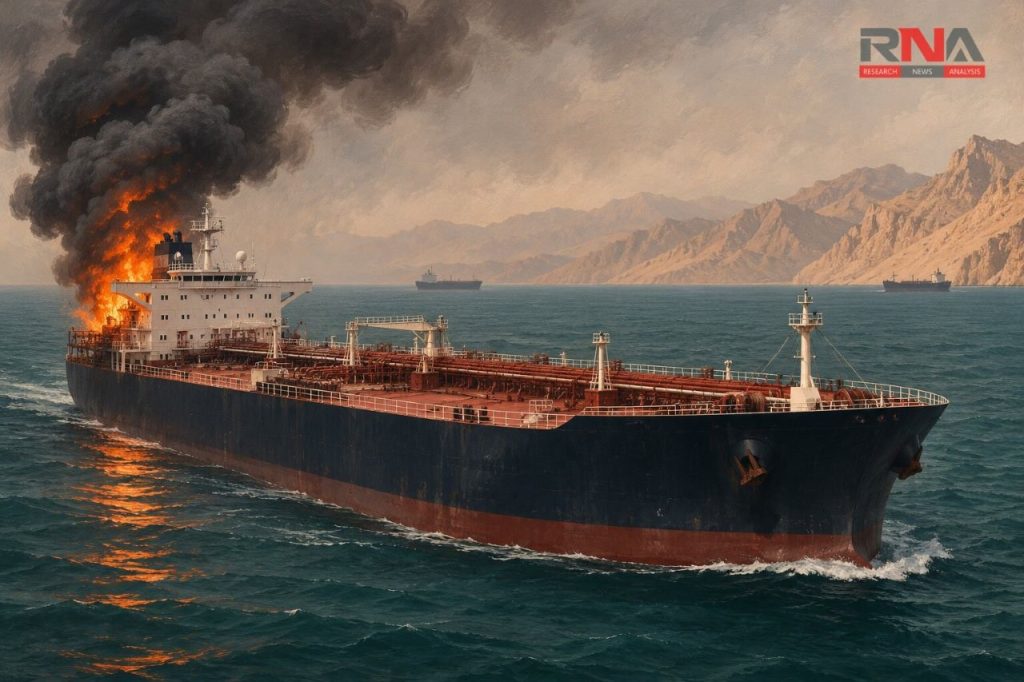
New Delhi: A succession of attacks on oil tankers and a liquefied natural gas carrier in and around the Strait of Hormuz has heightened concerns over commercial shipping, with Indian seafarers among the crews exposed to the violence. Iranian claims that 11 vessels caught fire after entering mined routes have accompanied separately documented attacks, although the available evidence does not establish that these accounts describe the same ships.
The latest reports extend beyond the strait into the northern Persian Gulf, where a tanker was struck by two unidentified projectiles, while an offshore tug was reported hit near Oman’s Musandam Peninsula. These incidents add to a late-October sequence involving the crude carriers Arzanah, Louise 1 and Riti, and the Qatari-owned gas carrier Al Mayeda.
The identities matter because reports of fires, projectile strikes and mine explosions cannot automatically be combined into a single tally. Nor does confirmation that a vessel was damaged independently establish who attacked it or validate Iran’s description of its passage as unauthorized.
Iran’s claims and the gaps in verification
On October 30, the Islamic Revolutionary Guard Corps (IRGC) navy said four tankers had caught fire while attempting to use routes it had prohibited, including a supertanker reportedly carrying more than two million barrels of crude. Reuters reported the claims but said it could not independently verify them or determine whether separate maritime alerts referred to the same vessels.
The IRGC navy subsequently said on Sunday that two more oil tankers had suffered explosions after striking mines along what it described as an unauthorized route. That announcement, carried by Iranian state media and reported by Reuters, did not provide the vessel identities needed to reconcile the claim with independently reported incidents.
On Monday, Iran’s regular navy separately reported that an unnamed tanker had struck a mine and caught fire east of the strait after switching off its navigation systems. Its account remained a military claim, with no named vessel or operator confirmation in the report available for verification.
The named vessels and their attack dates
Arzanah: Maritime security company Clearwater Dynamics identifies the Liberia-flagged crude carrier as the vessel struck by an unidentified projectile while leaving the strait in an incident dated October 28. However, the Indian minister for ports, shipping and waterways, Sarbananda Sonowal, placed the attack on October 29, leaving a discrepancy between the published chronologies. However, is possible that it happened when it was already October 29 in India and not where the incident happened. The Indian Standard Time is 1 hour 30 minutes ahead of Oman time.
Sonowal said the two Indian nationals aboard Arzanah were unharmed and that Indian authorities were coordinating with the ship management company. Available reporting does not establish that this vessel was the unnamed, heavily laden supertanker described in Iran’s subsequent mine-strike announcement.
Louise 1: Reuters, citing maritime security sources and the United Kingdom Maritime Trade Operations agency (UKMTO), dated the attack on the Panama-flagged tanker to October 29, approximately 25 nautical miles northeast of Khasab, Oman. A small boat attached two explosive devices to its hull, causing an engine-room fire and temporarily disabling the vessel before it resumed its voyage.
The devices were identified by maritime security sources as limpet mines, making this a different mechanism from a ship encountering a mine already laid in its path. Sonowal’s October 30 statement dated the incident to that day and initially described a projectile attack, while confirming that all 27 Indian seafarers and the remaining crew were safe.
Riti: Clearwater Dynamics linked the Panama-flagged crude carrier to a projectile strike during an outward transit of the strait on October 29. Oman subsequently announced on October 30 that its navy had evacuated 25 crew members from the burning vessel off Musandam and provided medical care.
The attack date and the rescue announcement should therefore be distinguished, rather than treated as evidence of two separate incidents. Reports agree on the evacuation but differ on some circumstances, including the vessel’s distance from the coast.
Al Mayeda: The clearest operator-confirmed account concerns the Marshall Islands-flagged LNG carrier, which was hit in the Persian Gulf on the evening of October 30. Its owner, Qatar Gas Transport Company, known as Nakilat, said in a statement on the incident that unidentified objects struck the ship, but no crew members were injured and no environmental damage resulted.
Nakilat said the vessel remained operational while the impact was being assessed, without identifying an attacker. Sonowal separately confirmed that its entire 25-member crew, including six Indian nationals, was safe, bringing the number of Indians reported unharmed aboard Al Mayeda, Louise 1 and Arzanah to 35.
These four named vessels provide a documented account of the recent attacks, but they do not establish the identities of every tanker mentioned in Iranian announcements. Al Mayeda is also an LNG carrier, which should be distinguished from the oil tankers cited in those claims.
Fresh attacks extend the danger
On Sunday, the offshore tug Selat Storm was struck by an unidentified projectile in the Strait of Hormuz, according to maritime security company Vanguard Tech, cited by Seatrade Maritime. A passing merchant ship relayed its distress call, and the tug was reported to be partially sinking, although the available account did not establish the crew’s condition.
A further UKMTO report, publicized on Monday, described an unnamed tanker struck on its port side by two unidentified projectiles about 72 nautical miles east of Saudi Arabia’s Ras Al-Khafji. All crew members were accounted for and no environmental impact was reported, placing another attack well inside the Gulf rather than in the strait itself.
These reports confirm that the danger encompasses different vessel types and locations, but neither should be added automatically to a tally of oil tankers allegedly burned by mines. The tug is not a tanker, and the northern Gulf incident was described as a projectile strike.
Competing accounts of maritime safety
Iran has repeatedly demanded that commercial ships coordinate their passage with its armed forces and avoid routes it designates as restricted. Its navy and the IRGC have attributed several fires to vessels ignoring those instructions, sometimes alleging that ships had disabled their tracking equipment.
The US military has offered a conflicting assessment, with US Central Command reported on October 28 as saying that internationally recognized primary transit routes remained clear of naval mines. That assurance and Iran’s warnings are claims by opposing military authorities; neither establishes the cause of every subsequent explosion or guarantees protection against projectiles and explosives attached directly to ships.
The broader shipping confrontation developed after US and Israeli attacks on Iran on February 28 and continued despite later diplomatic efforts. Subsequent agreements did not resolve disputes over navigation and maritime security, leaving merchant vessels exposed to recurring incidents.
Why the attacks matter to India
The Strait of Hormuz connects the Persian Gulf with the Gulf of Oman and the Arabian Sea, making it a critical outlet for regional energy exports. According to the US Energy Information Administration, approximately 20.9 million barrels of oil a day passed through it in the first half of 2025 – equivalent to about one-fifth of global petroleum liquids consumption.
Those figures describe pre-war trade, rather than current traffic, but illustrate the scale of the route’s importance to Asian buyers. India, China, Japan and South Korea together accounted for 74 per cent of the crude oil and condensate moving through Hormuz during that period, while the strait also carried more than one-fifth of global LNG trade.
For India, the immediate concern combines the safety of its seafarers with the security of energy deliveries through the Gulf. The confirmed welfare updates are reassuring for the crews concerned, but unresolved vessel identities, conflicting incident dates and repeated attacks leave the wider shipping picture uncertain.