


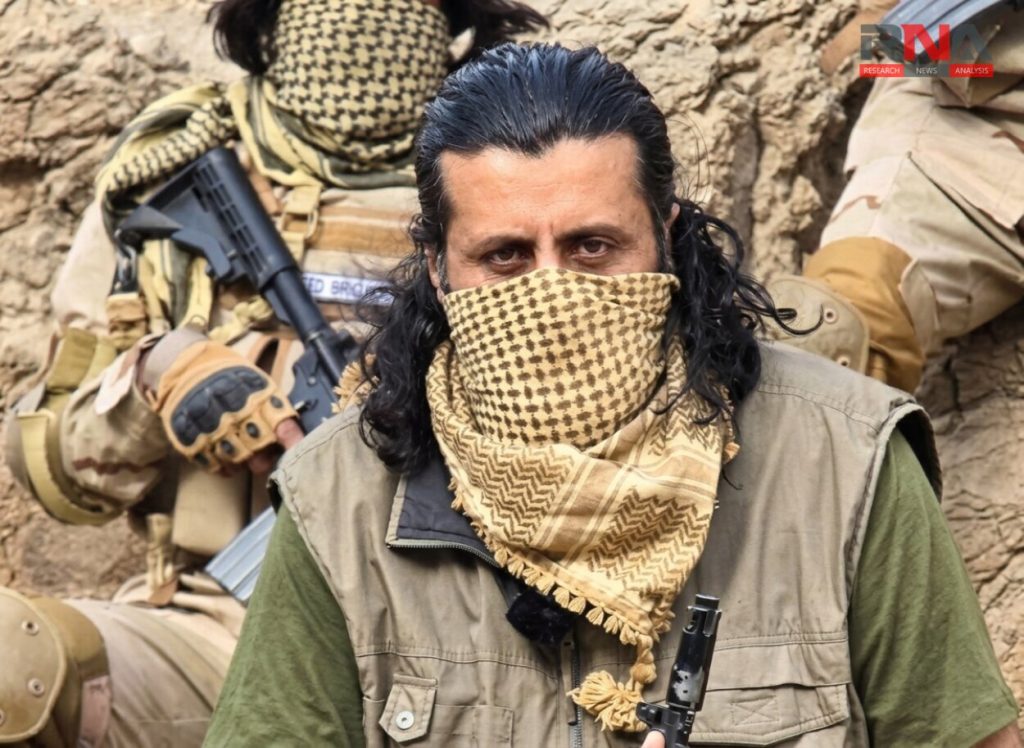
New Delhi: The Baloch Liberation Army (BLA) has appointed Rahman Gul, a former Pakistani army captain who once fought insurgents on behalf of Islamabad, as its new commander in chief, marking a significant leadership change in one of Pakistan’s most formidable separatist organizations. His elevation comes as Balochistan faces escalating militant violence, persistent tensions over Chinese investments and growing questions about the Pakistani military’s ability to contain the insurgency.
The appointment, announced on Saturday, was confirmed through a statement attributed to the outlawed organization and reported by Independent Urdu. The BLA said its senior command council had unanimously selected Gul, also known as Ustad Mureed or Mureed Baloch, following consultations with its senior commanders.
Gul previously commanded the Majeed Brigade, the BLA’s specialized suicide-attack formation, and served on its senior command council. His appointment follows the removal of Bashir Zeb Baloch, whose dismissal was announced on November 3 after an internal leadership meeting reportedly held on October 16.
A detailed profile published by the Jamestown Foundation described Gul as an influential militant strategist with extensive military experience and links to several major attacks. RNA Media could not independently verify the biographical details, military-service record or operational allegations contained in the Jamestown report.
From Pakistan’s military establishment to Baloch insurgency
According to Jamestown and the Islamabad-based Pakistan Institute for Conflict and Security Studies (PICSS), Gul joined the Pakistan Army in 2002 through the Pakistan Military Academy’s 109th Long Course. He reportedly served with the 19 Frontier Force Regiment for approximately eight years, including deployments in North and South Waziristan and along the Line of Control in the Kotli sector of Pakistan-occupied Jammu and Kashmir.
His military career reportedly included operations against the Tehreek-e-Taliban Pakistan (TTP), the militant organization that has waged a separate insurgency against Islamabad. Gul allegedly left the Army around 2010 and subsequently joined the BLA, initially operating in Balochistan’s Bolan region before acquiring command responsibilities in Kharan and Kalat.
Jamestown suggested that experiences during his military service, including his alleged exposure to the treatment of ethnic Baloch communities, may have contributed to his radicalization. However, that interpretation remains an assessment rather than an independently established explanation for his decision to abandon the military.
Born in Nushki in August 1984, Gul belongs to the politically influential Mengal tribal community and reportedly comes from a family associated with Baloch nationalist politics. His father, Mir Muhammad Afzal Mengal, contested the 2024 provincial election, while one of Gul’s brothers, Sarab Khan, has been identified in Pakistani security records as an Army officer.
Gul is also described as a Brahui-language poet and political writer whose literary activities helped establish his ideological standing within militant circles. His combination of conventional military training, tribal connections and experience in insurgent warfare distinguishes him from commanders who emerged primarily through student activism or underground political movements.
Why the leadership change matters
The transition follows reported differences within the BLA over battlefield strategy and the loss of trained fighters during large-scale operations. In a November 4 assessment, PICSS attributed Bashir Zeb’s removal partly to disagreements over Operation Herof 2, with Gul reportedly favouring smaller, more mobile formations instead of operations requiring large concentrations of militants.
If this assessment is accurate, Gul’s appointment could signal a change in operational methods rather than an immediate escalation in attack frequency. His experience with the Majeed Brigade may strengthen centralized planning and training, although there is insufficient evidence to conclude that the organization has adopted a new military doctrine.
The Majeed Brigade has been associated with attacks against Pakistani security establishments and Chinese personnel, making it particularly significant to the security of the China-Pakistan Economic Corridor (CPEC). Pakistani investigators have also named Gul in connection with attacks involving Chinese nationals, although such allegations do not establish his personal responsibility.
PICSS reports that Gul was among the accused identified in investigations into the April 2022 Karachi University suicide bombing and the October 2024 attack near Karachi airport. The BLA’s continuing hostility towards Chinese projects raises concerns for Beijing, whose investments in Balochistan have repeatedly encountered militant opposition.
Contradictory reports and mounting violence
Gul’s appointment also raises questions about earlier Pakistani media accounts claiming that he had been killed in Afghanistan. Pakistan’s Express Tribune, citing security sources, reported that Gul was killed in Helmand province on September 17, 2025, a claim difficult to reconcile with the BLA’s latest announcement.
Those earlier death reports have not been conclusively reconciled with the new information, and Gul’s reported military history remains subject to independent verification. The discrepancy underlines the difficulty of establishing reliable information about senior militant commanders operating across remote and heavily contested border regions.
The leadership change comes during an exceptionally violent period in Balochistan, where Pakistani forces have intensified counterterrorism operations. According to a Dawn report on Sunday, Pakistan’s military said eight militants were killed near Kolpur, while two soldiers, including a major, died following an attack involving armed quadcopters.
Separately, the Centre for Research and Security Studies recorded 829 violence-related fatalities in Balochistan during the third quarter of 2026, compared with 265 in the preceding quarter. These figures illustrate the broader deterioration in security, although they include deaths arising from militant attacks and security operations rather than BLA activity alone.
For Islamabad, Gul’s reported transition from Army officer to insurgent commander presents an unusual security challenge involving someone familiar with military practices and counterinsurgency operations. For Beijing, the immediate concern is whether the change consolidates the BLA’s capacity to threaten Chinese nationals and infrastructure, although the consequences of his appointment remain uncertain.