


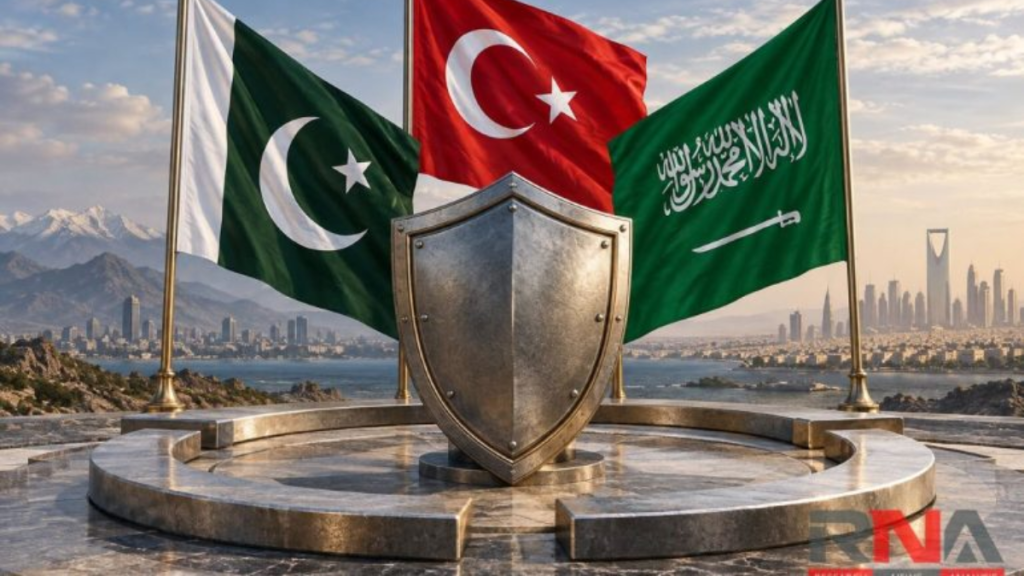
New Delhi: Pakistan’s public account of the pact changed in one respect between September 10 and October 5. It moved from saying that no military response was under discussion to agreeing to deploy forces. The change followed an event: the continuation of Houthi attacks on Saudi Arabia and the Saudi decision to seek activation.
On September 9, the defence minister, Khawaja Asif, said that if there was unprovoked aggression, or a spillover from Yemen into Saudi Arabia, the Mecca agreement would become operational. On September 10, the Foreign Ministry spokesperson, Sajjad Haider Khan, told his weekly briefing that no military reaction was under discussion and that Pakistan would act under the agreement when the time came, describing it as a defensive alliance with no plans for expansion. Reuters reported that Islamabad had warned Iran the same day to rein in the Houthis.
The weeks that followed filled in the sequence. On September 25, the prime minister, Shehbaz Sharif, told the UN General Assembly that a threat to the sanctity of Mecca and Medina was a red line and described the Houthi attack that Riyadh says targeted Mecca as one that outraged Muslims worldwide. The army chiefs of the three countries met in Riyadh the same day to discuss intelligence cooperation, military coordination and capability integration.
On October 2, Pakistan’s military said its top commanders strongly condemned Houthi attacks on Saudi Arabia. The foreign minister, Ishaq Dar, told reporters that he had briefed Iran on the pact and on how Pakistan would honour it, and that Iran had suggested engaging the Houthis politically. On October 5, after the Riyadh meeting, the Foreign Ministry said the three countries would provide the agreed forces for rapid deployment. Asif said Pakistan was in a supportive role, including reconnaissance, and that only Saudi forces were in combat.
Whether those statements contradict one another depends on how the September 10 remarks are read. One reading holds that “nothing under discussion” and “act when the time comes” cannot be reconciled with a deployment decision made 25 days later. The other holds that Pakistan described a conditional response to a trigger, and that the trigger occurred. Asif named the trigger on September 9, Sharif named the red line on September 25, and Dar told the press on October 2 that Tehran had been briefed before the committee met.
What Iran was told is documented as well. Dar said he had raised the pact with President Masoud Pezeshkian and the foreign minister, Abbas Araghchi, in New York in September. On March 3, he told the Senate that he had reminded Araghchi of Pakistan’s obligations to Saudi Arabia, and that Araghchi had responded by asking for guarantees that Saudi soil would not be used against Iran.
Iran’s public response came from the spokesperson Esmaeil Baghaei, who said on October 4 that Tehran hoped reports of a Pakistani deployment for war in Yemen were untrue. After the activation, Iran International reported, Araghchi said such agreements would not constrain Iran and Tehran was questioning Pakistan’s role as a mediator. Baghaei’s remark preceded the Riyadh meeting, while Iran International’s account of the sharper tone came on October 9, four days after the decision.
The three governments have spoken with one voice in only one document. The joint statement of October 5 said they had agreed to move immediately to practical implementation of the collective defence commitments and reaffirmed their unequivocal rejection of any attack or threat against the kingdom’s security and territorial integrity, without naming the Houthis. Prince Khalid bin Salman said the committee had agreed collective deterrence measures in response to the attacks and all those responsible for them.
The record shows two tracks conducted openly, not one conducted in secret: Pakistan told Iran what it would do and told its own public. It cannot show whether Iran accepted the explanation or whether later deployments will match the earlier descriptions. Under the joint statement, deployments are to follow national legislation. Pakistan has announced no parliamentary vote, and Türkiye’s parliament had not ratified the pact two months after signing.