


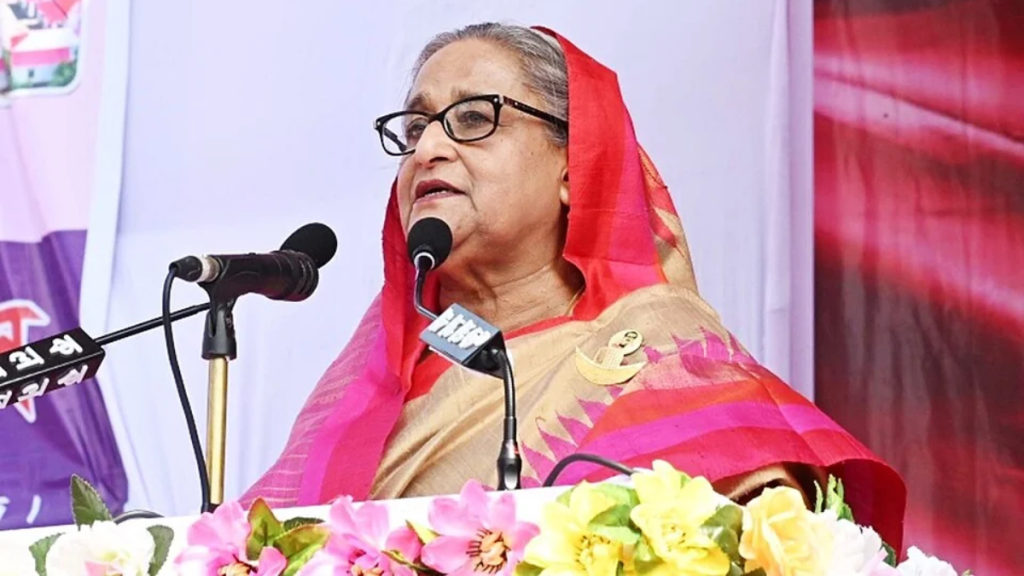
New Delhi: The former Bangladeshi prime minister, Sheikh Hasina, has invoked the memory of 1971 in a fresh attack on Dhaka’s rulers. She said Bangladeshis would have suffered “kicks from the boots of the Pakistani military” without independence.
Hasina made the remarks on Saturday from New Delhi. She spoke in an audio-only Zoom address to the 98th episode of the Awami League’s Dayamukti live series.
Hasina credited the fighters of the 1971 liberation war with the birth of the country. “Had it not been the freedom fighters of our country, this country wouldn’t have been independent,” she said.
She also took aim at the people now in power. She said that without independence, “no one would have got the chance to become the prime minister today”.
Hasina accused the Bangladesh Nationalist Party (BNP) government of targeting veterans of the war and destroying the symbols of liberation. She also alleged torture, deaths in custody and denial of medicine to prisoners.
Hasina claimed that someone killed a freedom fighter and hung his body from a tree. She gave no names, places or dates. She also called those in power “illegal usurpers of power” and urged citizens to resist them.
What is Hasina arguing?
The core of the speech was a claim: that Bengalis would still face military violence had they stayed inside Pakistan.
Her argument draws on the events of 1971. Hasina has long said Pakistan’s rulers chose repression over handing power peacefully to the Awami League after the 1970 election.
On March 25, 1971, the Pakistan Army launched Operation Searchlight to curb the Bengali nationalist movement. The crackdown set off nine months of killings across what was then East Pakistan. The death toll remains disputed.
India entered the war on December 3, 1971, after Pakistan attacked India’s western sector. About 100,000 Pakistani soldiers surrendered 13 days later, on December 16.
Return plan and the death sentence
Hasina plans to return to Bangladesh on December 16 to surrender before a court. Bangladesh’s International Crimes Tribunal sentenced her to death in absentia in November 2025. The court convicted her of crimes against humanity over the 2024 crackdown on student protesters.
The UN estimates that up to 1,400 people died in that crackdown. Hasina denied the charges and fled to India on August 5, 2024, as a student-led uprising ended her 15-year rule. The interim government banned the Awami League in May 2025.
The BNP won power in February 2026, with Tarique Rahman as prime minister. His government upheld the ban on Hasina’s party.
The speech comes amid new unrest in Bangladesh. The BNP government recently rejected her lawyers’ request for a new passport and national identity card.
Hasina applied for the passport on November 9. It marked her first official contact with Dhaka since her exile began. Bangladesh has deployed hundreds of paramilitary troops as violence spreads.
India and Bangladesh are also at odds over her future. Dhaka wants India to extradite Hasina under a bilateral treaty. New Delhi wants the Bangladesh Army to supervise her return and ensure a fresh, fair trial. The dispute has strained ties between the two neighbours since 2024.
Analysts say Hasina wants to corner the BNP government and restore her political relevance. Her main rival, BNP leader Khaleda Zia, died on December 30, 2025, aged 80.
Hasina also praised her father, Sheikh Mujibur Rahman, the country’s founding leader. She said Bangladesh would have become a developed country within 10 years had he lived.
Army officers assassinated him on August 15, 1975. Hasina and her sister escaped the massacre because they were abroad.
She said God must have kept her alive all this while so that she could return to Bangladesh and bring about change. It remains to be seen how things will turn out as Victory Day nears.