


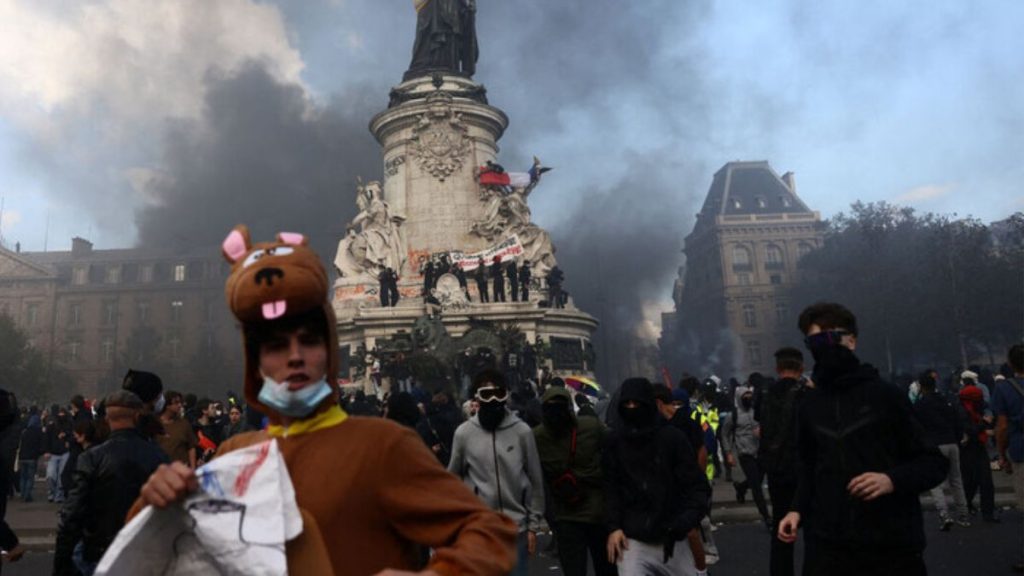
New Delhi: France’s government is confronting a widening crisis after nationwide demonstrations gave way to riots, thousands of arrests and damage to shops, while rising debt-servicing costs have unsettled investors ahead of the 2027 presidential election. Merchandise suspected of having been stolen during the unrest has also appeared on online resale sites, prompting ministers to press platforms for tougher monitoring and cooperation with police.
The violence followed weeks of student protests over understaffed schools and deteriorating teaching conditions. Demonstrations broadened to include university students, trade unions and supporters of the yellow-vest movement, with rising living costs, energy prices and public services among their grievances.
By Saturday, 550,000 people had joined demonstrations, according to the interior ministry, while organizers estimated 800,000, Chatham House reported Most marched peacefully, but rioters looted shops, set vehicles ablaze and clashed with police in Paris, Marseille and other cities. Fire severely damaged Limoges’ historic town hall.
Around 2,400 people were arrested over the weekend, according to authorities. At least 3,000 shops were damaged or looted, leaving businesses facing interrupted trading, stock losses and insurance claims. The distinction between demonstrators and those involved in violence is significant, as the original school protests had focused on grievances that predated the riots.
The French president, Emmanuel Macron, announced tighter restrictions on Thursday, saying authorities would ban what he termed illegitimate protests while permitting lawful trade-union marches, according to Reuters. Some routes could be changed to protect shopping districts, and authorities banned Saturday’s demonstrations in Lyon.
France’s debt squeeze intensifies election uncertainty
France’s public deficit was 5.1 per cent of gross domestic product (GDP) in 2025 and debt stood at 115.6 per cent, according to the national statistics institute. The government has since revised its 2026 deficit forecast to 5.4 per cent, compared with an original target of 5 per cent.
Its draft 2027 budget seeks to reduce the deficit to 5 per cent of GDP, still above the European Union’s 3 per cent reference level. The government forecasts debt at 119.3 per cent of GDP in 2026, while projected interest payments rise from €79.2 billion this year to €91.2 billion in 2027.
France’s Treasury expects financing requirements of €339.7 billion in 2027, including money needed to repay maturing debt. The scale of that requirement makes borrowing costs especially important as political uncertainty complicates passage of the budget.
On Thursday, the French 10-year government bond yield rose to approximately 5.11 per cent, having touched 5.14 per cent, its highest since 2002. The premium over comparable German bonds widened to 173.58 basis points, its largest since November 2011 Reuters reported. Higher yields mean new borrowing becomes more expensive, potentially squeezing funds for education, services and support for riot-hit businesses. The prime minister, Sebastien Lecornu, has offered affected employers access to a state-funded furlough arrangement, but uncertainty over compensation remains.
Morningstar DBRS expects insured losses from the riots to remain below €1.2 billion, assuming no further widespread violence. This is a forecast, not a verified claims total. Insurance federation France Assureurs said it could not yet estimate losses, while a planned state-backed riot-insurance scheme has not taken effect.
The budget problem is also political. Macron’s dissolution of parliament in 2024 left the national assembly fragmented, making spending cuts or tax measures difficult to pass. The president cannot seek a third consecutive term in 2027.
Gregoire Roos of Chatham House argues that the violence has further weakened France’s political centre. Marine Le Pen’s national rally has emphasized law and order, while Jean-Luc Mélenchon’s camp has drawn attention to social grievances and policing. Their explanations differ, but both challenge Macron’s government ahead of the election.
Looted goods surface on resale platforms as France seeks crackdown
The consequences of the disorder have extended beyond damaged shops. Suspicious advertisements for apparently new merchandise surfaced on resale platforms including Vinted, raising questions about how goods taken from stores may be offered to buyers online.
RTL reported that one listing showed bags of lipsticks described as Sephora products from October 17. The seller denied stealing them. Another advertisement offered a football shirt with its anti-theft device still attached shortly after a club shop in Lille was looted. Neither listing alone establishes criminal wrongdoing.
The issue, also highlighted by The New York Times on Thursday, prompted an emergency meeting on Monday involving Vinted, Amazon, eBay, Leboncoin, Meta and TikTok. The talks were led by the commerce minister, Serge Papin, and the digital affairs minister, Anne Le Hénanff, alongside representatives of the interior and justice ministries.
An official statement on Tuesday said platforms had agreed to intensify monitoring, report suspicious content, help investigators identify suspected handlers of stolen property and warn users about criminal penalties. Indicators include abnormally low prices, bulk lots of new products, visible security tags and references to looting.
The companies were asked to provide an initial account within 48 hours of removals, enforcement action and information passed to authorities. Ministers also activated VigE-commerce, an interdepartmental unit to coordinate monitoring of online sales. The statement did not announce how many listings had been conclusively traced to stolen stock.
Vinted said it was identifying and removing suspect advertisements and could permanently ban offending accounts. eBay said it could not confirm an increase in listings connected to the riots. Leboncoin said all advertisements passed automated screening before publication and that moderators examined reports, although it had no consolidated evidence of a surge in illicit listings.
For investigators, connecting an online advertisement to a particular theft may require store inventories, proof of ownership and seller information. Unusually cheap prices or intact packaging may warrant scrutiny, but cannot by themselves prove an offence.
The crackdown creates a second public-order challenge for France even as police prepare for further demonstrations. The longer-term test for the government remains whether it can protect legitimate protest, compensate affected businesses and restore confidence in public finances before voters choose Macron’s successor.