


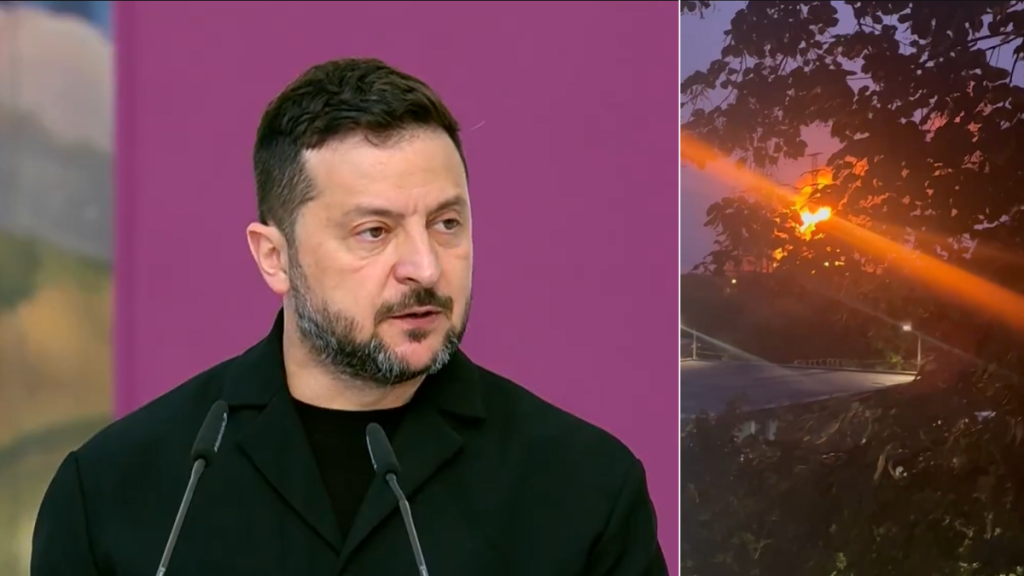
New Delhi: Ukraine has stepped up its long-range strikes deep inside Russia, targeting a rocket and space centre linked to Roscosmos, a military airbase and an oil facility in a series of attacks aimed at weakening Moscow’s military and economic capacity. The strikes, some of them hundreds of kilometres from the Ukrainian border, underline Kyiv’s growing ability to hit strategic targets far beyond the front line.
The Ukrainian president, Volodymyr Zelenskyy said Ukrainian forces struck the progress rocket and space centre in Russia’s Samara region, around 900km from the Ukrainian border. He said domestically produced Flamingo missiles were used in the attack on the Roscosmos-linked facility, which is involved in rocket technology and electronics production.
Zelenskyy also said Ukrainian forces had reached the Savasleyka airbase, about 700km from Ukraine. The base hosts Russian aircraft used to carry missiles against Ukrainian cities and villages, he said.
A third target was an oil facility at Ust-Luga, more than 800km from Ukraine, where Zelenskyy said Kyiv had confirmed the damage it had sought to inflict. The strikes form part of what he described as Ukraine’s campaign to impose long-range sanctions on Russia by reducing its ability to sustain the war.
The claims came as Russian authorities reported a major Ukrainian attack on the southwestern Samara region. Ivan Noskov, head of Samara city, said Russian had repelled a massive missile attack, but acknowledged localized damage to industrial sites and said medical assistance had been provided to people injured in the attack.
Russia’s defence ministry said its forces had shot down 598 Ukrainian drones over 19 Russian regions, as well as over the Black and Azov seas and Crimea. The scale of the reported interceptions reflects the increasing pressure on Russian air defences as Ukraine expands the geographic range of its attacks.
Ukraine’s long-range campaign has grown significantly this year, with Kyiv increasingly targeting Russian military industries, energy infrastructure and other facilities connected to the war effort. Data from conflict monitor ACLED cited in reports showed that Ukraine carried out three times as many strikes at longer ranges in July as it did in January. The expanding campaign has also forced Russia to spread its air-defence systems over a larger area.
The latest attacks were followed by further Russian strikes on Ukraine.
Russian forces targeted infrastructure at the Ukrainian ports of Odesa, Izmail and Yuzhnyi, according to Russia’s ministry. The attacks reflect the widening focus of both sides on ports, energy facilities, logistics networks and industrial sites that support their respective war efforts.
The latest escalation also came amid a separate dispute over possible Western weapons supplies to Kyiv. Moscow has sought clarification from Washington and Ankara over reports that Turkey could transfer a substantial stockpile of US weapons and ammunition to Ukraine, with Russian foreign ministry spokeswoman Maria Zakharova warning that such a move could seriously damage Russia’s relations with both countries.