


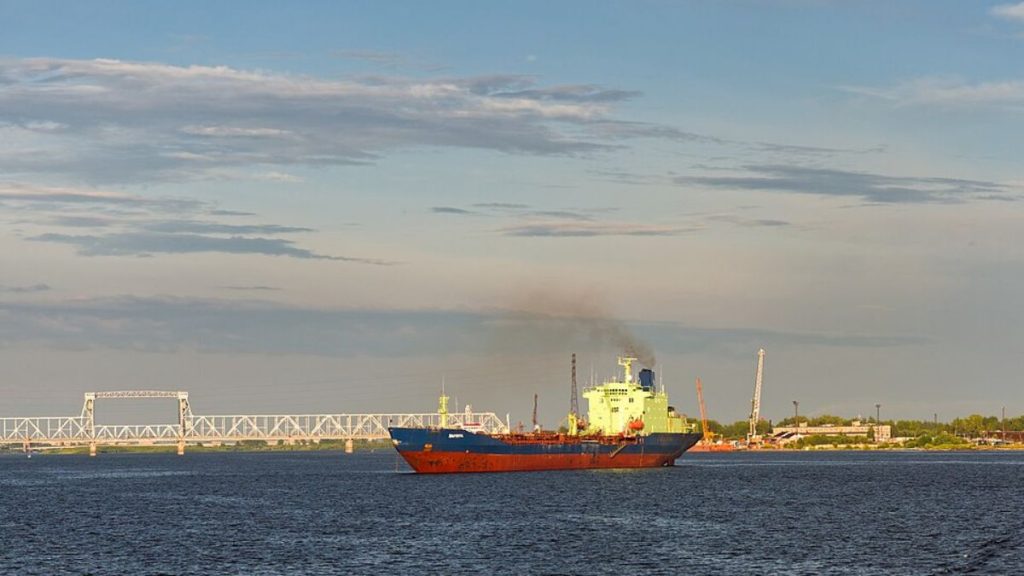
New Delhi: A Malta-flagged tanker carrying about 40,000 metric tonnes of Russian diesel has left the Baltic port of Primorsk after a supply agreement announced by the US president, Donald Trump. The ship initially listed New York as its destination and is expected to reach the US by November 7.
The Agioi Fanendes loaded ultra-low-sulphur diesel at the port on October 22, according to shipping data cited by Reuters.
The Kremlin confirmed on Friday that an initial tanker had departed without specifying its destination. “The first oil tanker has sailed off to customers, and regular supplies will continue,” the spokesperson, Dmitry Peskov, told reporters, according to the Associated Press.
On October 9, Trump announced an arrangement with the Russian president, Vladimir Putin, under which Russia would first export 300,000 metric tonnes to the US and other markets, then 500,000 tonnes in November and 1 million tonnes after that.
US sanctions eased for Russian diesel
The US Treasury’s Office of Foreign Assets Control issued General License 135 on October 9, authorizing specified transactions involving the sale, delivery, unloading and importation of Russian-origin diesel until April 7, 2027. It does not lift wider sanctions on Russia or authorize Russian crude oil imports.
Trump also threatened to ban US diesel exports to Europe unless European countries released more fuel from emergency reserves. The moves came as Washington sought to contain fuel costs before the November 3 midterm elections.
US Energy Information Administration data put the national average retail diesel price at $6.28 per gallon in the week of October 19. Energy analysts cited by AP questioned how far the Russian imports could lower prices: the tanker carries about 300,000 barrels, or roughly 7% of one day’s US diesel consumption.
Ukraine criticizes shift as Russian exports resume
The Ukrainian president, Volodymyr Zelenskyy, called Washington’s decision “a weak decision by strong partners”. Kyiv has repeatedly sought tighter restrictions on Russian energy earnings during Moscow’s invasion, while Ukrainian drone strikes on Russian refineries have also disrupted diesel output and previously caused domestic fuel shortages.
Trump asked Kyiv in September to halt the refinery strikes, according to the Associated Press.
Since the European Union barred Russian petroleum products in 2023, Moscow has shipped diesel mainly to Turkey, Brazil and African countries. After Russia lifted its own export restrictions, LSEG and Kpler data showed at least two tankers signalling Turkey and Brazil, with other Primorsk cargoes indicating Gibraltar, Port Said or the Atlantic Coast.
The Russian deputy prime minister, Alexander Novak, said further US shipments would follow as companies completed contracts. He projected that Russian diesel exports could recover to 3-3.5 million tonnes a month by the end of 2026.