


New Delhi: A roughly 750km stretch of airspace has been marked under restriction for August 19-20 through a notice to air missions (Notam), prompting speculation over a possible military activity. The notification does not identify the nature of the activity, and there is no official confirmation that the restriction is linked to any kind of missile test.
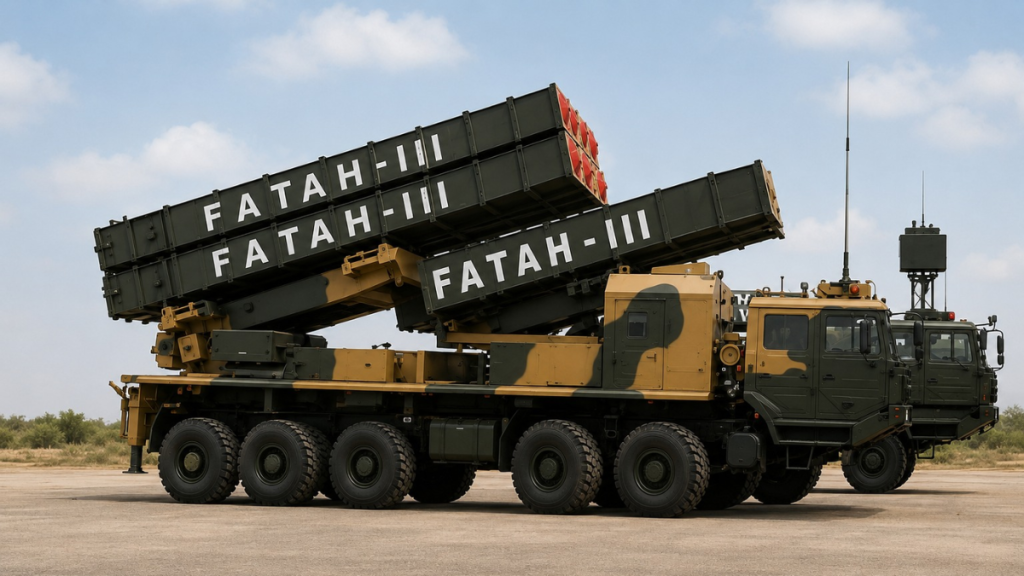
The development has also drawn attention to Pakistan’s expanding conventional strike capabilities, particularly its Fatah family of guided rockets and missiles. Media reports have speculated that the airspace restriction could be linked to a possible test of Fatah3, although there has been no official confirmation of such test.
The Fatah3 is a recently revealed member of Pakistan’s Fatah family of conventional strike systems. Unlike the Fatah1 and Fatah2, which Pakistan has publicly explained as guided rocket or surface-to-surface systems, the Fatah3 has been described as a supersonic cruise missile.
What is the Fatah3 missile?
In a video released on May 8 this year, Pakistan’s Inter-Services Public Relations (ISPR) publicly revealed the Fatah3, showing a still image of the missile mounted on a road-mobile launcher.
The Fatah3 is a ramjet-powered supersonic cruise missile developed by Pakistan as part of its conventional precision-strike arsenal. According to Quwa, the missile is assessed to be capable of sustained speeds of Mach 2.2−3.5 and is designed for land-attack and anti-ship missions. However, Pakistan has not publicly released detailed specifications for the system.
According to report, Fatah3’s range at around 290km in its export configuration, while a domestic variant could have a longer reach. By comparison, the Fatah4 is a separate ground-launched cruise missile with a reported range of 750km.
Warhead and targeting capabilities?
According to reports, Fatah3 could carry a warhead of around 240kg and be configured for both land-attack and anti-ship missions. It is believed to have a guidance system which supports different targeting modes for land and maritime targets, giving the missile flexibility in both roles.
Is Fatah3 based on Chinese missile?
The Fatah3 has similarities with China’s HD-1 supersonic missile, particularly in its overall design and propulsion arrangement. Quwa assesses that Pakistan may have used Chinese technology or components in developing the system. However, there is no official confirmation that the Fatah3 is a direct copy of the HD-1.
Pakistan’s May announcement showed the missile but did not announce a successful flight test. Reports also noted that there was no publicly observed test launch at the time of its assessment.
This is important in the context of the recent airspace restriction in Pakistan. Media reports have speculated that the August 19-20 Notam could be linked to a possible Fatah3 test.
Pakistan’s Fatah family comprises several systems designed for different ranges and strike roles. The Fatah1 is a guided rocket system with a reported range of around 140km, while the Fatah2 extends the reach to around 400km. The Fatah3 adds a supersonic cruise-missile capability to the family, while the Fatah4 is a ground-launched cruise missile with a reported range of 750km.
What is the Army Rocket Force Command?
Pakistan established the Army Rocket Force Command (ARFC) in 2025 to oversee its growing conventional long-range strike capabilities.
The command is associated with systems such as the Fatah family and is intended to give the Pakistan Army a dedicated capability for long-range conventional strikes.
The Fatah3 adds a supersonic cruise-missile capability to Pakistan’s existing Fatah family of conventional strike systems. However, its actual capabilities and operational status remain unclear.
The speculation comes amid a fresh diplomatic flare-up between Pakistan and the United States over Jammu & Kashmir. During his August 19 visit to Srinagar, US ambassador to India, Sergio Gor described Jammu & Kashmir as an “important part of India”, prompting Islamabad to summon the US chargé d’affaires and lodge a protest over the remarks, RNA Media reported.
The timing of the airspace restriction has therefore drawn attention, with the possible Fatah3 activity being viewed against the backdrop of the diplomatic tensions.