


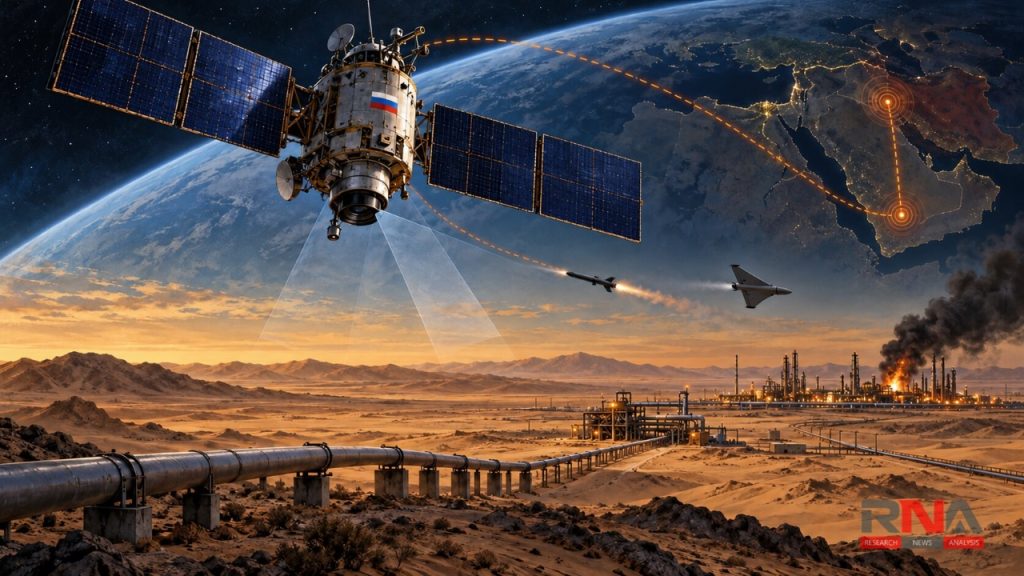
New Delhi: Russian satellite intelligence is allegedly helping Iran-backed forces strike Saudi Arabia’s energy and military infrastructure, according to an Associated Press investigation. The findings raise questions about Moscow’s role in a conflict that is threatening Gulf oil supplies.
The Geneva-based AURORAH Geosignal Intelligence examined 40 attacks between July 1 and October 19 this year, identifying Russian satellite activity around every target. However, it acknowledged that it had not intercepted intelligence transfers, leaving a gap between the observed reconnaissance patterns and proof of how information reached the attackers.
The AP investigation highlighted September strikes on East-West Crude Pipeline – also known as “Petroline” – pumping stations and King Fahd Air Base, where an Italian Eurofighter Typhoon was damaged. AURORAH reported a 50 per cent increase in Russian satellite activity around those targets compared with July.
Saudi and Houthi sources told AP that Iranian advisers passed Russian-derived targeting intelligence to allied forces, while Saudi officials also alleged Chinese involvement. Russia offered no immediate response to the latest allegations, and the accounts did not establish a publicly verifiable chain of authorization.
The allegations extend an intelligence-sharing controversy that predates the latest attacks on Saudi infrastructure. In a separate investigation broadcast in September, CNN tracked 14 Russian satellites passing over Prince Sultan Air Base two days before an Iranian attack that injured 12 US personnel and destroyed an American radar aircraft.
CNN’s sources assessed that external intelligence probably contributed to the strike’s accuracy, particularly because the aircraft had been moved from its usual position. They also suspected that Russian assistance had supported other Iranian attacks, including against a CIA facility in Riyadh, although those assessments did not themselves provide public access to the alleged targeting data.
Earlier, Reuters reported on April 7 that a Ukrainian intelligence assessment recorded at least 24 Russian satellite surveys covering 46 sites across 11 Middle Eastern countries between March 21 and March 31. A western military source and a regional security source separately told the agency that their intelligence indicated extensive Russian surveillance and the sharing of imagery with Iran.
That report also carried an important qualification from the US space-tracking company, Kayhan Space: a satellite’s passage overhead does not establish that it collected imagery. The distinction matters because identifying an orbital opportunity, confirming that a sensor was used and demonstrating that its output supported an attack are separate evidential steps.
Moscow has previously rejected similar accusations, with the Kremlin dismissing a report about satellite imagery and drone technology transfers in March. That earlier denial provides Russia’s stated position on the broader allegations, although it does not constitute a specific response to the latest findings.
The strategic importance of the pipeline helps explain why the alleged targeting support has implications beyond the battlefield. The East-West system connects Saudi Arabia’s eastern oil facilities with Yanbu on the Red Sea, allowing crude exports to bypass the Strait of Hormuz, where alternative routes remain limited.
The International Energy Agency reported that Saudi and Emirati exports through their principal bypass ports rose from 4.1 million barrels a day in February to 7.8 million in June, before falling to 5.5 million in August following Houthi attacks in the Red Sea. The subsequent shutdown of the Saudi pipeline further constrained a route that had helped compensate for disrupted Gulf shipments.
The threat continued this week, with the Houthis claiming on Tuesday that they had struck Saudi Arabia’s largest refinery with a missile. Saudi authorities had not immediately confirmed the claim, while Brent crude futures rose 1.2 per cent to $115.24 a barrel as renewed supply concerns unsettled markets.
For India, the exposure extends beyond the price of imported crude to the security of energy supplies moving through the region. According to the IEA, China and India together received 44 per cent of crude exports passing through Hormuz in 2025, while India, Bangladesh and Pakistan each depended on the strait for almost two-thirds of their LNG imports.
Taken together, the investigations suggest that the conflict’s reach may depend increasingly on access to reconnaissance as well as missiles and drones. The unresolved issue is how far the observed satellite activity can be traced through intelligence transfers to individual attacks – and who authorized that assistance.