


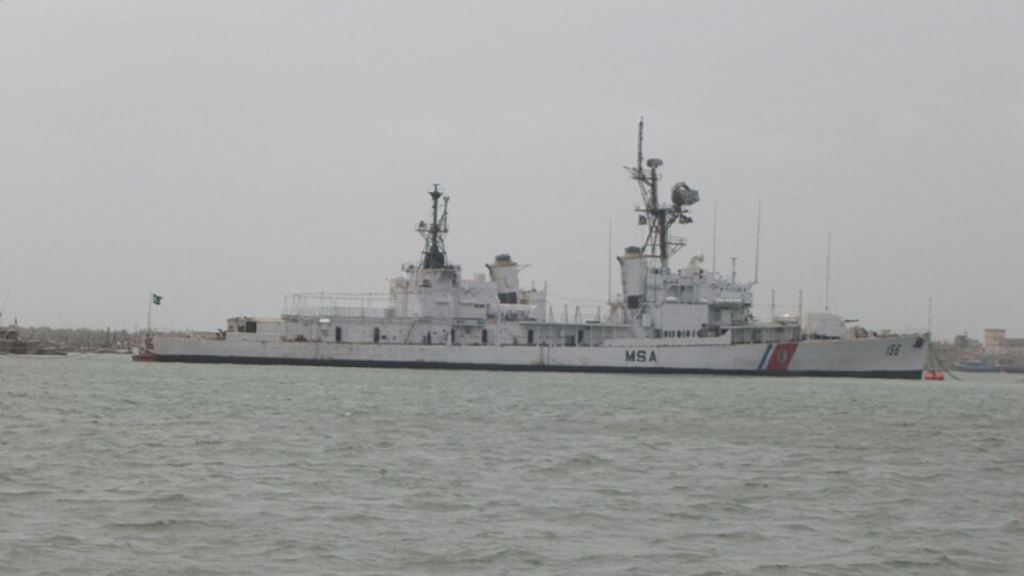
In April 2024, a sleek grey hull slid into the water at a Chinese shipyard, the first of eight Hangor-class attack submarines Pakistan is acquiring under a $5 billion deal with Beijing. By late 2025, three more had followed it into sea trials. In December, a second Babur-class corvette, PNS Khaibar, was formally commissioned. Pakistan’s naval chief, Admiral Naveed Ashraf, told Chinese state media the program was “progressing satisfactorily,” calling the newly inducted Type 054A/P frigates among the most advanced surface combatants anywhere in the fleet. By 2026, the first Hangor boat – air-independent propulsion, torpedoes, land-attack cruise missiles, a submerged endurance measured in weeks rather than days – was being formally handed over in a ceremony attended by President Asif Ali Zardari himself, who called it a “historic milestone.” Once the full order is delivered, Pakistan’s submarine fleet will roughly double, giving the Navy a persistent underwater presence it has never had in its history.
This is, on paper, one of the most consequential naval expansions Pakistan has undertaken in decades. It is also almost entirely disconnected from the actual maritime experience of ordinary Pakistanis who go to sea for a living.
On August 11, 2026, a Yemeni-flagged cargo vessel called the Tihamah, carrying food supplies through the Bab el-Mandeb Strait, was struck by Houthi ballistic missiles. It caught fire. As rescue teams moved in, it was hit again. Six people died, including three Pakistani sailors; a fourth Pakistani national was injured, later joined by five more wounded countrymen among the survivors. It took the Foreign Ministry, not the Navy, to manage the aftermath — coordinating with the Pakistani consulate in Jeddah and the embassy in Riyadh, since Islamabad has no diplomatic mission in Yemen at all. By August 20, Deputy Prime Minister Ishaq Dar was releasing statements confirming that the injured had “safely returned to Pakistan” and that the remains of the dead had been repatriated. He added, almost as an afterthought, that “the safety and security of seafarers must be ensured at all times.”
It was a strange thing to have to say out loud, nearly two weeks after the fact, by a foreign minister rather than a naval commander. Because ensuring exactly that is, on paper, a core justification for everything the Pakistan Navy has spent the last decade building.
A fleet built for the wrong kind of war
The Pakistan Navy’s official rationale for its modernization drive rests on a familiar set of arguments: safeguarding sea lines of communication, protecting Pakistan’s exclusive economic zone, deterring India in the Arabian Sea and – always somewhere in the list – “maritime security” in the broadest sense. The Navy did, in fact, deploy Tughril-class frigates into the Arabian Sea in January 2024 in response to what it called “recent incidents of maritime security,” at the height of the earlier wave of Houthi attacks on Red Sea shipping. There is a functioning surface fleet, an expanding submarine arm, maritime patrol aircraft and a growing partnership with China that gives Pakistan access to platforms few navies its size can field.
None of it, however, was built with an eye toward the specific and recurring danger faced by Pakistani seafarers: ordinary merchant sailors, deckhands and engine-room crew who serve on foreign-flagged commercial vessels passing through some of the world’s most volatile chokepoints. Submarines deter state navies. Frigates project flags and shadow rival fleets. They do very little for a Pakistani national working the night watch on a Tanzanian-flagged tanker under a Yemeni-crewed rescue effort, exposed to a militia with ballistic missiles and no obligation to distinguish combatant from bystander.
This is not a hypothetical gap. It has now produced bodies.
Prestige platforms, absent protections
The pattern is worth stating plainly, because it recurs with unsettling regularity. Pakistan supplies a disproportionate share of the global merchant marine workforce — sailors who crew ships flagged to Panama, Liberia, the Marshall Islands, Tanzania, wherever the owner finds it cheapest to register. When those ships pass through the Bab el-Mandeb, the Strait of Hormuz, or waters off Somalia, Pakistani crew are exposed to exactly the same risks as everyone else on board, but with none of the naval or diplomatic infrastructure that flag states or major shipping powers can bring to bear on their behalf. There is no Pakistani naval liaison shadowing merchant convoys through the Red Sea. There is no standing arrangement for extraction or medical evacuation of Pakistani nationals from conflict-adjacent shipping lanes. When something goes wrong, as it did in August, the response is improvised: a foreign ministry statement, a consulate scrambling in Jeddah, an embassy in Riyadh doing work that in a country with commensurate naval reach might have involved actual naval assets.
Contrast that with the volume of attention, funding, and diplomatic capital that accompanies each new frigate commissioning or submarine launch. These events come with presidential appearances, “historic milestone” rhetoric and carefully worded statements about deepening strategic partnership with Beijing. The optics are of a navy ascending — increasingly capable, increasingly blue-water, increasingly central to the country’s post-2025 defence posture after the conflict with India accelerated military cooperation with China across both air and naval domains. Yet the single most direct point of contact between the Pakistani state’s maritime posture and the lived experience of Pakistani citizens at sea remains its weakest link.
What “maritime security” should mean
None of this is an argument against naval modernization itself. A larger, more capable submarine fleet has legitimate strategic logic behind it, particularly given the regional balance with India and Pakistan’s reliance on secure sea lanes for trade. The question is not whether Pakistan needs Hangor-class submarines or Type 054A/P frigates. It is whether “maritime security,” as a phrase the Navy invokes constantly in its own communications, has actually been allowed to mean anything beyond deterrence of rival state navies.
A navy’s ambitions are usually judged by the platforms it fields and the tonnage it displaces. But there is a more basic test, one that gets far less attention in commissioning ceremonies: does the expansion of naval capability translate into a measurable reduction in risk for the country’s own citizens who make their living on the water? By that test, the record is thin. Pakistani sailors continue to die in attacks on commercial shipping with no naval mechanism dedicated to their protection. Repatriation of the dead and wounded remains a diplomatic improvisation rather than an established naval or consular protocol. The gap between what the Navy says about itself — a rising, blue-water force central to national security and what it has actually delivered for the citizens most exposed to maritime danger is not a matter of interpretation. It is visible in obituaries.
The credibility question
Every institution is entitled to pursue strategic modernization, and every navy will prioritize deterrence and power projection over less glamorous forms of protection, because that is simply how militaries are built and funded. But an institution that markets itself publicly on the language of security and protection invites scrutiny when the citizens most literally exposed to the sea are left to fend for themselves. If the Pakistan Navy wants the credibility that comes with blue-water ambitions — submarines that can stay submerged for weeks, frigates described as among the most advanced in the region, a fleet that has roughly doubled its underwater reach in a single year – it will eventually have to answer a simpler question than any it currently faces from Beijing or New Delhi: what, concretely, does any of it do for the Pakistani sailor on watch when the missile comes in low over the Bab el-Mandeb?