


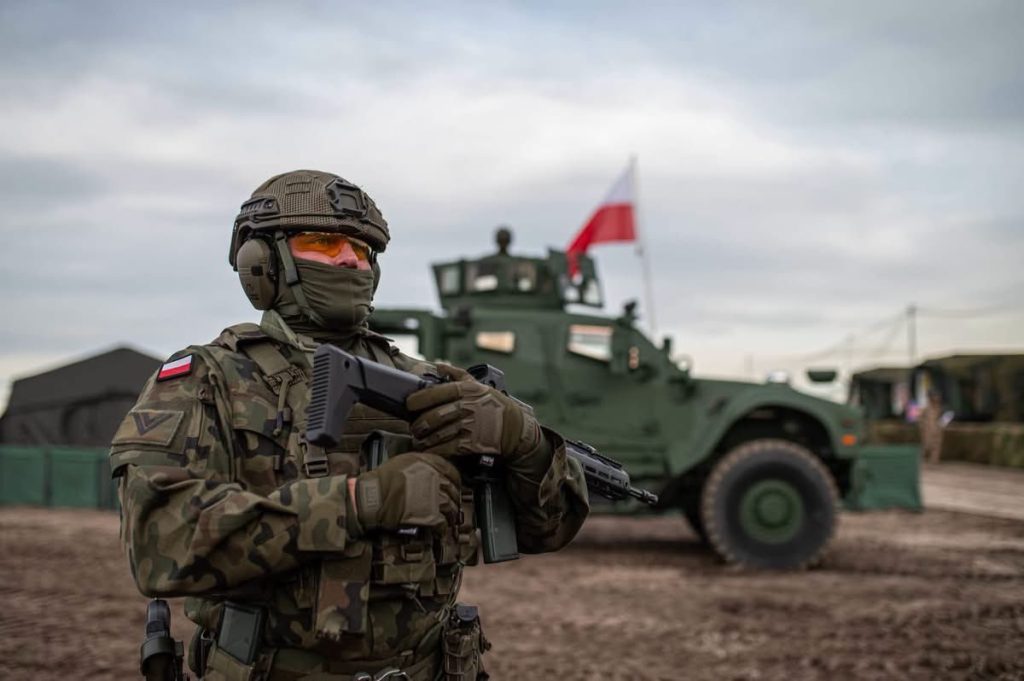
New Delhi: Thousands of European troops are conducting a major military exercise in southeastern Poland to prepare for a possible deployment to Ukraine after the war with Russia ends, marking a significant advance in Europe’s plans to guarantee Kyiv’s long-term security. The operation, led by Britain and France, comes as renewed diplomatic efforts involving the United States, Russia and China have raised questions about the shape of a future peace settlement and Europe’s role in enforcing it.
The two-week exercise, named Koalicja – 2026, began on November 9 and will continue until November 22, involving approximately 2,800 personnel from 11 European and Nato-member countries. Its principal objective is to establish whether a multinational force can be assembled, transported, commanded and sustained inside Ukraine if a ceasefire or peace agreement creates conditions for its deployment.
The exercise is being conducted under the Multinational Force-Ukraine (MNF-U), the military component of the 37-nation Coalition of the Willing, established to strengthen Ukraine’s security against future Russian aggression. Although most participating countries belong to Nato, the proposed deployment would operate outside the alliance’s command structure and would require an invitation from the Ukrainian government.
According to the British defence ministry’s operational announcement, the mission would concentrate on rebuilding Ukraine’s armed forces, improving airspace security and restoring maritime operations in the Black Sea. Unlike conventional United Nations peacekeeping operations, the proposed European force would neither monitor a ceasefire nor physically separate Russian and Ukrainian combatants.
European military preparations gather momentum
The military activities are centred on the Nowa Deba training area, approximately 100 kilometres from Ukraine’s border, where troops are rehearsing coordinated deployments, battlefield communications, counter-drone operations and logistical support. The exercise also involves fighter aircraft, surveillance drones and aerial refuelling capabilities intended to demonstrate how different national contingents could operate under a unified command.
France has contributed approximately 1,100 personnel, while Britain has deployed 300 troops, Royal Air Force Typhoon fighters and Voyager refuelling aircraft. Poland is providing extensive logistical support, while Turkey is directing a separate maritime simulation from Istanbul to practise mine-clearance operations that could eventually reopen Ukrainian shipping routes.
The exercise follows nearly a year of multinational planning and is designed to test the practical difficulties of moving military personnel and equipment across several European countries. It also examines how participating armies can integrate their command systems, communications networks and supply chains without compromising operational effectiveness.
Poland has nevertheless maintained that hosting the exercise does not mean it intends to station its own soldiers inside Ukraine after the war. Warsaw considers its principal contribution to be logistical assistance, reflecting the political sensitivities surrounding any direct European military presence on Ukrainian territory.
Russia rejects European military presence
Moscow has sharply criticized the proposed multinational force, arguing that the deployment of Western troops would create additional threats to Russian security rather than guarantee peace. The Russian foreign ministry spokeswoman, Maria Zakharova, warned that foreign military units operating inside Ukraine would be considered legitimate military targets, irrespective of their stated defensive responsibilities.
The warning exposes a fundamental contradiction in the European initiative: a force intended to prevent another Russian invasion could itself become a potential trigger for confrontation. Western military planners have consequently emphasized that participating troops would retain the right to defend themselves, raising difficult questions about the rules of engagement and the consequences of a direct clash with Russian forces.
As RNA Media reported on November 3, British and allied personnel could return Russian fire if attacked during a future deployment. Such provisions underline the distinction between a lightly armed monitoring mission and a multinational military formation expected to maintain credible defensive capabilities.
The tensions intensified on Friday when Poland reported a suspected airspace violation near its border with Ukraine, approximately 75 kilometres from the exercise area. The Polish defence minister, Władysław Kosiniak-Kamysz, suggested that the incident could represent another Russian provocation, although the origin of the unidentified object had not been independently established.
Trump-Putin-Xi summit complicates Europe’s calculations
The military preparations have acquired additional diplomatic significance following the November 19 meeting in Shenzhen between the US president, Donald Trump, the Russian president, Vladimir Putin, and the Chinese president, Xi Jinping. The unprecedented trilateral summit addressed international security and the Ukraine conflict, although it produced no publicly announced breakthrough towards ending the fighting.
According to the Chinese foreign ministry’s official account, Xi emphasized dialogue, peaceful coexistence and respect for the security concerns of major powers. Beijing has not issued a separately identifiable public response specifically addressing the military exercise in Poland, leaving its position on the proposed European deployment unclear.
Meanwhile, European leaders meeting in Berlin on November 19 reiterated that any settlement must preserve Ukraine’s sovereignty and provide credible safeguards against renewed aggression. Their joint declaration explicitly welcomed the ongoing Polish exercise and proposed a combination of sustained military assistance, American-supported ceasefire verification and European security commitments.
The German chancellor, Friedrich Merz, said the exercise demonstrated Europe’s readiness to contribute alongside Washington to securing a future peace. However, the unresolved questions of territorial control, Russian acceptance and the extent of American military backing remain substantial obstacles to any deployment.
For European governments, the immediate challenge is to transform political security assurances into a workable military arrangement without precipitating direct confrontation with Russia. The exercise demonstrates growing operational preparedness, but whether those preparations can eventually become an effective deterrent will depend less on troop movements in Poland than on the terms of a negotiated settlement and the willingness of participating governments to enforce it.