


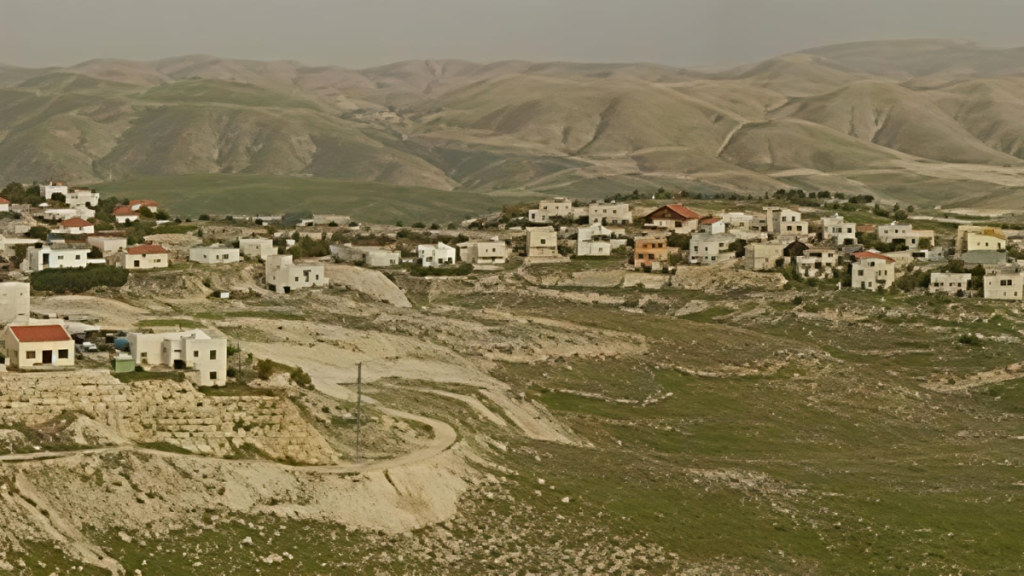
New Delhi: The European Union renewed its call on Israel on Friday to halt settlement expansion in the occupied West Bank, warning that continued construction and other unilateral steps threaten the viability of a future Palestinian state. An EU spokesperson urged Israel to stop legalizing settlement outposts, appropriating Palestinian land, and carrying out demolitions and forced evictions, saying these actions “undermine the viability of the two-state solution.”
The statement came just days after Israel’s security cabinet approved 1.3 billion shekels, worth $427.8 million, to build 34 new settlements across the West Bank. The plan spans across: nine settlements in Samaria, seven in Binyamin, four in the South Hebron Hills, seven in the Jordan Valley, six in Gush Etzion and one in the Megilot Regional Council area. It brings the total number of settlements approved under the current Israeli government to 103.
The decision was actually made back in March, but wasn’t made public until July, reportedly to avoid friction with Washington. Among the sites included are three settlements evacuated under Israel’s 2005 disengagement plan, that is, Homesh, Sa Nur and Ganim. Watchdog groups say their revival signals an effort to rebuild Israeli control in the northern West Bank and physically link Jenin with Tubas and the northern Jordan Valley.
Israel’s finance minister, Bezalel Smotrich, who has long opposed Palestinian statehood, called the funding a “settlement revolution.” Israel’s settlements minister, Orit Strock, went further, describing it as one of the most significant settlement initiatives in the country’s history.
The announcement wasn’t the only major move that week. Just days earlier, Smotrich and Israel’s prime minister, Benjamin Netanyahu, signed a separate $2.5 billion agreement with the Samaria Regional Council to expand infrastructure in the northern West Bank, funding thousands of new homes in existing settlements.
Why settlements remain such a flashpoint
The dispute over settlements goes well beyond land use. The UN, the International Court of Justice and most countries consider Israeli settlements in territory occupied since 1967 illegal under international law, a position Israel rejects. The EU has separately said it does not recognize Israeli sovereignty over the territories occupied that year.
For Palestinians, the expansion has meant years of pressure on communities that have lived in the West Bank for generations. Land is appropriated, homes are demolished, and families are displaced. Settler violence against residents, including attacks on people and property, has become something Palestinians in the territory now live with routinely.
There’s a bigger structural worry too, one that goes beyond any single settlement. In an earlier statement this year, the EU warned that Israel’s settlement policy risks the “fragmentation of the West Bank,” severing the link between its northern and southern halves and blocking a connected Palestinian urban corridor running through Ramallah, East Jerusalem and Bethlehem. As settlements multiply across the territory, EU officials argue, they don’t just shrink the land available for a future Palestinian state, they carve it into disconnected pieces.
The scale of the new funding has drawn criticism from Israeli rights groups as well. Anton Goodman of Rabbis for Human Rights said the new settlements would further cut off Palestinian access to their own land, arguing the sites are small in size but strategically placed to expand control.
Peace Now, an Israeli anti-settlement watchdog, was more critical, describing the separate infrastructure agreement with the Samaria Regional Council as “a fire sale of the State of Israel.”
No consensus yet on stronger EU measures
Despite the criticism, the EU itself remains divided over how far to go. EU foreign ministers failed this week to agree on proposals that could have restricted trade involving Israeli settlements, even as several member states pushed for tougher action. The bloc’s 27 members remain split on whether economic measures are the right response.
That internal division hasn’t stopped individual countries from acting on their own. Six European governments and Canada have separately criticized Israel’s E1 settlement plan near Jerusalem as “unacceptable,” warning companies against bidding on related construction tenders.
Violence against Palestinians continues
The EU’s warning came against a backdrop of ongoing violence in the West Bank. Two Palestinian children were taken to hospital after Israeli settlers allegedly threw stones at their family’s vehicle, leaving them with head and facial injuries. Separately, a 16-year-old Palestinian boy remained hospitalized after being shot by Israeli forces.
The EU’s foreign policy chief, Kaja Kallas, called the situation in the West Bank “really intolerable,” and said continuing developments there were making a two-state solution increasingly difficult to achieve.