


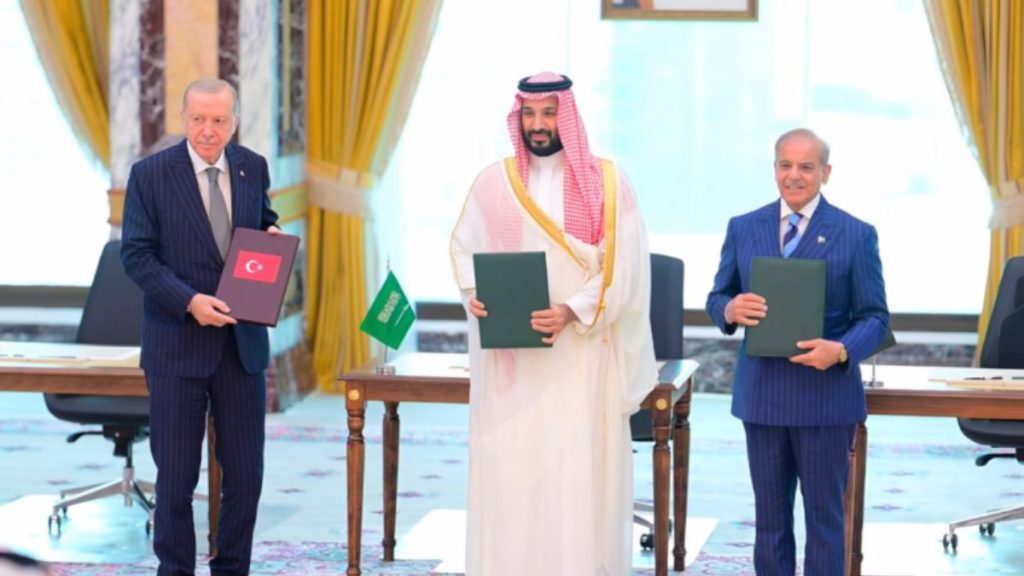
New Delhi: The Turkish president, Recep Tayyip Erdogan, has completed Turkiye’s domestic ratification of the Makkah Joint Defence Agreement with Pakistan and Saudi Arabia, advancing a pact providing for mutual assistance after an external armed attack. The presidential decision was published in Turkiye’s official gazette on Friday as representatives of the three countries prepared for talks in Islamabad.
Decision No. 12017, signed on Thursday, followed the Turkish parliament’s approval on November 5. Pakistan and Saudi Arabia had already completed their domestic procedures, according to Turkish officials. The agreement was signed in Mecca on August 7 by Erdogan, the Saudi crown prince, Mohammed bin Salman and Pakistani prime minister, Shehbaz Sharif.
Collective defence clause and its limits
Article 2 states that an external armed attack against one signatory is considered an attack against all three. However, its provision for immediate assistance specifies an attack by another country or group of countries, leaving questions over its application to attacks by the Houthis, a non-state movement.
The partners are required to assess the assistance needed and available capabilities, potentially including military means, under the United Nations charter’s self-defence provisions. The clause does not prescribe an automatic declaration of war or identical action in every situation.
Nor does Erdogan’s approval alone establish that the treaty is legally in force. Article 16 requires the final ratification instrument to be deposited with the committee’s secretariat; no confirmation of that final deposit was available on Friday.
Beyond collective defence, the treaty provides for joint exercises, personnel exchanges, counterterrorism cooperation, defence production and research. It also covers secure intelligence sharing and logistical assistance involving ammunition, fuel, spare parts and equipment.
A strategic political and defence committee of foreign and defence ministers and military chiefs will oversee implementation. Its secretariat is based in Saudi Arabia, with retired Pakistani Lieutenant General Nauman Mahmood named its first secretary general.
Islamabad talks focus on regional threats
Pakistan is hosting talks on November 27 and 28 involving Saudi and Turkish delegations, Reuters reported. Pakistani foreign minister, Ishaq Dar; defence minister, Khawaja Muhammad Asif; and army chief Field Marshal Asim Munir, are expected to participate, with intelligence cooperation and defence industry partnerships among the issues for discussion.
The alliance had already taken steps towards implementing its defence commitments. RNA Media reported in October that the three countries agreed at an emergency meeting in Riyadh to activate collective deterrence measures and prepare the rapid deployment of agreed military capabilities to Saudi Arabia.
At an emergency meeting in Riyadh on October 5, the three countries agreed to activate collective deterrence and arrange the rapid deployment of agreed military forces and capabilities to Saudi Arabia, subject to national laws, Turkiye’s foreign ministry said. Saudi defence minister, prince Khalid bin Salman, linked the decision to attacks on the kingdom and its holy sites. Turkish officials have ruled out offensive operations inside Yemen, while deploying Turkish troops to Saudi Arabia would require separate parliamentary authorization.
Asif told Agence France-Presse that “Any threat to Saudi Arabia is a threat to Pakistan and Turkey according to the pact, which is absolutely clear.” He also described the alliance as being at a nascent stage, signalling that operational procedures still require development.
The partners have different strategic strengths: Turkiye has one of Nato’s largest militaries and a growing defence industry, Saudi Arabia is a major energy exporter, and Pakistan possesses nuclear weapons. Their cooperation takes shape amid regional tensions involving Iran, Israel and the United States, while Islamabad pursues efforts to revive US-Iran negotiations.
Pakistan has described the agreement as defensive and not directed against Iran. The Islamabad discussions will test how the three governments intend to translate their commitments into practical cooperation without becoming involved in wider regional conflicts.