


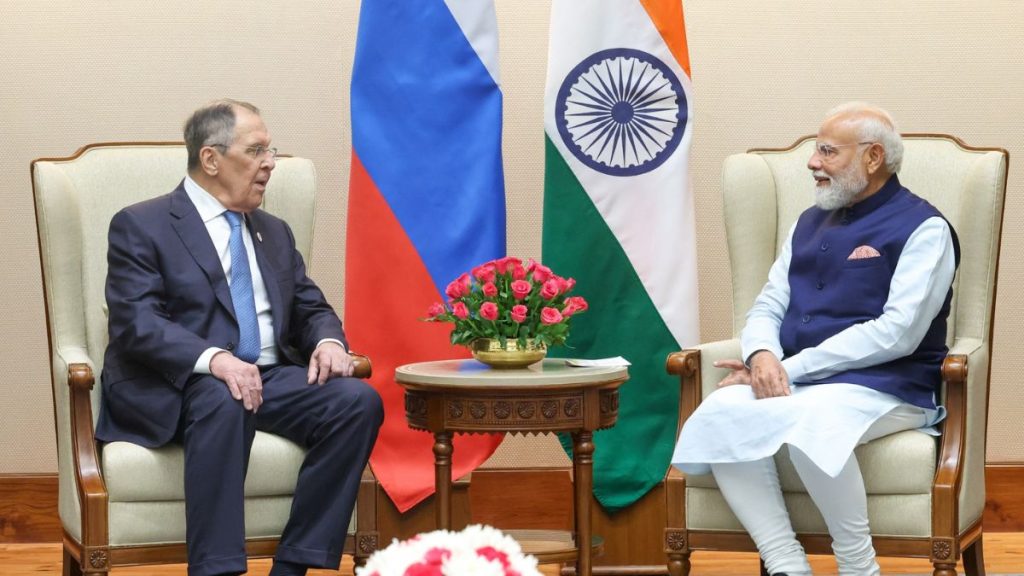
India and Russia, on Friday (May 15, 2026), decided to enhance their defence and energy cooperation when Russian Foreign Minister Sergey Lavrov discussed the “privileged strategic partnership” with Indian Prime Minister Narendra Modi and External Affairs Minister Dr. S. Jaishankar in New Delhi.
After his two-day visit to India, Lavrov told a media event in New Delhi that the detailed discussions spanned high-stakes sectors like defence manufacturing, space exploration, energy supplies, and fertiliser cooperation.
Emphasising the depth of the diplomatic engagement, Lavrov noted that he held an extended dialogue with Modi and Jaishankar. These deliberations, he noted, were anchored in the foundational agreements established during the India-Russia summit held in New Delhi last December between Russian President Vladimir Putin and Modi.
“During the talks with Jaishankar, and during a lengthy reception and conversation with Modi, we discussed the key areas of our privileged strategic partnership,” Lavrov said.
The Russian Foreign Minister confirmed that the roadmap for the future includes the joint production of weapons and intensified collaboration in the space sector, alongside critical efforts to stabilise the supply of fertilisers.
With an eye on insulating the bilateral bond from external geopolitical shocks, Lavrov emphasised that both nations are working to “improve the mechanisms of cooperation” to ensure their economic ties remain resilient against “negative, unfriendly pressure from third countries.”
Energy security remained a focal point of the briefing, with Lavrov noting that the Kremlin remains responsive to New Delhi’s energy demands.
“Our Indian counterparts always receive a positive answer to their requests for supplying more energy,” he said, adding, “It is no secret that Russian oil supplies to India have increased.”
Turning his attention to the global stage, Lavrov launched a sharp critique of “Western interference in the domestic affairs of several countries,” which he blamed for the current instability across West Asia and North Africa.
Describing the region as a “yarnball of contradiction,” he attributed the escalating tensions in Iran, Syria, Yemen, and the Palestinian territories to the “flagrant interference of Western countries.”
He claimed these disruptions were rooted in “the coups d’état that we have been observing for the last 15 years, starting with the so-called Arab Spring,” and noted that Russia “extends solidarity with Cuba.”
In a significant nod to India’s rising diplomatic stature, Lavrov suggested that New Delhi’s “vast diplomatic experience and international standing” make it a prime candidate to mediate the friction between Iran and the United States.
During their meeting, Modi had reiterated India’s steadfast support for the “peaceful resolution of conflicts” such as the ongoing crises in Ukraine and West Asia.
The Prime Minister’s Office later confirmed that the leaders reviewed the trajectory of bilateral progress since the 23rd India-Russia Annual Summit while exchanging perspectives on the shifting geopolitical landscape.
In his bilateral meeting with Jaishankar, the two sides discussed “various aspects of the India-Russia Special & Privileged Strategic Partnership, including trade & investment, energy & connectivity, science & technology, as well as facilitating mobility of skills & talents, Global and multilateral issues of mutual interest.”
“During the visit, FM Lavrov also called on Prime Minister Shri Narendra Modi on 14 May 2026. He briefed the PM on the progress in bilateral cooperation since the last Annual Summit meeting between India and Russia in December 2025,” the Indian Ministry of External Affairs said in a statement.
“The discussions also covered regional and global issues of mutual interest, including the situation in Ukraine and West Asia/Middle East. PM reiterated India’s consistent stand in favour of dialogue and diplomacy,” it added.