


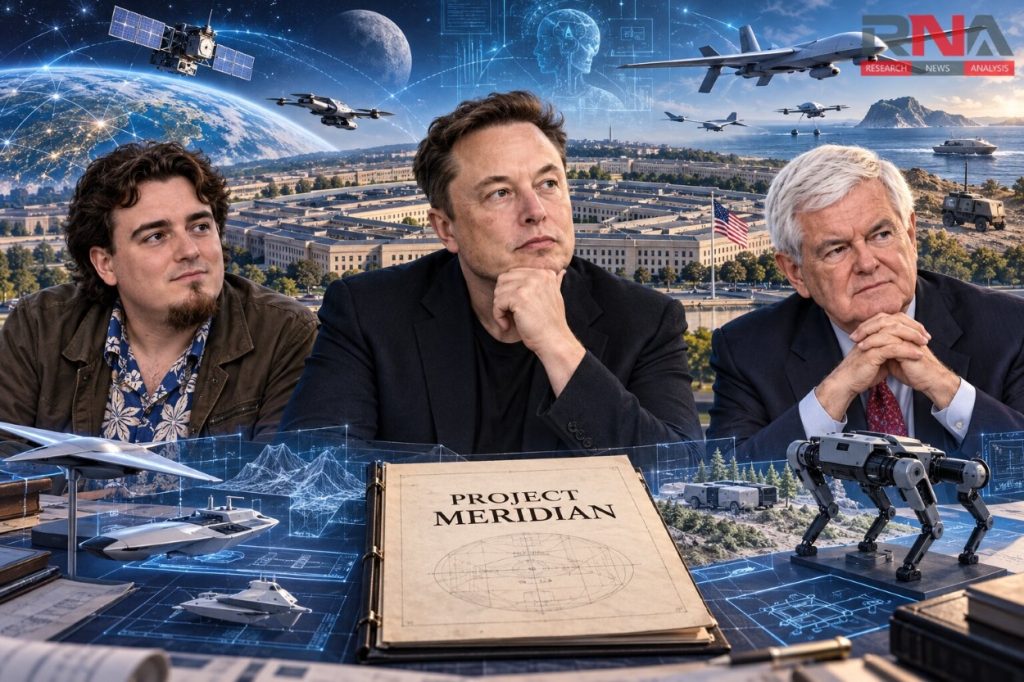
New Delhi: The Pentagon has enlisted Elon Musk to co-lead Project Meridian, a 120-day study aimed at identifying the weapons, technologies and military capabilities the United States will need on future battlefields. The US defence secretary, Pete Hegseth, announced the initiative on Wednesday, naming the Anduril Industries co-founder, Palmer Luckey, and the former speaker of the US House of Representatives, Newt Gingrich, as its other co-leaders.
Unveiled during Hegseth’s “State of the Force” address at Marine Corps Base Quantico in Virginia, the project will examine how warfare could develop over the coming years and decades. Its central task is to anticipate the capabilities American forces may require, identify gaps in their preparedness and recommend practical steps towards developing, testing and deploying emerging technologies.
The initiative will operate under the Pentagon’s chief technology officer, Emil Michael, with support from experts drawn from industry, academia and policy circles. According to the commissioning memorandum, Michael will commission the study through a partner organization whose identity was not specified in the document.
The findings and recommendations are due by January 28, 2027, giving the leadership team four months to complete its assessment. The Pentagon plans to release an unclassified report to the public, accompanied by a classified annex containing material intended for restricted circulation.
Hegseth presented the decision to involve outside figures as a response to the limitations of relying exclusively on the military establishment to forecast future conflict. He argued that the Pentagon risked introducing institutional bias by both framing the questions and supplying the answers.
The study’s remit extends across potential operating environments, including underground spaces and the region between Earth and the Moon, known as cislunar space. The official announcement describes this geographical breadth as part of an effort to prepare for military requirements beyond today’s established battlefields.
Technologies identified for examination include artificial intelligence, autonomous systems, directed energy, robotics and biotechnology. These fields give Meridian a wider remit than a review confined to drones, encompassing developments that could affect military equipment, operational support and the environments in which forces operate.
Hegseth also distinguished the project’s purpose from drafting new military strategies or government policies. Its stated emphasis is on identifying future technological requirements and ways to meet them, making the immediate deliverable an assessment and recommendations rather than a new operational command.
Musk’s involvement brings experience from a company already active in national security work through satellite and launch services. SpaceX describes its Starshield business as using Starlink technology and the company’s launch capabilities for government requirements, with an initial focus on Earth observation, communications and hosted payloads.
Luckey’s company operates in another area central to the review: software and autonomous military systems. Anduril describes its Lattice platform as connecting sensors and weapons systems, including equipment supplied by third parties, into an integrated network.
Their participation nevertheless raises questions about how commercial interests will be managed when recommendations could influence future Pentagon spending. Both SpaceX and Anduril hold defence contracts, although that existing relationship does not itself establish wrongdoing or show that Meridian’s recommendations will favour their products.
Meridian was announced alongside a separate proposal for an Autonomous Warfare Command, intended to accelerate the expansion of robotic and autonomous capabilities across the US armed forces. Hegseth said that command would be headed by a four-star officer, while the Pentagon’s accompanying plans envisage it becoming operational in October 2027.
The distinction is significant: Meridian will examine longer-term requirements, while the proposed command is intended to build and provide capabilities for military use. Together, the announcements reflect the Pentagon’s effort to shorten the distance between technological development and deployment as relatively inexpensive unmanned systems assume a larger battlefield role.
The wider context is the rapid evolution of drone warfare, particularly in Russia’s war against Ukraine, where unmanned aircraft have become central to reconnaissance and attack. That experience has reinforced concerns in Washington about relying heavily on expensive conventional platforms while adversaries expand cheaper autonomous capabilities.