


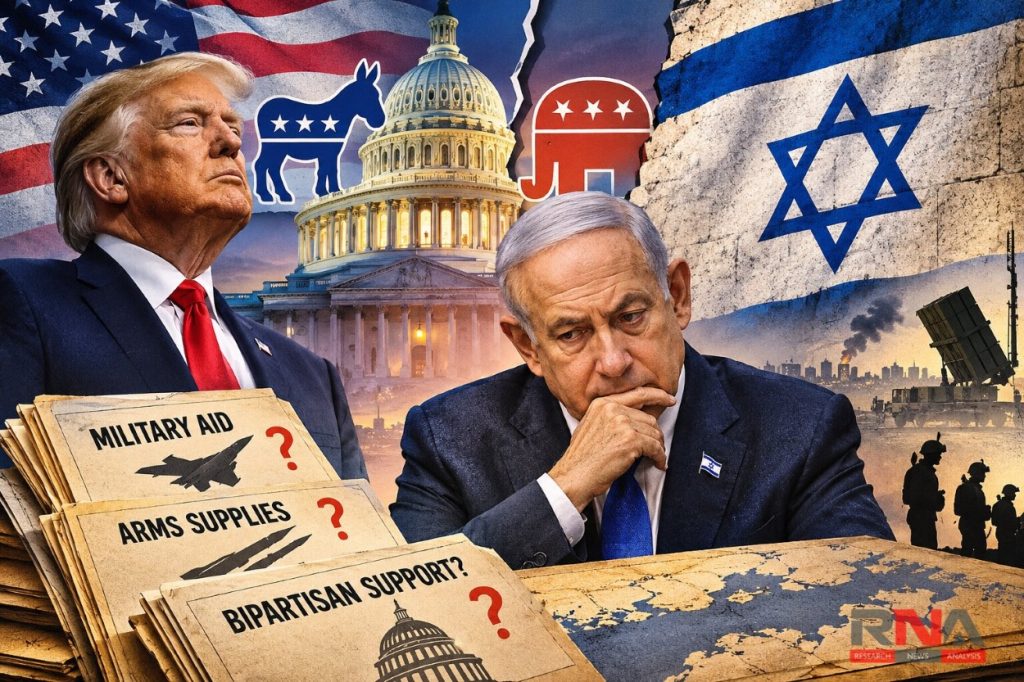
New Delhi: The Democratic Party’s sweeping victory in the United States midterm elections has unsettled Israel’s political and security establishment, raising questions about the future of Washington’s military assistance and diplomatic support for its closest Middle Eastern ally. The results have also exposed growing dissatisfaction with Israel among American voters across party lines, challenging an alliance that has traditionally enjoyed strong bipartisan backing in Washington.
The Democrats’ capture of both the House of Representatives and the Senate in the November 3 elections has given them greater influence over congressional scrutiny of American foreign policy. Although the president, Donald Trump, retains considerable authority over international affairs, the incoming Congress could complicate arms transfers, defence cooperation and Washington’s handling of conflicts involving Israel, Iran and the Palestinians.
The political change comes at a particularly sensitive moment for Israel, where parliamentary elections held on October 27 produced no clear governing majority. The prime minister, Benjamin Netanyahu, faces difficult coalition negotiations as his opponents accuse him of allowing Israel’s relationship with the United States to become excessively dependent on Trump and the Republican Party.
Growing alarm in Israel
Israeli newspapers and political commentators have described the American election results as a warning that the foundations of the bilateral relationship can no longer be taken for granted. The concern extends beyond Democratic criticism of Israeli operations in Gaza and the occupied West Bank to signs that sections of Trump’s own political constituency are questioning Washington’s commitments to Israel.
The vice-president, JD Vance, identified the United States’ relationship with Israel and the continuing war with Iran as factors contributing to Republican electoral losses. His assessment has particularly worried Israeli analysts because it suggests that calls for reassessing American support are no longer confined to progressive Democrats.
Israeli security analyst Yaakov Katz told the BBC that the implications could extend well beyond electoral politics. He warned that Israel’s dependence on American aircraft, spare parts, weapons and missile-defence systems makes any disruption to military cooperation a potentially serious operational concern.
That dependence matters because American support encompasses considerably more than direct financial assistance. Israel relies heavily on US-made combat aircraft, precision weapons, air-defence cooperation and access to advanced military technology, making continuity in supplies important to its defence planning.
Military aid under scrutiny
Trump has added to the uncertainty by announcing plans to terminate annual American military assistance to Israel earlier than previously scheduled. The announcement reportedly surprised Israeli officials, who were seeking clarification about its implications for the existing bilateral security assistance agreement.
Under the current 10-year arrangement, signed in 2016, Washington committed $38 billion in military assistance for the period ending in 2028. The package comprises $33 billion in foreign military financing and $5 billion for missile-defence programmes, although additional assistance has been approved separately over the years.
The Israeli government has presented the proposed transition away from conventional aid as evidence of a more mature defence partnership. However, the Institute for National Security Studies in Israel has warned that a successor arrangement may face substantial political obstacles, particularly as lawmakers increasingly demand accountability over Israeli policies.
Democrats could use congressional hearings, investigations, budget negotiations and legislation to scrutinize arms sales and military assistance. Nevertheless, their ability to impose fundamental changes remains constrained by Trump’s presidential veto and divisions within the Democratic Party itself.
Netanyahu faces political backlash
The election results have intensified criticism of Netanyahu’s longstanding approach towards Washington, particularly his decision to cultivate close relations with Republican leaders. Opposition figures argue that his confrontation with the administration of the former president, Barack Obama, over the 2015 Iran nuclear agreement marked a turning point in Israel’s traditionally bipartisan diplomatic strategy.
The opposition leader, Yair Lapid, has called for rebuilding relationships across America’s political divide rather than aligning Israel with one party. Another opposition figure, Gadi Eisenkot, has pledged to restore bipartisan cooperation if he succeeds in forming a government, although neither political bloc currently commands a parliamentary majority.
The controversy also reflects changing attitudes towards Israel following its military campaigns in Gaza and Lebanon and the joint US-Israeli war against Iran. Several newly elected Democratic lawmakers, including Abdul El-Sayed of Michigan, have challenged unconditional military assistance, reflecting a broader debate about the costs and consequences of American involvement in Middle Eastern conflicts.
Strategic partnership faces a test
Despite these developments, an immediate rupture in US-Israel relations appears unlikely because Trump retains executive authority over foreign policy and Israel continues to enjoy significant support within both American political parties. Washington’s ambassador to Israel, Mike Huckabee, has maintained the administration’s established positions, and Israel’s ambassador to the United Nations, Danny Danon, has emphasized the continuing importance of American diplomatic protection at the UN security council.
Nevertheless, the Council on Foreign Relations has identified the Democratic takeover as a significant development for US foreign policy during Trump’s remaining two years in office. For Israel, the central challenge will be preserving essential defence and diplomatic cooperation while adapting to an American political environment in which longstanding assumptions about unconditional support are increasingly being questioned.