


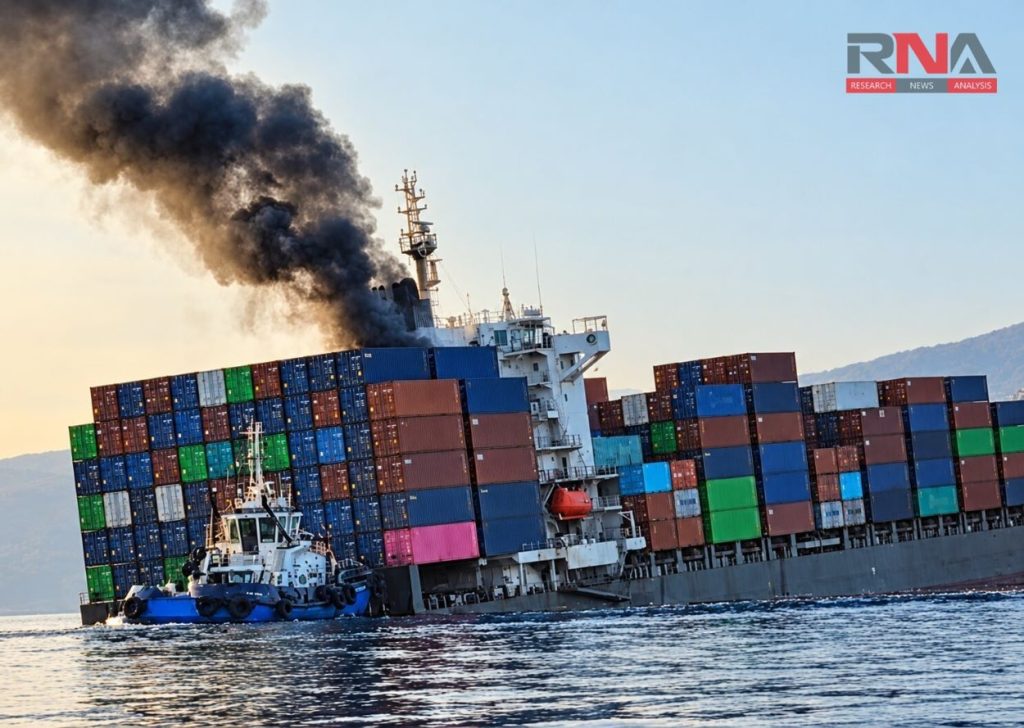
New Delhi: A Singapore-registered container ship has sunk after catching fire following a reported projectile strike in the Strait of Hormuz, adding to mounting concerns over the safety of commercial shipping through the strategic waterway. Singapore confirmed on Wednesday that all 21 crew members aboard the GFS Pride had been evacuated safely, while another Singapore-registered vessel was damaged in a separate incident.
The Maritime and Port Authority of Singapore said the GFS Pride and GFS Giselle were reportedly struck by unidentified projectiles on October 13 and October 14, respectively, according to Singapore time. The GFS Pride sustained damage and an onboard fire before sinking, while the GFS Giselle suffered hull damage but reached a safe anchorage under its own power.
All 22 crew members aboard the GFS Giselle were also safe, with no injuries reported on either ship. Singapore said it was coordinating with the vessels’ management company and condemned the attacks as violations of international law, calling for compliance with the United Nations Convention on the Law of the Sea and protection for seafarers.
The precise cause of the sinking remained disputed, with Iran presenting a different account of an apparently related incident. Its Islamic Revolutionary Guard Corps navy claimed that a container vessel had struck a naval mine while attempting to use a route Tehran described as unauthorized and dangerous, but the connection between that claim and the GFS Pride was not independently established.
A separate vessel, the Antigua and Barbuda-flagged bulk carrier Cape Dao, was reported by maritime security sources to be sinking after damage from a projectile strike on September 23, 2026. Reuters cited maritime risk consultancy Vanguard as saying a rescue attempt had failed, while the Wall Street Journal subsequently reported that the vessel had gone down, illustrating the evolving picture of losses in the area.
The incidents come during a sustained increase in attacks on merchant vessels, extending the danger beyond oil tankers to ships carrying ordinary commercial cargo. A Financial Times analysis recorded attacks on 24 vessels in the two weeks to October 11, including six targeted that day, and reported growing reluctance among shipowners to accept voyages through the region.
The escalation also has an explicitly political dimension, according to two senior Iranian officials quoted by Reuters. They said Tehran had changed its tactics to sustain high oil prices and frustrate efforts by the US president, Donald Trump, to reduce energy costs before the November 3 congressional elections.
The officials also described plans to widen operations beyond Hormuz, although their account represents Iran’s stated intentions rather than independently verified operational plans. The US Navy-led Joint Maritime Information Center assessed the threat to merchant shipping as severe in its October 11 report.
The confrontation over shipping has developed alongside the wider conflict that began with US and Israeli strikes on Iran on February 28, 2026. Tehran has restricted passage to exert pressure on Washington, while the US has imposed a naval blockade on Iranian ports and expanded economic sanctions.
For India and other Asian energy importers, the disruption threatens a supply route with few adequate substitutes. The strait connects the Persian Gulf with the Gulf of Oman and the Arabian Sea, providing the maritime outlet for substantial volumes of Gulf oil and liquefied natural gas.
According to the US Energy Information Administration’s pre-war assessment, approximately 20 million barrels of oil passed through Hormuz each day in 2024, equivalent to about one-fifth of global petroleum liquids consumption. Asia received an estimated 84 per cent of the crude oil and condensate moving through the passage, with India among its principal destination markets.
That dependence means even intermittent attacks can have consequences well beyond the vessels directly affected, through delayed deliveries, higher freight charges and increased energy costs. Although Saudi Arabia and the United Arab Emirates have pipelines that bypass Hormuz, the EIA has warned that most supplies passing through the strait lack an alternative means of leaving the region.