


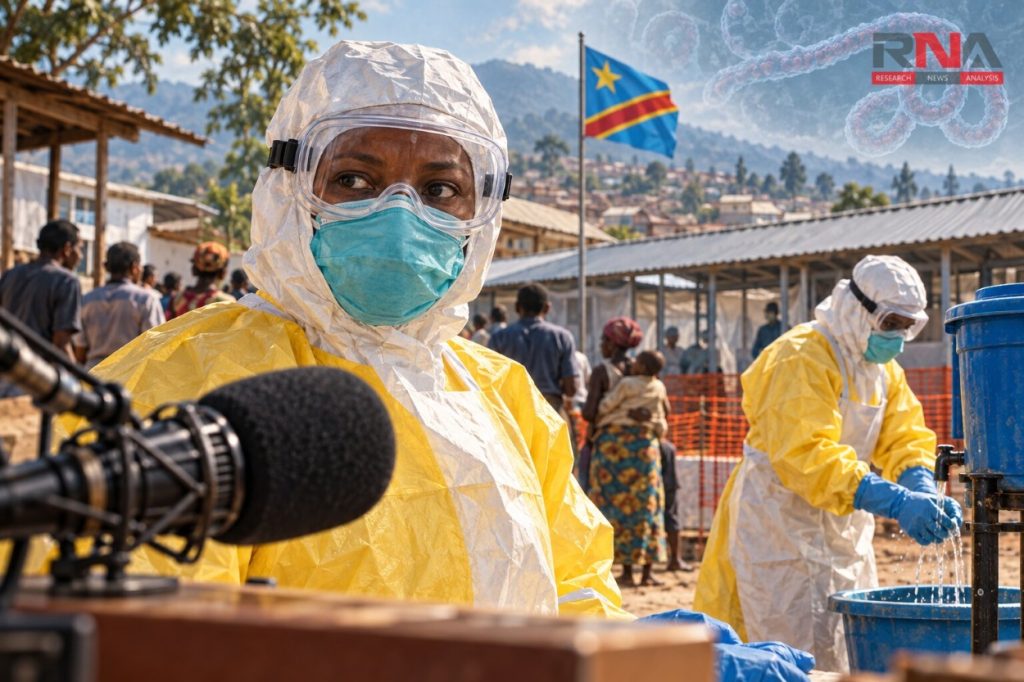
New Delhi: A politician from ruling party in the Democratic Republic of the Congo (DRC) died after being beaten following a radio appearance promoting Ebola prevention, his party said on Monday. The killing in Butembo comes as the country struggles with an outbreak that has infected more than 8,000 people, alongside violence and shortages of medical staff hampering containment efforts.
Marie-Celestin Karondwa, a local official and spokesperson for the Union for Democracy and Social Progress (UDPS), was attacked on September 27 after returning from a programme on Radio Mwangaza. According to a party statement reported by the Congolese national news agency, ACP, he had encouraged listeners to participate in efforts to combat the disease.
The party said his attackers beat him, stole his belongings and burned his home, and alleged that he was targeted for supporting its position on Ebola’s existence and danger. However, the attackers’ identities, their number and their motive had not been independently established, Reuters reported.
The UDPS federation in Butembo demanded an investigation to establish the circumstances of the killing and bring those responsible to justice. Its statement also urged party members and residents to remain calm and respect the law, as the city confronts one of the country’s most serious Ebola hotspots.
The previous day, armed assailants attacked a handwashing checkpoint in nearby Beni territory, killing at least one person and injuring others, a civil society group said. That incident adds to the violence confronting efforts to contain Ebola in eastern Congo.
Resistance has also affected teams responsible for safely burying Ebola victims, whose bodies can remain infectious. An earlier Associated Press report described exhausted burial workers facing hostility from bereaved families upset by restrictions on traditional funeral practices.
Ebola spreads across seven DR Congo provinces
The latest health ministry figures, covering the period up to September 26, recorded 8,067 confirmed infections and 3,901 deaths across 63 health zones in seven of Congo’s 26 provinces. The reported deaths represent more than 48 per cent of confirmed cases, according to the AP’s latest outbreak update.
Declared on May 15 this year, the outbreak is caused by Bundibugyo virus, one of several viruses responsible for Ebola disease. It has become Congo’s deadliest Ebola outbreak, although the 2014–2016 West African epidemic, which killed more than 11,000 people, remains the deadliest globally.
The national picture conceals considerable regional variation. It recorded that between August 31 and September 20, cases fell by 26 per cent in Ituri and 15 per cent in Haut-Uele, while North Kivu recorded a 73 per cent increase. The World Health Organization (WHO) subsequently noted early declines in North Kivu but cautioned that the outbreak remained uncontrolled across a wide area.
Staffing remains a serious constraint even where additional treatment beds are available, with facilities lacking enough personnel and operational partners. WHO also reported particularly severe outcomes among children under five, whose case fatality rate exceeded 60 per cent, compared with approximately 40 per cent among adults.
According to Africa’s public health agency, 50 health workers have died since the outbreak began, while delayed or unpaid wages have prompted strikes. The crisis is also disrupting ordinary medical services: the UN humanitarian coordination office reported a 13 per cent decline in routine primary healthcare services in Ituri between April and June, with both operational pressures and patients’ fear contributing.
Vaccination of frontline workers began in Bunia on September 19, using Ervebo under a compassionate-use programme. However, Ervebo is licenced against the Zaire Ebola virus, and its deployment should not be confused with established protection against Bundibugyo, for which there is no licenced vaccine or specific treatment.
Research is intended to establish whether Ervebo provides protection against the virus driving this outbreak, while other vaccine candidates are being developed. WHO said earlier this month that an observational study and a planned clinical trial would help assess its effectiveness against Bundibugyo.
The absence of an approved virus-specific medicine does not mean patients cannot benefit from treatment. WHO guidance emphasizes that early supportive care, including rehydration and management of symptoms, improves survival. Containment also requires prompt detection, contact tracing, infection control, safe burials and community cooperation – measures that depend on residents trusting and being able to reach health teams.