


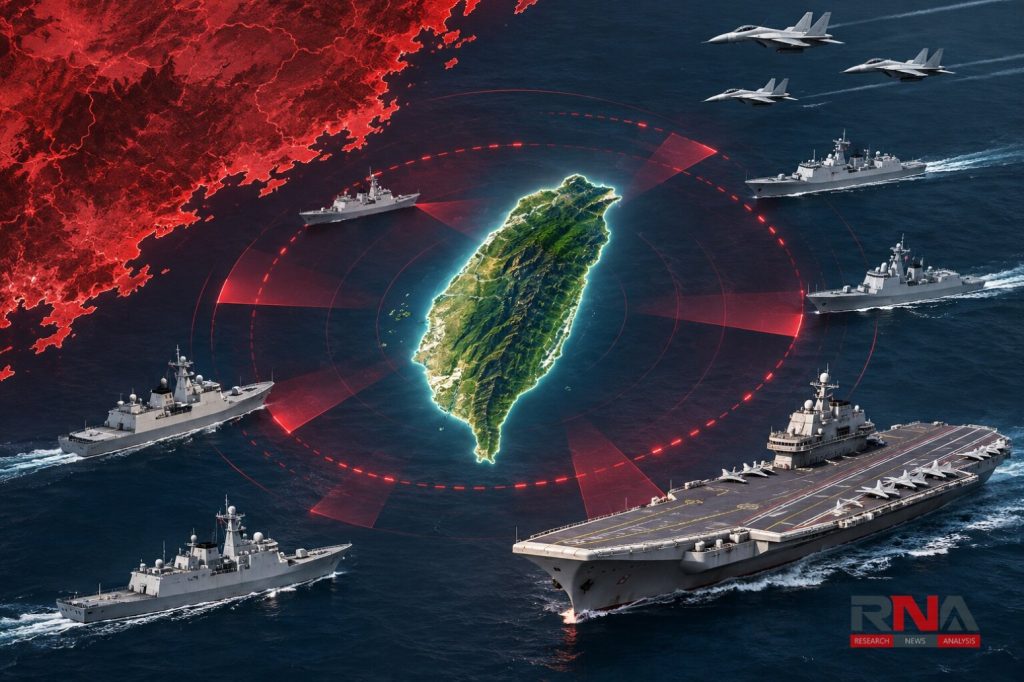
New Delhi: China has conducted one of its largest naval mobilizations around Taiwan and across the western Pacific without formally announcing military exercises. This has raised fresh concerns that Beijing is refining its ability to blockade the self-governed island and deter foreign intervention.
The operation, involving more than 100 naval and coast guard vessels at its peak, included simulated attacks on military targets and urban centres, according to Taiwanese security officials, who described the deployment as a calculated campaign of intimidation.
The exercises, carried out in early November, involved Chinese naval formations operating across a vast maritime area extending beyond the Taiwan Strait into the western Pacific. A senior Taiwanese security official told Reuters that the deployment exceeded the scale of China’s formally announced Justice Mission 2025 exercises, suggesting that Beijing had significantly expanded both the geographical reach and operational complexity of its military activities.
Unlike previous exercises accompanied by public warnings, designated operational zones and official military announcements, the latest mobilization proceeded without Beijing formally identifying it as a coordinated operation. Taiwanese officials believe this deliberate absence of publicity allowed China to demonstrate its military capabilities without generating the diplomatic confrontation normally associated with large-scale exercises around Taiwan.
A foreign intelligence source familiar with the developments similarly suggested that the approach enabled Beijing to exert sustained military pressure without attracting an immediate international response. However, China’s defence ministry has not publicly confirmed the reported scope of the operation, and the Taiwanese account of the simulated attacks has not been independently verified.
The exercises reportedly involved the eastern, northern and southern theatre commands of China’s People’s Liberation Army, bringing together naval formations normally responsible for different operational regions. Such coordination is particularly significant because a military blockade of Taiwan would require China to control maritime approaches while simultaneously preventing reinforcements from reaching the island.
Taiwanese officials also reported that a Chinese submarine launched an intercontinental ballistic missile from the Yellow Sea towards Chinese territory during the broader period of military activity. If confirmed, the launch would add a strategic dimension to the exercises, although the reported connection between the missile launch and the naval mobilization remains unverified.
Chinese deployment continues
Although the number of Chinese vessels operating across the region has declined from its early-November peak, substantial forces remained deployed on Friday. Two Taiwanese security officials estimated that approximately 70 vessels were still operating within the first island chain – the strategically important maritime arc extending through Japan, Taiwan and the Philippines.
Taiwan’s national security council secretary-general, Joseph Wu, said Chinese naval formations from three theatre commands, together with the Liaoning aircraft carrier strike group, continued operating in waters east of the Philippines. He also reported sustained Chinese military aviation activity near Taiwan, indicating that the reduction in surface vessels did not necessarily represent the conclusion of the wider operation.
The latest daily assessment issued by Taiwan’s defence ministry on November 13 recorded 30 Chinese military aircraft sorties, eight naval vessels and three other official ships operating around Taiwan during the preceding 24 hours. Of the aircraft sorties, 23 crossed the Taiwan Strait’s median line and entered sectors of Taiwan’s air defence identification zone, prompting monitoring by Taiwanese aircraft, naval vessels and coastal missile units.
Taiwan’s defence minister, Wellington Koo, had confirmed earlier this week that Chinese forces were conducting anti-access and area-denial exercises involving the Liaoning and other naval formations. Such operations are designed to restrict an adversary’s freedom of movement and, in a Taiwan conflict, could complicate attempts by American or allied forces to approach the island.
China has maintained that the Liaoning’s western Pacific activities constitute routine training intended to improve its long-range operational capabilities rather than threaten any particular country. Beijing considers Taiwan part of its territory and has repeatedly expressed a preference for peaceful reunification, although it has never renounced the possible use of force.
Strategic pressure ahead of Trump-Xi meeting
The timing has added a diplomatic dimension to the military developments, with China preparing to host the Asia-Pacific Economic Cooperation (APEC) leaders’ summit in Shenzhen next week. The gathering is expected to bring together the US president, Donald Trump, and China’s president, Xi Jinping, for their third meeting this year, placing Taiwan’s security and regional stability against the backdrop of broader US-China relations.
In a policy address on November 12, Xi reiterated Beijing’s objective of peaceful reunification with Taiwan without explicitly discussing military force. Nevertheless, the simultaneous deployment of substantial Chinese forces suggests that Beijing continues to combine diplomatic messaging with military pressure, maintaining several options for influencing developments across the Taiwan Strait.
The strategic implications extend beyond Taiwan because the surrounding waterways are critical to Asian commerce, energy shipments and international supply chains. A 2025 study by the Center for Strategic and International Studies estimated that approximately $2.45 trillion in goods passed through the Taiwan Strait in 2022, representing more than one-fifth of global maritime trade.
For India, the developments reinforce concerns about the security of the Indo-Pacific’s principal maritime corridors and the growing operational reach of the Chinese Navy. The participation of multiple Chinese theatre commands also underlines Beijing’s efforts to develop coordinated naval operations far beyond its immediate coastline, with implications for the wider regional balance of power.
The immediate concern for Taiwan is that increasingly frequent, large-scale exercises could gradually normalize Chinese military deployments around the island, making it harder to distinguish routine coercion from preparations for an actual blockade. Whether or not the latest manoeuvres represent a rehearsal for military action, their scale and lack of advance notification demonstrate how Beijing can apply pressure without formally declaring an escalation.