


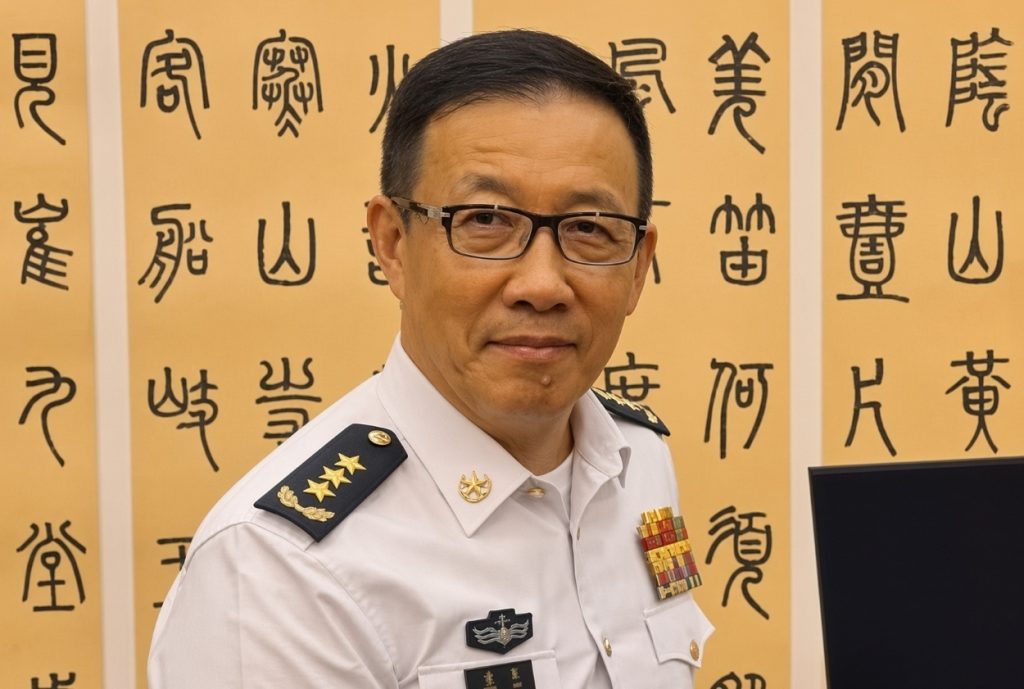
New Delhi: China’s defence minister, Admiral Dong Jun, used the opening of Beijing’s flagship security conference this week to caution against a return of “hegemony, militarism and historical revisionism”, in remarks widely read as a coded rebuke of Japan. The address, delivered on Tuesday, set the tone for the 13th Beijing Xiangshan Forum, a three-day gathering that has become China’s answer to Singapore’s Shangri-La Dialogue.
Dong, who is an admiral in the People’s Liberation Army – Navy (PLA-N), told delegates that the world must never forget the lessons of history and must stay alert to any resurgence of old patterns of domination. He did not name Japan directly, but the timing and language left little doubt about the intended audience.
Ties between Beijing and Tokyo have sunk to their lowest point in decades. The rupture followed remarks by Japan’s prime minister, Sanae Takaichi, roughly 10 months earlier, in which she suggested Tokyo could intervene militarily if a crisis over Taiwan turned violent.
That statement drew a furious response from Chinese officials at the time and has coloured almost every subsequent exchange between the two governments. Dong’s speech in Beijing appears to have been calibrated to keep that pressure on, without crossing into open confrontation.
According to Chinese state media, Dong urged countries to check what he called the resurgence of regressive historical trends and to cease provocative acts. He described the current moment in world affairs as a fragile one, calling for a fresher and more equal approach to resolving international disputes.
Notably, he offered few specifics and avoided direct criticism of either the United States or its allies by name. Analysts covering the forum said this restraint was deliberate, given that China’s president, Xi Jinping, is due to travel to Washington later this month for a meeting with the American president, Donald Trump.
Japan, by contrast, appears to have become the more convenient target. Singapore-based security researcher James Char has noted that strained relations between Beijing and Tokyo make Japan an easier subject for pointed rhetoric at a moment when Beijing is keen to avoid antagonising Washington ahead of the Xi-Trump summit.
The forum itself drew hundreds of military officers, diplomats and scholars from dozens of countries. A North Korean delegation, led by vice-minister Kim Kang-il, travelled to Beijing to attend, underlining Pyongyang’s continued alignment with Chinese security diplomacy.
Western participation was comparatively muted. The United States sent a senior Pentagon official, Cynthia Carras, who serves as principal director for China, Taiwan and Mongolia, rather than a cabinet-level representative, a choice several diplomats read as a sign of Washington’s ambivalence toward the event.
Dong’s remarks also touched on Taiwan and the South China Sea, both persistent flashpoints in the region. He repeated Beijing’s familiar position that major powers must abandon zero-sum thinking and refrain from bullying smaller states, without detailing how China intends to act on that principle itself.
This is not the first time this year that Chinese officials have used the language of historical revisionism against Japan. In August this year, a Chinese defence ministry spokesman, Zhang Xiaogang, accused Japanese right-wing forces of pursuing a dangerous agenda and warned that Japan’s rearmament could see history repeat itself.
That earlier statement came in response to a string of Japanese military moves, including plans to expand the country’s defence ministry, equip unmanned underwater vehicles with long-range missiles and test hypersonic missile technology in Australia. Tokyo has defended these steps as necessary responses to a deteriorating security environment in East Asia, pointing to North Korea’s missile programme and China’s own military build-up.
For India, the exchange carries more than passing interest. New Delhi has steadily deepened defence and strategic ties with Tokyo through the Quad grouping and bilateral service-level cooperation, and any sharpening of Sino-Japanese hostility feeds directly into the wider Indo-Pacific balance that Indian planners track closely.
Beijing’s Xiangshan Forum has, since its founding, functioned as a deliberate counterweight to the Shangri-La Dialogue, offering China a platform to frame its own narrative on regional security without the scrutiny that a more open forum might invite. Wednesday’s speech fits that pattern: assertive on principle, vague on specifics, and calibrated to needle Tokyo while sparing Washington the sharper edge of Beijing’s rhetoric, at least for now.