


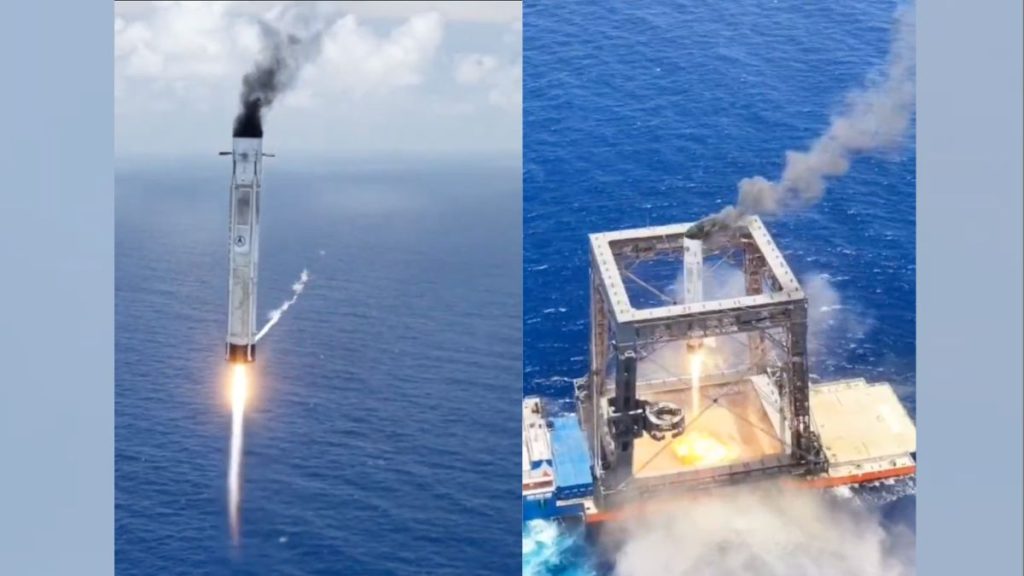
New Delhi: China launched its new Long March-10B rocket for the first time on Friday, from the Hainan Commercial Space Launch Site in Wenchang, according to state media. The rocket successfully placed its payload into orbit, and for the first time, China also managed to recover the rocket’s first stage.
Normally, once a rocket’s first stage finishes its job, it is simply discarded. This time, China guided it back down to Earth and caught it using a large net mounted on a floating platform at sea. Both the launch and the recovery went as planned.
The Long March-10B is a two-stage rocket that runs on liquid fuel and is designed to be reused. It’s about 63 metres tall, 5 metres wide, weighs about 760 tonnes at lift-off, and can carry up to 16 tonnes into low Earth orbit when flown in reusable mode. Only the first stage gets reused, the upper stage is used once and discarded.
The way China recovered the booster is different from how SpaceX does it. SpaceX’s Falcon 9 rockets land upright on legs, either back on land or on a drone ship at sea. China’s booster, instead, was caught mid-air by a net, the first time this recovery method has been used successfully on an orbital-class rocket booster.
This makes China only the second country, after the US, to successfully recover an orbital rocket booster. SpaceX pulled off its first such landing back in December 2015 and has since reused its boosters hundreds of times.
Being able to reuse rocket parts makes launches cheaper and lets countries launch more often. State media described the success as a big step for China’s space programme that could help it launch satellites more easily and work toward future missions to the Moon and deep space.