


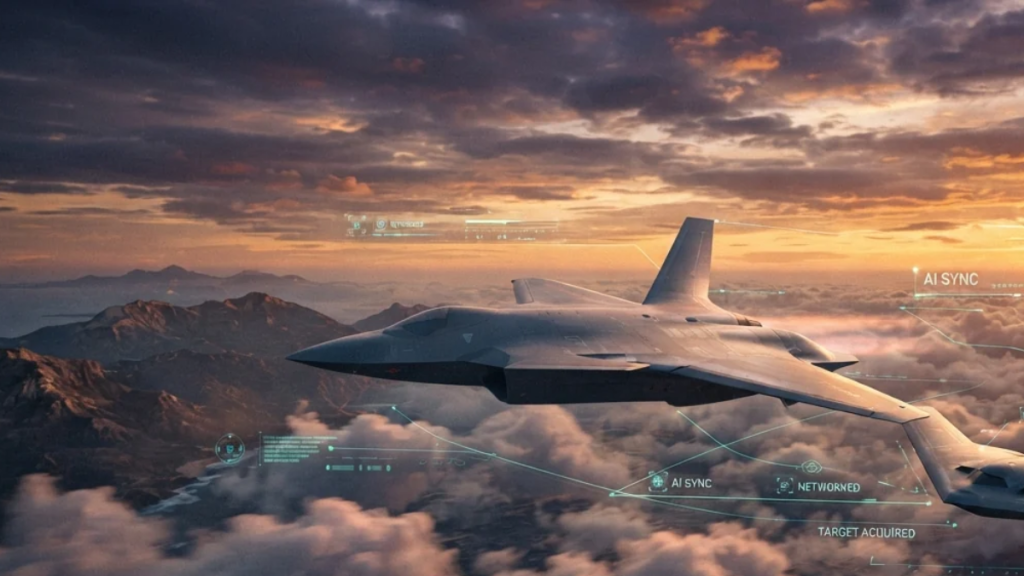
New Delhi: China is pushing towards a new model of air combat in which fighter pilots operate alongside autonomous aircraft, with the Chinese army bringing AI-powered loyal wingman drones into its training programme. The development adds a training dimension to Beijing’s expanding unmanned combat aircraft programme, which aims to integrate drones into operations involving advanced fighter jets.
The scale of China’s ambitions is reflected in its development and public display of multiple autonomous combat aircraft. During its September 2025 Victory Day military parade, Beijing showcased several types of combat drones believed to be designed for collaborative operations with manned and unmanned aircraft through an interconnected network.
The People’s Liberation Army is now preparing pilots for this form of warfare. Its military newspaper, PLA Daily, reported on Tuesday that an aviation brigade under the southern theatre command had introduced manned-unmanned teaming (MUM-T) exercises into ground-based simulator training for young pilots. The system allows pilots to engage in simulated combat with the support of loyal wingman drones, SCMP reported. An accompanying photograph featured a Shenyang J-16, although the aircraft used in the exercises were not specified.
The simulator recreates demanding combat situations, including successive waves of approaching targets and electromagnetic interference. Such scenarios will also require pilots to respond to multiple threats and coordinate with unmanned aircraft, testing their ability to operate in increasingly complex battlefield environments.
China’s MUM-T ambitions are also being applied to its fifth-generation J-20 stealth fighter. A study by the US Air Force’s China Aerospace Studies Institute (CASI) in June this year identified the PLA Air Force’s ninth aviation brigade as participating in the validation of coordinated MUM-T penetration operations including the J-20. The study indicated that Chinese air force units had begun working on the validation of such combat methods as early as 2024.
Beijing has also provided glimpses of the aircraft it intends to integrate into these formations. In November 2025, a promotional video released by the PLA Air Force showed the GJ-11 stealth unmanned combat aerial vehicle, also known as Xuanlong 08, flying alongside a J-20 and a J-16D electronic warfare aircraft. CCTV released further footage in November 2026, showing the GJ-11 operating with a J-16 and, separately, J-20 fighters.
The shift towards MUM-T could give Chinese fighter formations additional operational capabilities by allowing unmanned aircraft to undertake supporting roles alongside crewed platforms. It would also create new requirements for pilots, who would have to coordinate multiple aircraft operating in contested airspace. These types of scenarios are part of routine simulator training suggests the PLA is preparing its personnel for this evolution in the nature of air combat.