


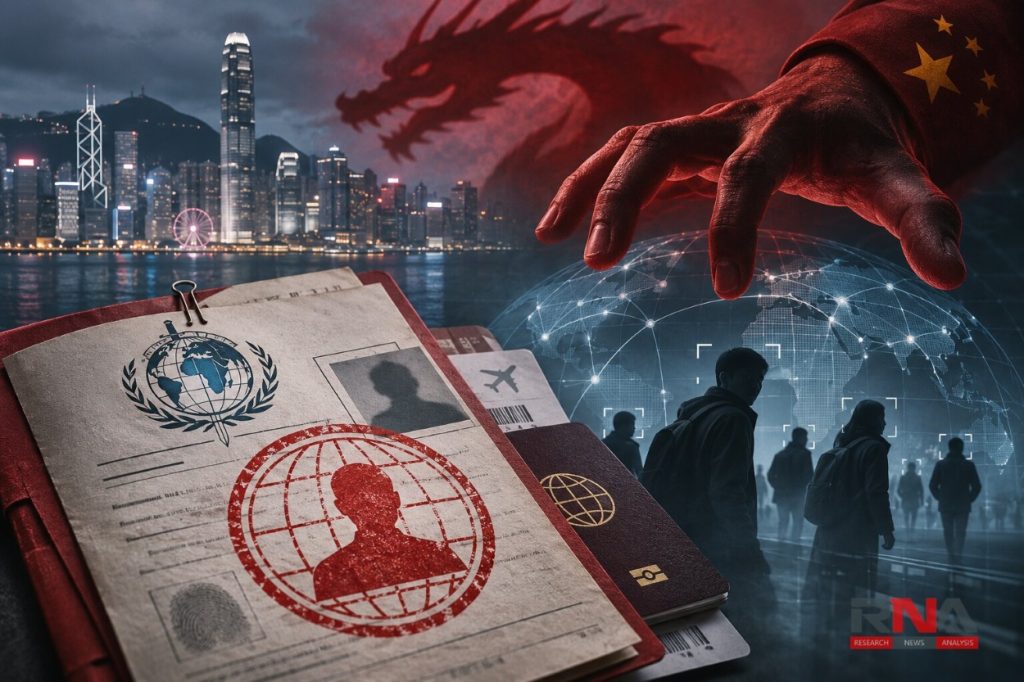
New Delhi: China is facing fresh allegations of exploiting Interpol’s international policing network to pursue political dissidents, democracy campaigners and other perceived opponents living overseas. The accusations come days before Hong Kong hosts the global police organization’s general assembly for the first time, bringing renewed scrutiny to Beijing’s alleged campaign of transnational repression.
A British barrister specializing in extradition and international human rights law, Ben Keith, has raised concerns over China’s use of Interpol’s red notices to pursue individuals whose alleged criminal offences may conceal political motivations. His revelations, reported by the Guardian on Wednesday, coincide with the publication of a legal study examining Beijing’s efforts to secure the return of people residing outside Chinese jurisdiction.
The 94th Interpol general assembly, scheduled to take place in Hong Kong from November 30 to December 3, will bring together senior law enforcement officials and government representatives from the organization’s 196 member countries. The gathering will deliberate on international policing priorities, institutional governance and cooperation against cross-border crime.
Allegations of politically motivated pursuit
Keith has identified five cases involving potentially improper Chinese requests through Interpol and separately sought information concerning five prominent Chinese dissidents residing in Britain. The absence of a definitive response to his enquiries has raised concerns, although it does not establish that the individuals are subject to international alerts.
For Hong Kong democracy campaigners who have relocated to Britain, the implications could be particularly serious. Their immigration or residency status in Britain does not necessarily insulate them from detention or extradition proceedings when travelling through other countries.
A new report, “The Red Notice Trap”, authored by Keith and fellow barrister Rhys Davies of IHR Advisors, examines how Beijing allegedly combines international police cooperation with financial restrictions, deportation proceedings and pressure on relatives to secure the return of wanted individuals.
The authors acknowledge that not every Chinese request is politically motivated. However, insufficient disclosure of country-specific data by Interpol makes it difficult to establish the actual scale of abuse.
How Interpol’s red notices work
Headquartered in Lyon, France, Interpol facilitates cooperation between national police forces against terrorism, organized crime, human trafficking, financial fraud and other serious offences. However, it does not possess independent powers of arrest or maintain a supranational police force.
An Interpol red notice asks law enforcement agencies across member countries to trace and provisionally detain a wanted individual pending extradition or other judicial proceedings. It is not an international arrest warrant, and the decision to detain an individual rests with national authorities under their respective domestic laws.
Article 3 of Interpol’s constitution expressly prohibits involvement in matters of a political, military, religious or racial nature. Governments seeking to circumvent this restriction could potentially present political prosecutions as conventional criminal investigations involving fraud, corruption or other economic offences.
Beijing’s global pursuit of fugitives
The allegations are closely linked to two major Chinese initiatives – Operation Fox Hunt, launched in 2014, and Operation Sky Net, launched in 2015 – under the anti-corruption drive of the Chinese president, Xi Jinping. Beijing officially describes these campaigns as mechanisms to apprehend economic offenders who have fled overseas and recover illegally acquired assets.
According to Chinese government figures, the 2024 Sky Net campaign secured the return of 1,597 fugitives and recovered illicit assets worth approximately $2.55 billion. However, foreign governments and human rights organizations have questioned the methods employed in some of these operations.
In August 2026, Reuters reported that Chinese lawmakers were examining legislation to strengthen Beijing’s legal powers to pursue corruption suspects overseas. The proposed legislation comes against a backdrop of allegations involving unauthorized surveillance, intimidation and coercion outside Chinese territory.
A separate investigation by the International Consortium of Investigative Journalists in 2025 examined confidential Interpol documents and extradition records, uncovering instances of Chinese authorities allegedly targeting politically connected businessmen, government critics and members of minority communities.
A cancelled notice, but nearly four years in prison
One particularly disturbing case concerns Uyghur activist Idris Hasan, also known as Yidiresi Aishan, who was arrested in Morocco in July 2021 after travelling from Turkey. Chinese authorities had sought his return over alleged terrorist affiliations.
Although Interpol subsequently withdrew the red notice, Moroccan judicial authorities continued processing Beijing’s extradition request. The country’s highest court approved his extradition in December 2021.
The United Nations Committee against Torture subsequently determined that sending Hasan to China would violate Morocco’s international obligations. According to Amnesty International, he was eventually released on February 12, 2025, after spending 43 months in detention.
The case illustrates a fundamental institutional weakness – even when Interpol identifies and rectifies an improperly issued notice, it cannot compel national authorities to terminate the legal proceedings triggered by it.
Hong Kong summit puts Interpol’s credibility to the test
The allegations also coincide with growing international concerns over Hong Kong’s enforcement of its national security legislation beyond the territory’s borders. Hong Kong is not independently represented as an Interpol member, with its requests routed through China’s national central bureau.
A 2025 British parliamentary investigation into transnational repression highlighted allegations of Interpol misuse involving China, Russia and Turkiye. It also identified delays in the mechanisms available to individuals challenging politically motivated notices.
The forthcoming assembly assumes additional significance because elections are due for all seven positions on the Commission for the Control of Interpol’s Files, the independent body responsible for overseeing the organization’s handling of personal information.
Hong Kong’s police commissioner, Joe Chow Yat-ming, has meanwhile described the forthcoming gathering as an expression of international confidence in the city. Neither Interpol nor the Chinese embassy had responded to the latest specific allegations in the Guardian’s initial report.
For countries like India, which hosted the 90th Interpol general assembly in New Delhi in October 2022, the controversy has wider implications for international security cooperation. Maintaining the credibility of mechanisms used to pursue genuine terrorists, financial offenders and organized crime syndicates requires ensuring that they do not become instruments of political persecution.