


New Delhi: Canada’s immigration authorities have issued a fresh clarification on how many hours international students may legally work while enrolled in study programmes. This comes even as hundreds of students – a large proportion of them Indian – continue to contest the rejection of their postgraduation work permits under what they describe as a retroactively applied rule.
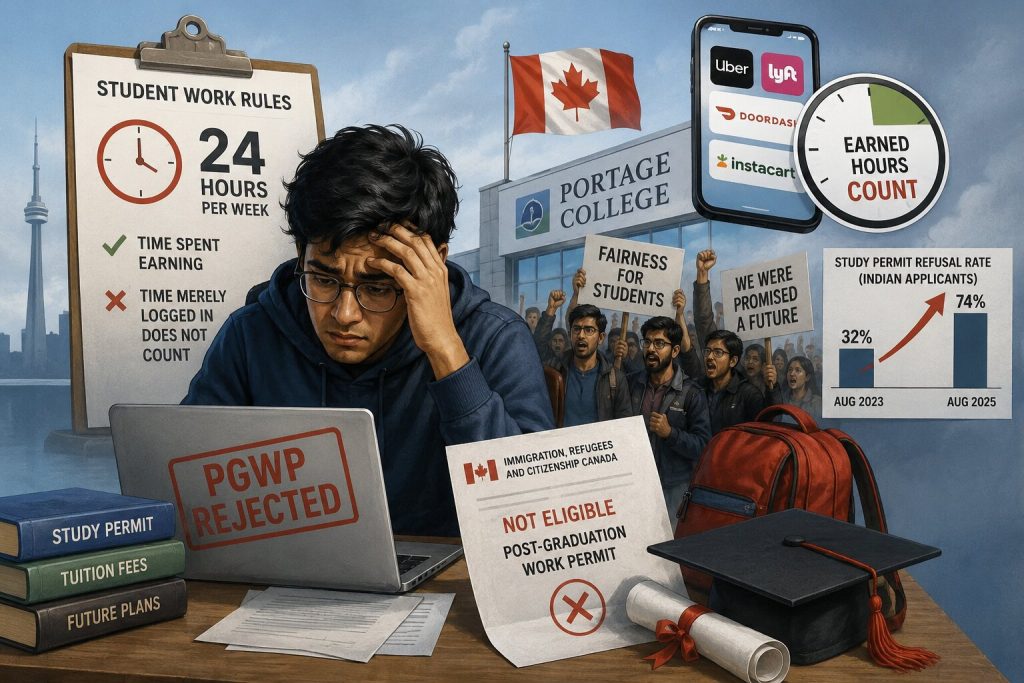
Immigration, Refugees and Citizenship Canada (IRCC), responding to a query raised through its Immigration Representatives Mailbox, has clarified how it counts working hours for students who earn through gig-economy platforms such as Uber, Lyft, DoorDash and Instacart, where the boundary between being logged in and being paid is often blurred.
According to the regulated Canadian immigration consultant who raised the query, Ankita Goyal, international students in Canada are permitted to work off campus while studying, provided they meet the conditions of their study permit. However, one key condition being the weekly limit on off-campus work hours during term time, which cannot exceed 24 hours.
The department’s answer turns on a simple distinction: time spent earning money, not time merely spent logged into an app. IRCC stated that hours are defined as any time a student spends earning wages or collecting commission, even if they are on call during that period and not actually working at that precise moment. Put differently, a student who stays logged into a delivery app for five hours but is paid for only two would, on this reading, have those two hours – not five – count towards the 24-hour cap.
The department has, however, placed the burden of proof squarely on the student. They are expected to keep granular records distinguishing paid time from idle, unpaid time online, and to be able to demonstrate compliance if asked.
The clarification, while narrow in its origin, carries wider implications. Immigration observers note that if IRCC’s logic – that only time tied to actual earnings counts as work – were extended beyond gig work to other categories of self-employment, it could affect how hours are assessed for programmes that examine qualifying skilled work experience, where unpaid administrative or business-development time may not count towards a threshold even though the person considers themselves to be working full-time.
Calgary students caught in harsher storm
The gig-work clarification has landed against a far more fraught backdrop. Roughly 480 international students, many from India, had gathered in Calgary on July 17 to protest the rejection of their post-graduation work permit (PGWP) applications, after IRCC found that their diploma programmes – run out of Portage College’s Calgary campus in partnership with a private training body – did not qualify for the permit. Neither institution appears on the federal government’s list of designated learning institutions eligible to confer PGWP eligibility, a database that was itself updated on July 16.
Students affected argue the goalposts were moved after the fact. Government of Canada guidance was quietly modified on June 24, 2026, to clarify that students who completed a non-credit programme of study are not eligible for a post-graduation work permit – a clarification that, students point out, arrived some 18 to 21 months after many of them had already begun their courses, having paid tuition fees of roughly $32,000 for a two-year programme.
IRCC’s position is that this was never a change in eligibility criteria, merely a clarification of a rule that had existed all along, meaning affected students cannot expect to be automatically grandfathered in. Many are now pursuing formal appeals, and immigration analysts expect the interpretation to be tested further as those appeals proceed.
The episode has coincided with the lapsing of a separate concession. A temporary policy that had allowed some work permit holders to study in Canada without a separate study permit expired on June 27 after three years in force, which tightened the compliance net further for anyone hoping to combine work and study status informally.
Part of wider tightening
Both developments sit within a broader recalibration of Canada’s international education system that has disproportionately affected Indian applicants. According to data IRCC shared with Reuters, the study permit refusal rate for Indian applicants rose to 74 per cent in August 2025, up sharply from 32 per cent in August 2023, even as the overall refusal rate across all nationalities stood at around 40 per cent that month.
The number of Indian applicants fell correspondingly, from 20,900 in August 2023 – when they made up just over a quarter of all applicants – to 4,515 in August 2025. Canadian officials have attributed the stricter posture to a rise in fraudulent applications, alongside national caps on study permits introduced from 2024 as part of a wider effort to rein in temporary migration.
For Indian students already in Canada, the message from recent weeks is consistent: the government is narrowing discretion at almost every stage of the student pathway – from how work hours are counted week to week, to which institutions can lead to a work permit, to how many are let in at all. Immigration consultants advise students to treat institutional accreditation, programme credit status and hour-tracking as matters requiring documentary proof rather than assumption, and to seek professional advice before relying on informal interpretations of eligibility.