


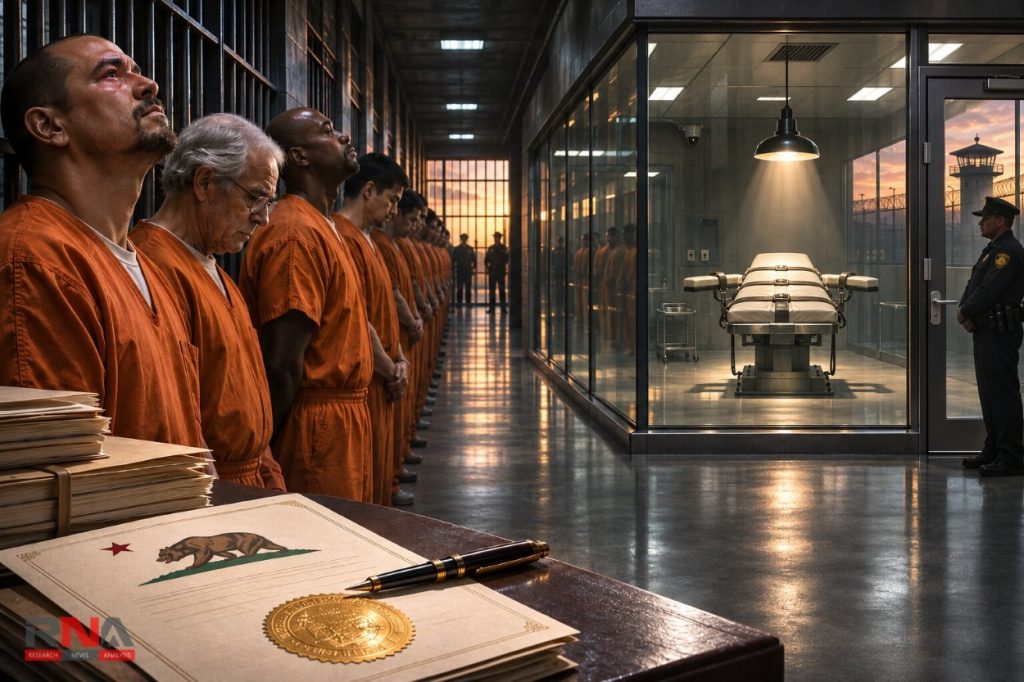
New Delhi: California has taken an unprecedented step towards ending capital punishment, with the state’s outgoing governor, Gavin Newsom, announcing the commutation of death sentences imposed on all 548 prisoners awaiting execution. The decision, announced on Thursday, constitutes the largest mass clemency in American history and marks a major turning point in the country’s increasingly contentious debate over whether the state should have the authority to take human life.
The sweeping measure will replace death sentences with life imprisonment without the possibility of parole, ensuring that those convicted of serious crimes remain incarcerated without facing execution. However, the decision does not immediately cover every prisoner, as the California supreme court must approve 382 of the commutations under a constitutional provision governing clemency for people with multiple felony convictions.
The announcement affects 529 men and 19 women and could eventually reduce the number of prisoners awaiting execution across the United States by nearly 30 per cent. According to the Death Penalty Information Center (DPIC), approximately 1,388 people would remain under death sentences nationwide once the commutations are fully implemented, the lowest figure since 1984.
Explaining his decision in an open letter to Californians, Newsom argued that capital punishment was fundamentally incompatible with the values of a justice system that recognized human dignity and the possibility of judicial error. He maintained that even the most carefully constructed legal system could not entirely eliminate mistakes, making execution an irreversible punishment that governments could not administer with absolute certainty.
The governor acknowledged that his decision could reopen painful memories for families whose loved ones had been murdered, describing it as one of the most difficult choices of his political career. Nevertheless, he argued that protecting society through lifelong imprisonment and authorizing the state to execute prisoners were two distinct questions, and that abandoning executions did not diminish the seriousness of their crimes.
Two decades without an execution
California has not carried out an execution since 2006, although capital punishment has remained part of its criminal justice system and its death row has been the largest in the Western Hemisphere. Newsom, who assumed office in 2019, imposed a formal moratorium on executions shortly afterwards and subsequently dismantled the execution chamber at San Quentin prison, effectively suspending the machinery of capital punishment without abolishing the law itself.
The administration also transferred condemned prisoners from San Quentin to other correctional facilities, gradually ending the traditional system of segregated death row incarceration. The latest commutations go considerably further by seeking to remove the legal possibility of execution for existing condemned prisoners, although the death penalty itself remains lawful in California and new death sentences can still be imposed.
The financial burden has also strengthened arguments against capital punishment, particularly in a state where prolonged appeals and complicated judicial procedures have kept prisoners awaiting execution for decades. The DPIC estimates that California has spent approximately $6 billion administering its death penalty system since its reinstatement in 1978, during which only 13 executions were carried out.
Judicial errors and racial disparities
Beyond financial considerations, abolitionist organizations have emphasized the risks of wrongful convictions, inadequate legal representation and racial disparities in capital sentencing. Since 1973, more than 200 prisoners sentenced to death across the United States have subsequently been exonerated, demonstrating that even convictions reached through established judicial procedures can prove mistaken.
California’s own experience illustrates these concerns, with eight death row prisoners exonerated over the years, all of them men from racial minority communities. The state’s appeal system has also struggled with a shortage of qualified lawyers, leaving numerous condemned prisoners waiting years for legal representation to challenge their convictions or sentences.
The American Civil Liberties Union welcomed Newsom’s decision as an important advance against a punishment it regards as discriminatory, unreliable and inhumane. Robin Maher, executive director of the DPIC, similarly described the announcement as a defining development in American capital punishment, observing that previous governors had granted blanket clemency but never on such a scale.
Families divided over justice
The decision has nevertheless provoked strong opposition from prosecutors and victims’ rights organizations, which argue that the governor has overridden sentences reached by juries and upheld through judicial review. The California District Attorneys Association condemned the move, warning that it disregarded the suffering of victims’ families and weakened public confidence in the justice system.
However, the reaction from victims’ relatives has not been unanimous, reflecting a deeper disagreement over whether executions provide meaningful closure. Jess Nichol, whose 12-year-old sister Polly Klaas was murdered in 1993, supported the commutations, explaining that she had come to believe executing her sister’s killer would contribute little to her recovery or public safety.
A broader American reckoning
The announcement comes as capital punishment faces renewed scrutiny across the United States, where 23 states have abolished the practice but several others continue to conduct executions. A Pew Research Center survey cited by Al Jazeera found that 66 per cent of Americans supported the death penalty for murder, although 73 per cent acknowledged the possibility of executing an innocent person.
Newsom’s action also carries political significance as his second and final gubernatorial term approaches its conclusion in January 2027, with speculation growing about a possible presidential campaign in 2028. His successor, the Democrat Xavier Becerra, has pledged to maintain the execution moratorium, but permanently abolishing capital punishment in California would require a separate decision by voters, who rejected abolition proposals in 2012 and 2016.
The contrast with Washington is particularly striking, as the administration of the US president, Donald Trump, has supported expanding federal capital punishment even as California moves in the opposite direction. Whether Newsom’s decision influences other states remains uncertain, but it has reinforced a fundamental question confronting modern democracies – whether justice can be served through lifelong imprisonment without granting governments the irreversible power to execute those they convict.