


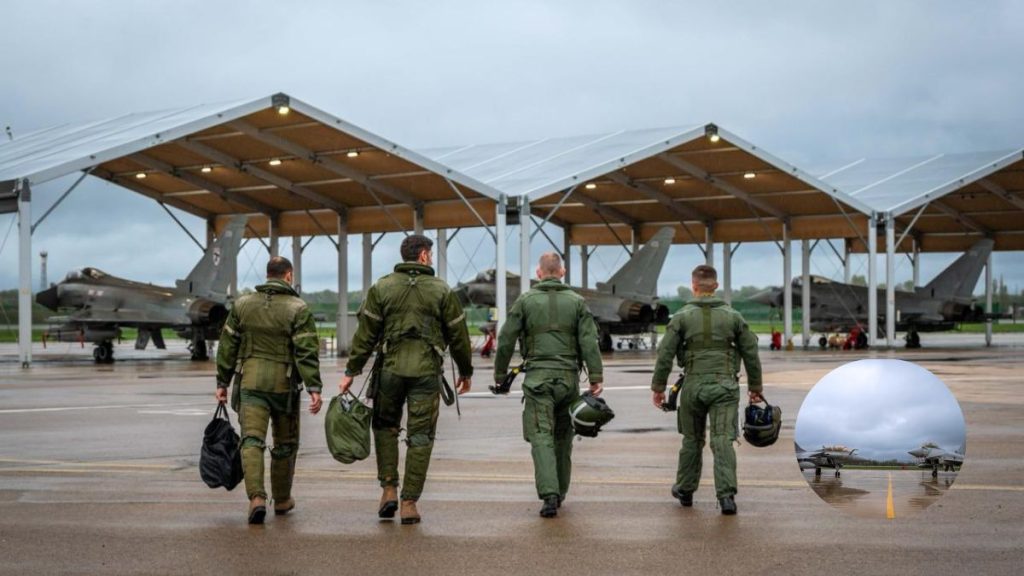
New Delhi: Royal Air Force (RAF) Typhoon fighters participated in a French nuclear deterrence exercise for the first time, escorting Rafale aircraft during a simulated nuclear strike over the Mediterranean Sea. The exercise, announced on Friday, marks a significant development in military cooperation between Britain and France amid tensions with Russia and uncertainty over long-term American security commitments.
Codenamed Rummy, the exercise took place on Tuesday evening, with French Rafales departing Saint-Dizier air base in northeastern France before being escorted by British Typhoons. The French armed forces ministry confirmed that no nuclear weapons were involved, with the exercise intended to strengthen coordination and interoperability.
“Having independent nuclear forces does not preclude coordination,” the French armed forces minister, Catherine Vautrin, said, describing British participation as an important milestone.
The British defence secretary, Wes Streeting, reaffirmed both countries’ commitment to European security and maintaining credible nuclear deterrence.
The exercise follows the Northwood Declaration, signed by Britain and France on July 10, 2025, to strengthen coordination between their independent nuclear forces. It established a joint nuclear steering group covering policy, capabilities and operations without transferring nuclear command authority.
The group first met in Paris in December 2025, when British officials also observed France’s Operation Poker nuclear deterrence exercise. Rummy represents a further step, involving British aircraft directly in a conventional escort role.
France maintains submarine-launched and air-launched nuclear capabilities, while Britain’s independent deterrent is based on submarine-launched missiles. The RAF Typhoons did not carry nuclear weapons.
France spends approximately €5.6 billion ($6.04 billion) annually maintaining its nuclear deterrent, comprising an estimated 290 submarine-launched and air-launched nuclear weapons, making it the world’s fourth-largest arsenal. Britain has approximately 225 nuclear warheads, while Russia and the United States each possess more than 5,000 in their total nuclear inventories, according to figures cited by Reuters.
In March, the French president, Emmanuel Macron, announced plans to expand France’s nuclear arsenal and introduced a forward deterrence initiative. It allows European partners to participate in nuclear exercises and envisages possible temporary deployments of French nuclear-capable assets on allied territory.
Macron emphasized that France would retain exclusive authority over decisions involving its nuclear weapons.
The developments come amid Russia’s continuing war in Ukraine and European concerns over future US security commitments, prompting renewed debate about strengthening European defence capabilities.
Exercise Rummy demonstrates closer operational coordination between Britain’s conventional airpower and France’s airborne nuclear deterrent. However, both countries retain independent arsenals, and the exercise does not establish a shared nuclear strike capability or alter their command arrangements.